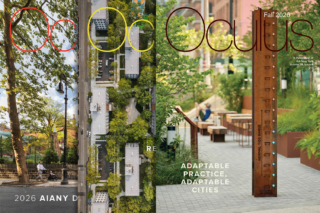



This issue of Oculus is built around a simple but stubborn idea: that adaptability is not a style or a trend, but a discipline. It is the practice of treating what already exists as raw material for what the city needs next. That idea sits at the center of this year’s AIA New York presidential theme, “Repair: Democracy and Urban Space.”
A vacant building or block is an opportunity. Those buildings are asking us: “What else could I be?” The same is true of an aging apartment block that no longer serves the residents who have grown old inside it, an office tower that has the potential to become housing, or a floodplain neighborhood built as though the climate of 1960 would hold forever.
I’ve been returning lately to Dr. Martin Luther King Jr.’s final book, Where Do We Go From Here: Chaos or Community? In 1967, King framed the choice facing the country as the slow neglect that fragments a society and deepens injustice or the harder, collaborative work of building a “beloved community”: an integrated, economically just society. That work takes engagement, trust, and a hopeful optimism about an uncertain future. Hope is a practice.
It’s a practice this profession needs right now. We’ve just come through a hotter summer than the global population has ever experienced. El Niño–fueled droughts and storms, warming oceans, flash floods that shut down subway platforms in minutes and will do so again. Architects are advocates for the larger society and its ecology, often one building, one space, one system at a time. It takes a particular skill to design for a future that anticipates change and to be a guide and an unwavering companion to clients and the public through that process. Give yourself grace: you won’t convince anyone of the value of that work until you can describe the future it’s building toward, one that’s regenerative and adaptive. Adaptable cities are repairable cities. New York is always reinventing itself; the question is whether we design into that change on behalf of our beloved communities or accept the slow violence of the status quo.
Repair is often mistaken for restraint, for doing less. In practice, it demands more of us. Repair or mending asks architects to read a building or a neighborhood carefully enough to understand what it still holds and to be skilled enough to make that potential legible. Adaptability is repair’s operating principle. A city that can only build new is a city that eventually runs out of room, capital, and patience. A city that knows how to adapt what it has can keep reinventing itself.
The climate crisis has made that adaptation non-negotiable. We’re confronting hotter summers, changing energy costs, rising water, and infrastructure sized for a century that has already ended. We can look to the Bronx for one example of adaptability operating at the scale of the watershed. The city’s Department of Environmental Protection is preparing to break ground on the Tibbetts Brook Daylighting Project, bringing back to the surface a stream buried in a sewer pipe beneath Van Cortlandt Park and the Broadway corridor for more than a century. Once complete, the project is expected to cut combined sewer overflows into the Harlem River by roughly 228 million gallons a year while creating new rail-to-trail parkland and extending the Putnam Greenway north to the Empire State Trail. A century-old piece of buried infrastructure becomes, in one move, flood relief, habitat, and public space.
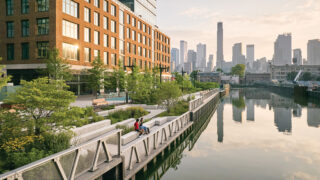
A few miles south, at the other end of the water’s edge, the South Battery Park City Resiliency Project is making the same argument at a different scale. SBPCR is building a new edge in front of what’s already there: it will be an integrated flood-barrier system woven into a rebuilt public realm running from the Museum of Jewish Heritage through Wagner Park to Pier A Plaza, engineered to withstand a 100-year storm through 2050 and the sea-level rise that comes with it. The project folds deployable flood gates into a reconstructed Wagner Park pavilion rather than walling the neighborhood off from its waterfront, and it pairs the flood defense with stormwater capture and reuse systems built into the landscape itself.
Adaptable systems require a profession, and a city, willing to change the rules that still reward speed and permanence over flexibility: codes written for single uses, financing structures that penalize slowreturn resilience investments, zoning that treats adaptation as an exception rather than a default.
New York has never lacked buildings worth saving, landscapes worth reconsidering, or a climate that’s already making the case for us. What it needs is a design culture that treats adaptability as its main ambition—one that designs for the “beloved community.”