





As New York City pursues increasingly ambitious climate goals, architects are being asked to consider carbon across a much broader spectrum of decisions. Operational energy and embodied carbon, once largely separate areas of analysis, increasingly intersect with questions of electrification, grid capacity, material procurement, construction practices, and long-term building performance. At the same time, the volume of information available to inform those decisions is expanding rapidly.
Life cycle assessment platforms can compare the carbon implications of design alternatives before products have been selected. Urban-scale energy models can examine how thousands of buildings might respond to electrification and an evolving electrical grid. Building controls and sensors can reveal how systems perform over time. Construction data can provide insight into what was actually procured, installed, and built.
Artificial intelligence and machine learning are accelerating some of these processes further, allowing practitioners to identify patterns and evaluate scenarios at scales that would have been impractical only a few years ago.
Yet access to more data does not necessarily produce lower-carbon buildings. The more consequential question for architects is how these tools change design practice: Can they help us make better decisions earlier? Can they help teams act with confidence when information is incomplete? Can they connect decisions made during design to the realities of procurement, construction, operations, and the larger energy system? And can the information generated by one project make the next project better?
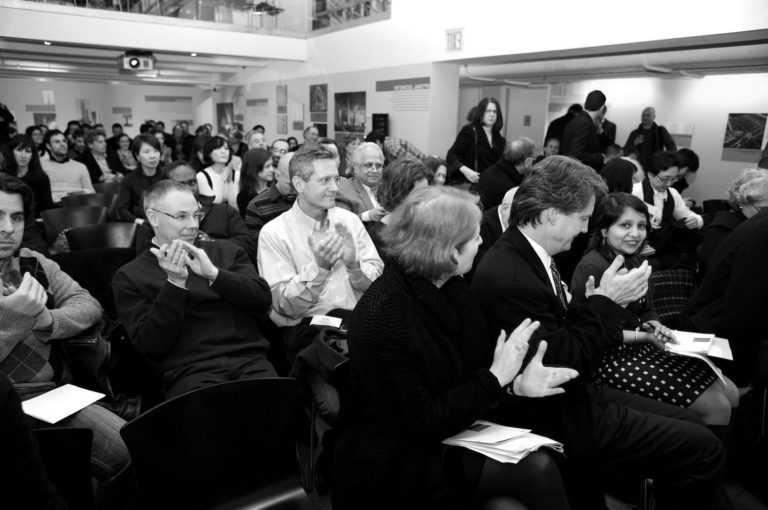
AIA New York launched its Building Decarbonization Action Plan in November 2025 to provide a comprehensive roadmap for New York City to regulate the entire lifecycle of carbon in the built environment across three core stages: embodied carbon, operational carbon, and circularity. Following this publication, AIANY’s Committee on the Environment (COTE) Decarbonization Subcommittee convened Driving Digital Decarbonization: Tools Reducing Carbon Emissions at Scale, a half-day symposium bringing together leaders in architecture, engineering, construction, technology, research, and policy. The three panel discussions held in February 2026 followed carbon data through different scales and stages of the building lifecycle: “Streamlining Lifecycle Embodied Carbon Reporting” examined how increasingly connected datasets can inform design and material decisions; “Modeling Energy Data for Future-Proofing NYC’s Grid” expanded the lens beyond individual buildings to consider electrification, peak demand, and grid interaction; and “Data-Driven Construction Practices” explored how field data can carry carbon goals through procurement and construction and ultimately feed real-world performance back into future design.
Across these conversations, a common idea emerged. The promise of digital decarbonization is not simply greater precision or automation. Its value lies in creating continuity between information and action and between the many people making decisions throughout a building’s life. For architects, that means moving beyond using digital tools primarily to demonstrate performance after a decision has been made, toward using them to understand consequences while there is still an opportunity to shape the outcome.
From PDFs to decisions: why the future of embodied carbon depends on better data, not more date
Today, a vast majority of sustainability professionals and, increasingly, other practitioners across the AEC industry are familiar with one or many acronyms in the world of embodied carbon reporting: PCR, EPD, LCA, GWP. What was once a niche language spoken by a handful of specialists has rapidly become part of mainstream building practice. Yet despite the proliferation of standards, databases, and software platforms, a fundamental question remains: how do we move from measuring embodied carbon to actually reducing it?
That question sat at the heart of the conference’s first panel discussion. Participants focused on how to move from simply collecting data to making that data usable and how to create digital systems that support that effort by helping project teams make better decisions while those decisions still matter.
Creating a common language for carbon
Any embodied carbon comparison relies on underlying data provided by Environmental Product Declarations (EPDs). And EPDs, in turn, are based on a vast infrastructure of standards, databases, assumptions, and verification procedures. Ben Ciavola of WAP Sustainability works at the nexus of this web; he said the crux of the issue is “focusing on data interchange.” Specifically, for him, the critical question underlying all EPD work needs to be “How do we get all of our groups talking to each other, speaking the same language?”
The industry’s current wave of digital transformation is attempting to solve exactly that problem. Open data standards, machine-readable EPDs, APIs, and centralized databases are creating pathways for information to move directly between manufacturers, consultants, designers, contractors, and owners.
While ensuring comparability and compatibility between EPDs and other LCA datasets is critical to embodied carbon efforts across the industry, the reality is that the data are somewhat uncertain and imperfect. Ciavola argued that the goal should not be perfect precision, since “we are absolutely confident that we’re moving in the right direction with the decisions that we’re making.”
Peter Bacas of ERG said he “really does not like the word uncertainty.” Instead, Bacas suggested that practitioners think about specificity. Some data is more granular than others. Some products have highly detailed facility-specific EPDs. Others rely on industry-average benchmarks. The challenge is understanding what level of specificity is appropriate for a particular decision.
Matching the Data to the Design Decision
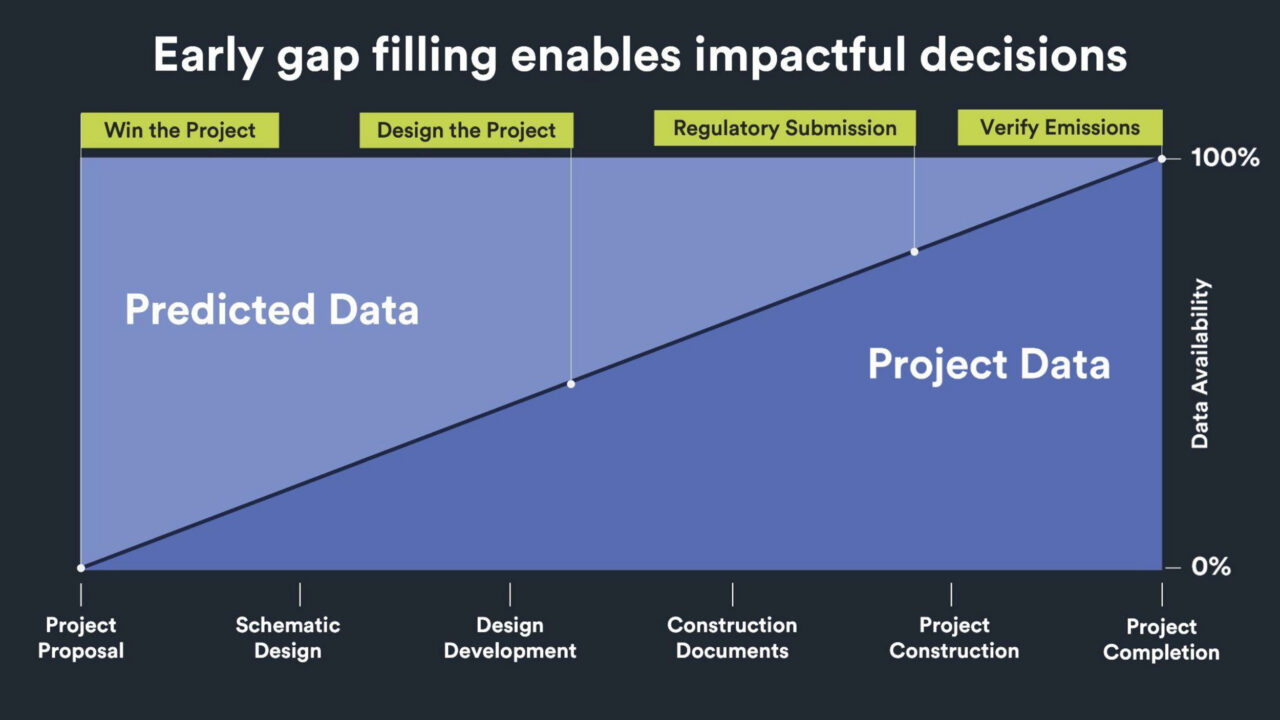
Jack Rusk, CEO of C.Scale, observed that the industry’s largest carbon reduction opportunities often occur before project-specific information exists. Design decisions that have the greatest influence on a building’s lifetime carbon footprint happen during early concept phases, yet the most precise carbon information often arrives much later, when specifications are finalized and procurement begins. Emerging tools therefore emphasize directional guidance rather than waiting for perfect information. The objective is not absolute precision but rather better decision-making. As Rusk explained, “whole life carbon thinking is not just something you report but a way that as you’re moving through the project you’re making better decisions.”
Another method for accounting for practitioners’ inability to know detailed information early in design is to use generic embodied carbon data. AECOM’s Rushita Vora emphasized that generic datasets remain essential. Early-stage carbon analysis often depends on industry benchmarks because product selections have not yet been made. As design progresses, assumptions made with generic data can gradually be replaced with more specific information, but the industry must “use both of these” to make the change we desire.
Moving embodied carbon into everyday practice
As these tools mature, embodied carbon analysis is moving from a specialist reporting exercise toward an everyday design process, with closer links to BIM, procurement, and an expanding range of building systems. Each panelist viewed scale through a different lens: Vora pointed to automated connections between BIM models and carbon analysis tools; Rusk described a future where whole-life carbon assessment becomes part of every project rather than a select few; Bacas envisioned tighter connections between building-scale carbon assessments and procurement processes; and Ciavola highlighted the expansion of digital carbon data beyond concrete, steel, and asphalt into more complex product categories such as mechanical and electrical systems.
Taken together, these perspectives suggest that embodied carbon is ready to be part of the daily lexicon of practitioners throughout the industry. The goal is not a better report but a better building.
From energy to loads: why decarbonization now requires thinking like a grid operator
The symposium’s second panel opened with a simple prompt: what’s the biggest data-related barrier to decarbonizing New York’s buildings and grid? The four answers—covering operations, state policy, engineering, and design—turned the conversation away from individual technologies and toward the gaps between them. For 20 years, low-carbon building design followed one logic: better envelope, better systems, less energy, lower emissions. Digital tools, from energy modeling to advanced operating systems, drove that process. But the panel argued that as electrification takes over as the priority, efficiency and even the removal of onsite fossil fuels are no longer the main goals. As moderator Carlos Cerezo, Director of Sustainability at KPF, put it, individual building decisions now need to support goals set at the scale of the grid: peak loads, distributed storage, thermal networks. The future of low-carbon buildings depends on what happens outside the property line, and current urban data science and AI platforms promise to automate that problem away. The panel wasn’t convinced it’s that simple.
The problem of confidence at scale
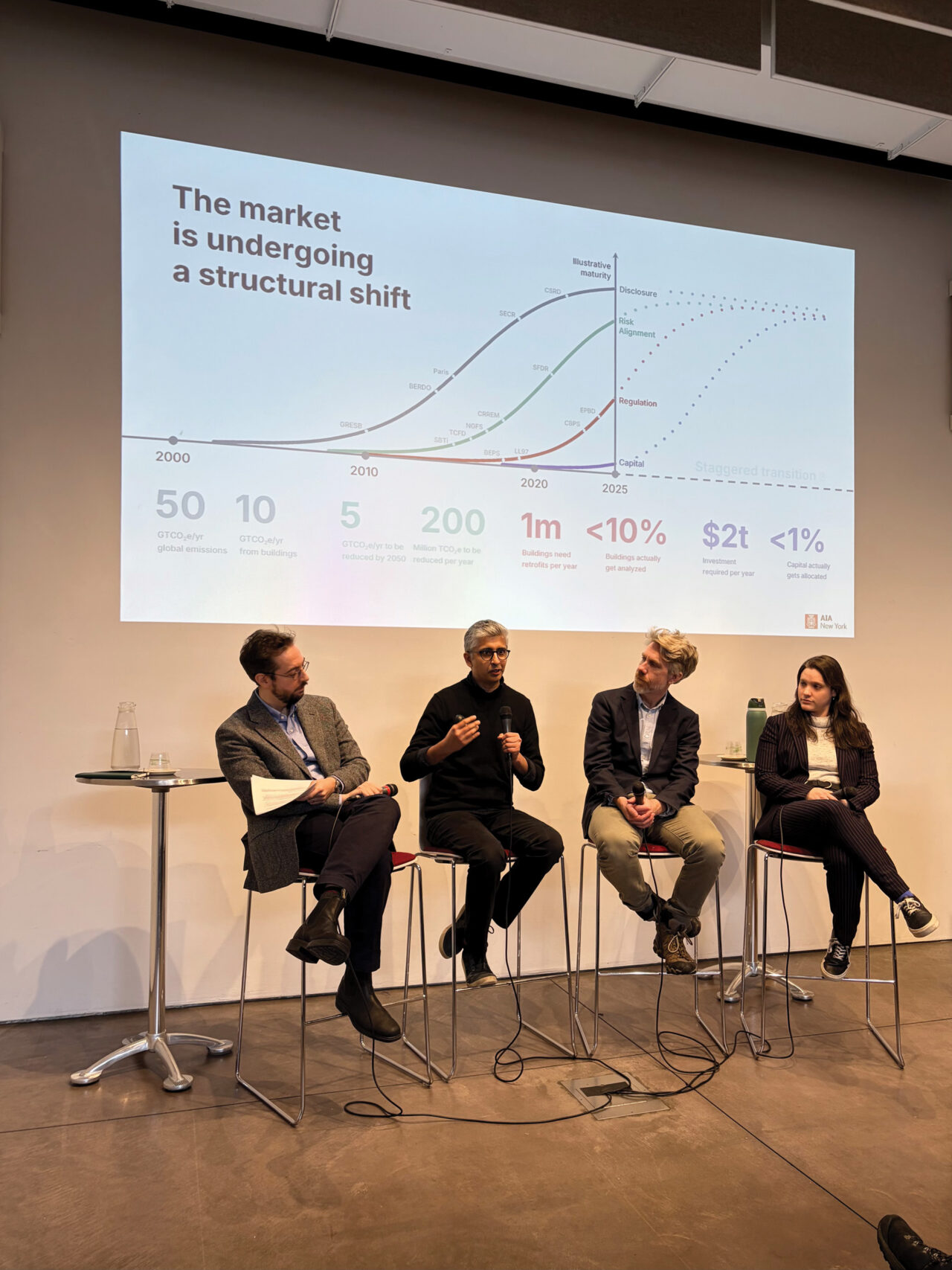
Shreshth Nagpal, CEO of Carbon Signal, opened his comments by mapping how the decarbonization market has matured: “The last decade has been about measurement and reporting, then investment, now regulations.” The numbers are stark: roughly a million buildings need retrofitting globally each year, and the industry manages less than 10% of that. An estimated $2 trillion in annual retrofit capital is needed, and barely 1% gets deployed. Reducing that number means making billion-dollar decisions before anyone touches a building, which requires energy data at a granularity, temporal and spatial, that we may never have.
For Nagpal, the real obstacle is reliability, not a shortage of data or tools: “What we need is the ability to make those decisions with confidence, very fast, at scale,” he said. Rather than chase a data-precision dream, his approach quantifies uncertainty directly, mapping best, worst, and most-likely scenarios so decision-makers can act on partial data with confidence. “Uncertainty is my favorite word,” he said, playing off Bacas’s comments. Nagpal argued that transparent, probabilistic models are easier to trust than the illusion of one “correct” answer. He sees designers playing a key role here: folding grid-integration metrics into design early and connecting client, utility, and operator.
The grid is becoming a design constraint
Michael Reed of the New York State Energy Research and Development Authority grounded the conversation in our unfolding regulatory moment. In December 2025, the New York Public Service Commission ordered Con Edison to develop a reliability plan for all NYC. By this summer, the utility had to submit a plan to procure 125 megawatts of nonemitting demand-flexibility resources by 2032, scaling to 750 megawatts by 2036. Strategies such as battery storage, thermal energy storage, and peak-load shedding allow buildings to store energy, shift heating and cooling demand, or temporarily reduce nonessential electrical loads during periods of peak usage. Reed is upfront about competing priorities: decarbonization, he said, “is not the fundamental motivator for the system operator. It’s reliability and affordability.” Electricity demand is projected to grow roughly 3% a year, driven as much by cooling and data centers as by heating and electrification. The result of plans like ConEd’s, in his words, is a future energy system that should be “less peaky, much, much lower in carbon intensity, and more affordable than energy is today.” Whether current incentives for heat pumps, batteries, and demand response are also moving that needle is still an open question, he suggested, made harder by the lack of a standard protocol for buildings and grid operators to talk to each other. Whenever that grid future arrives, building designs that work with the grid will see rising economic value in NYC.
Why data alone isn’t enough
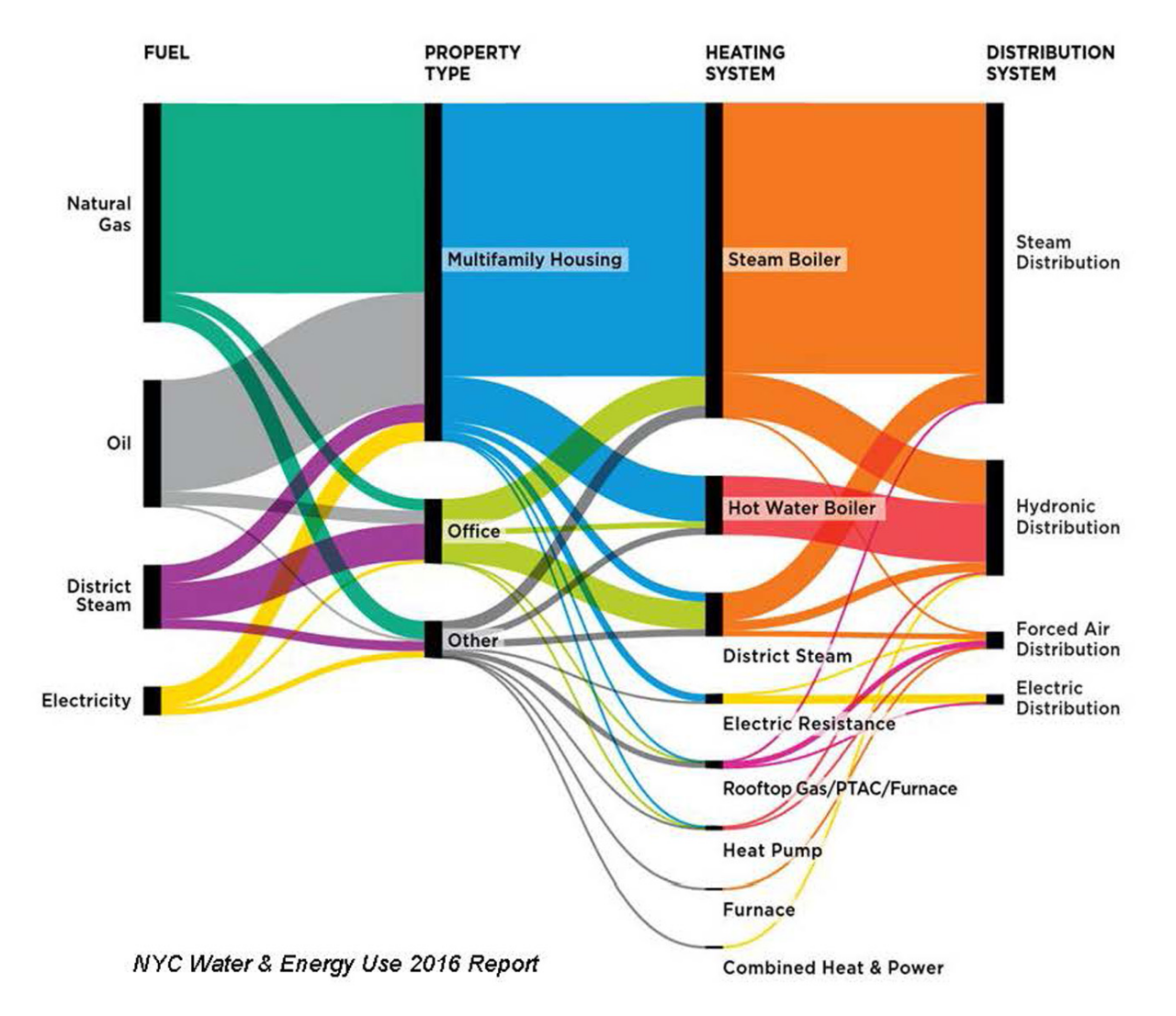
When asked about the promise of “grid-interactive” buildings, Molly Dee-Ramasamy, a principal at JB&B, brought the discussion back to the realities of building operations. Today’s low-carbon buildings, she argued, are “defined less by individual technologies that operate in a siloed manner and more about integrated systems that interact over time”: heat recovery working with heat pumps, thermal storage with controls, building automation with utility signals. That integration has a cost. Dee-Ramasamy shared a diagram of everyone who owns a piece of an electrified building’s data infrastructure—owners, operators, vendors, utilities, controls providers—often reporting to different entities and rarely talking to each other. Even in sophisticated buildings, granular load data is scarce and often untrustworthy.
“Data by itself is not necessarily useful,” Dee-Ramasamy said, a line that summed up a recurring theme of the panel. Building performance platforms, smart meters, internet-of-things devices, and energy dashboards generate enormous volumes of data, but the industry lacks both actionable information and the trust needed to act on it. That trust gap, Dee-Ramasamy and Nagpal argued, is cultural as much as technical. Sharing models across a building’s lifecycle, and used from design through utility-scale planning and analysis, would open the door to a more flexible and responsive grid. The architect’s role through that lifespan, in this framing, becomes technological mediation: making sure each party’s models and data carry forward and stay useful.
What modeling can or cannot promise
Timur Dogan of Cornell and Climate Studio pushed back on treating modeling as an accuracy contest. Coming at the problem from a design angle, he argued that architects’ most powerful lever is still passive design and load shaping. Performance modeling is a design tool before it’s a carbon tool: carbon reductions follow from buildings that work better for people. Nagpal agreed, reiterating that good design and data precision are two different goals: “What we need is a modeling culture willing to communicate data without paralyzing the people who have to act on it.” AI specifically is useful where it speeds up a decision a human can still check, risky where it manufactures confidence nobody has earned. Dogan, speaking as a tool developer, pointed to a structural disconnect: the performance data architects generate for design or code compliance rarely looks like what a grid operator needs for planning. “How do we make that easy, transparent, and intuitive?” he asked. “I think that’s where we’re light years away.” Cerezo tied Dogan’s focus on human experience back to grid reliability, pointing to near-capacity grid conditions during recent snowstorms as a reminder that resilience belongs in this conversation too.
Asked what single change would accelerate progress most, the panelists converged on incentives and trust rather than technology. The tools to model, measure, and communicate building performance largely exist already. What’s missing is shared confidence, across owners, engineers, utilities, and regulators, to act on imperfect information together, at the speed the climate transition demands. The most successful projects going forward may not be the ones using the least energy but the ones contributing most to a resilient, flexible, affordable grid.
From design intent to construction reality
By the time a project reaches construction, many of its most consequential carbon decisions have already been made. Structural systems have been selected, material quantities established, and performance targets incorporated into the design. Yet construction is also where those intentions encounter the realities of procurement, sequencing, schedule, weather, cost, and risk. The symposium’s third panel considered how digital tools can help bridge the gap between design intent and construction reality.
Concrete offers a useful example of how this can work. Britain Morris of construction technology company Converge discussed the use of embedded sensors to measure concrete strength gain in real time. These systems have traditionally been used to support scheduling and quality control, helping contractors determine when formwork can be removed or post-tensioning can occur. But the same information can also support lower-carbon construction.
Concrete mixes and construction schedules are necessarily shaped by risk. When teams have limited information about actual performance, they may act conservatively, perhaps opting for higher-strength or higher-cement mixes, extended curing periods, and longer operation of temporary heating equipment. That caution can also make teams more reluctant to adopt unfamiliar lower carbon cement blends.
As Morris observed, “One of the biggest hidden carbon drivers isn’t just the cement content, it’s risk and it’s uncertainty.”
Real-time performance data can reduce some of that uncertainty. Rather than relying exclusively on prescribed time periods or periodic cylinder breaks, teams can understand how the concrete is actually performing under site conditions. Morris described this as a shift “from time-based assumptions to performance based decisions.”
For architects, the significance extends beyond concrete. Many lower-carbon design strategies introduce some degree of perceived risk because they depart from established products, specifications, or construction practices. Better performance data can help provide contractors, owners, and design teams with the confidence to pursue these strategies without compromising schedule, quality, or constructibility.
Bringing carbon into project delivery
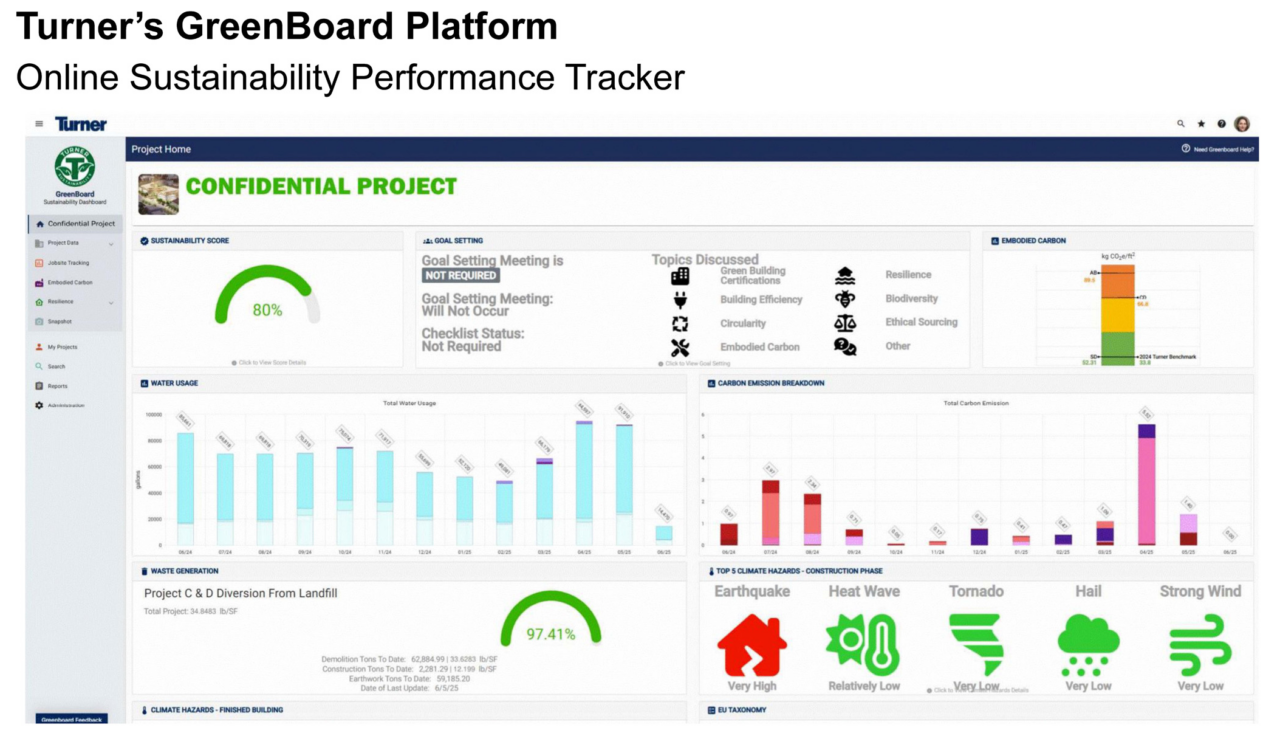
Rebecca Schmidt of Turner Construction described a parallel shift at the scale of construction management. Turner’s GreenBoard platform tracks jobsite emissions associated with fuel and electricity use, along with water, waste, and embodied carbon.
“We’ve seen it as a way of working sustainability and decarbonization into our operational process,” Schmidt explained.
That integration has implications upstream. Turner is also incorporating embodied carbon analysis during pre-construction, allowing structural systems and materials such as concrete and steel to be evaluated alongside cost and constructibility. Carbon can therefore become another piece of information available when alternatives are still being considered rather than a calculation performed after procurement decisions have been made.
For architects, this creates an opportunity for a more continuous conversation with contractors. Connecting design, procurement, and construction data creates a clearer line between design intent and as-built carbon performance.
Creating a feedback loop for design
Perhaps the larger opportunity is what happens to construction data after a project is complete. Sensors, procurement platforms, equipment monitoring, and project-management systems are generating increasingly detailed information about how buildings are constructed. When that information remains isolated within individual projects, much of its potential is lost.
Used collectively, however, construction data can begin to inform future design decisions. Did the specified low-carbon concrete perform as anticipated? How did alternative materials affect procurement or schedule?
Morris summarized the challenge succinctly: “Sensors aren’t going to reduce carbon on their own.” Their value comes from the decisions they enable. When construction data feeds back into future specifications, material selections, and carbon models, actual project outcomes can begin to replace assumptions.
From better information to better buildings
Taken together, the three panels traced an expanding role for data across the lifecycle of a building. From early design through construction and operations, digital tools can connect carbon goals to the decisions that determine actual performance.
The common challenge at each stage is not a lack of information. It is knowing what information is meaningful, understanding its limitations, and creating workflows that allow people to act on it. The panels repeatedly returned to questions of confidence and uncertainty: imperfect embodied-carbon datasets, probabilistic energy models, incomplete operational data, and the construction industry’s understandable reluctance to change established practices without evidence that an alternative will perform as expected. Digital tools can help make those uncertainties visible rather than pretending they do not exist, allowing teams to make informed decisions without waiting for a level of precision that may never arrive.
For architects, this represents an evolution in practice rather than a transfer of responsibility to technology: judgment remains essential, but it can be informed by a broader and more continuous picture of a building’s consequences. The opportunity, then, is not to make every architect a data scientist nor to automate increasingly complex decisions. It is to make carbon consequences more visible within the decisions architects and their collaborators already make. The goal, as the symposium repeatedly demonstrated, is not better data for its own sake. It is better decisions and, ultimately, better buildings.
CARLOS CEREZO DAVILA, PhD, LEED AP (“From Data to Decisions”), is director of sustainability at KPF and co-chair of the AIANY Committee on the Environment (COTE) Decarbonization Subcommittee. Collaborating with design teams and consultants worldwide, he works to minimize the life-cycle impact of architectural projects through high-performance design.
JEREMY SHIMAN, AIA, LEED AP BD+C (“From Data to Decisions”), is a senior project architect and building performance specialist at WRNS Studio. He serves on AIANY COTE’s Social Equity and Embodied Carbon subcommittees, as co-chair of the Carbon Leadership Forum’s New York hub, and as a technical reviewer for the AIANY Design Awards.
KELLEY TAPIA, AIA, WELL AP, LEED AP BD+C, Fitwel Ambassador, TRUE Advisor (“From Data to Decisions”), is a sustainability architect and founder of Samskara Studio. She is co-chair of the AIANY COTE Decarbonization Subcommittee. Throughout her career, Kelley has focused on integrating sustain-ability, human health, and long-term resilience into the design and delivery of the built environment.