







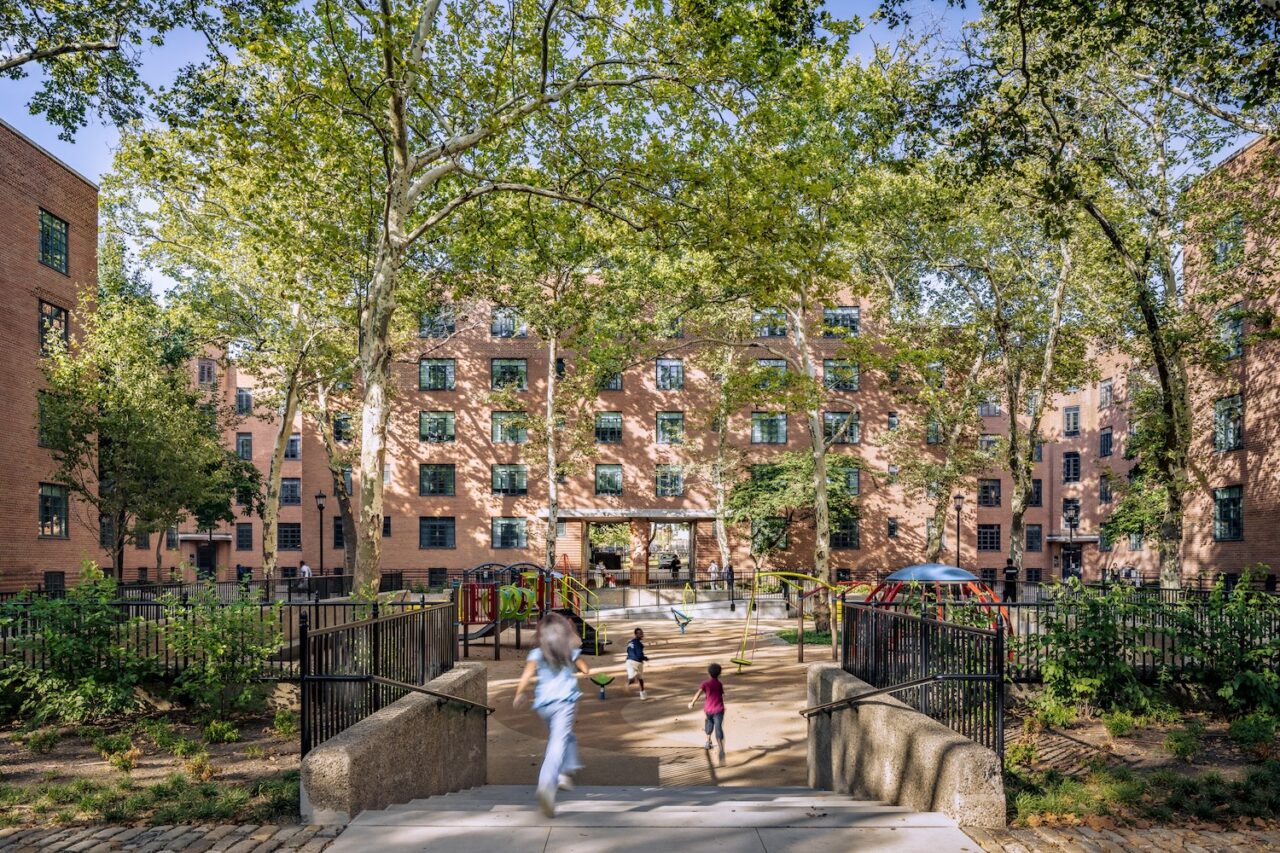
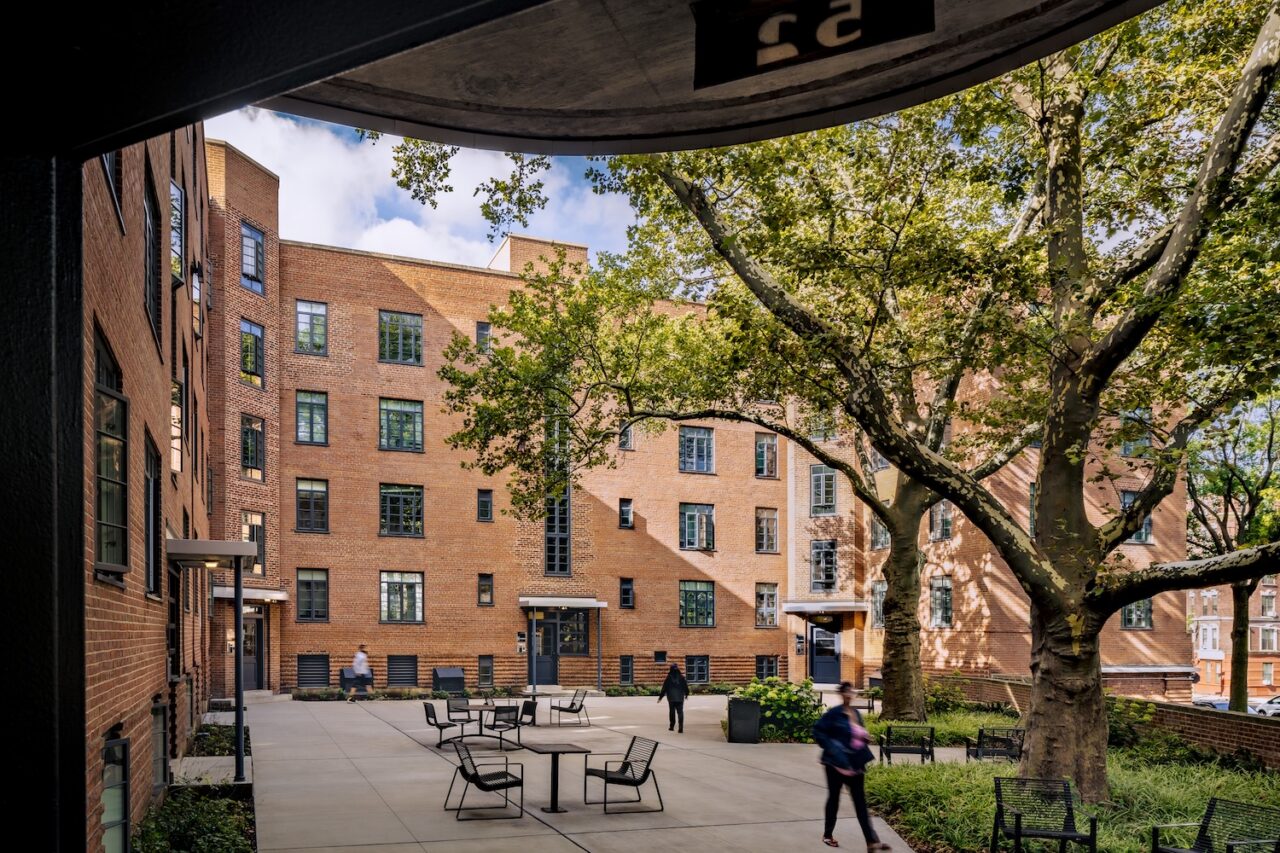
A visitor to the Harlem River Houses could easily mistake the grounds for a bucolic college campus. Built in 1936 and 1937 as one of the nation’s first federal public housing projects, this collection of seven four- and five-story brick buildings on two Manhattan superblocks is distinguished by London-plane allées, Belgian-block walkways, ample courtyards, and playgrounds, balanced shared and semiprivate spaces, murals, statuary, upgraded fenestration, supportive facilities, a grassy amphitheater, and an onsite branch library. It was not always such a welcoming place to live—“before” pictures a few decades old show glaring disrepair. Yet its current condition, a paragon among recently renovated public housing campuses, suggests that the New York City Housing Authority (NYCHA) can be a dignified alternative to the unaffordable housing that local market mechanisms excel at producing.
At the June 4 opening of the U.S. Conference of Mayors’ annual meeting, over 40 mayors nationwide identified housing as their most urgent priority. New York’s residential crisis is notoriously severe, and NYCHA, the city’s largest landlord, has been reconfiguring itself to address that need after years of underfunding, deferred maintenance, and occasional scandals. NYCHA’s Regeneration Initiative comprises Permanent Affordability Commitment Together (PACT), a 2016 program retaining NYCHA ownership while granting 99-year leases to managerial/repair/maintenance partnerships and converting Section 9 subsidies for government-owned public housing projects to Section 8 tenant-based rental assistance in private housing under the US Department of Housing and Urban Development (HUD)’s Rental Assistance Demonstration (RAD) program and the newer Public Housing Preservation Trust. The aim of both is to generate funds for repairs while maintaining permanent affordability and safeguarding residents’ rights.

According to NYCHA’s 2025 Fact Sheet, the system is home to about “1 in 16 New Yorkers…511,384 authorized residents in over 177,565 apartments within 335 developments through public housing, Section 8, and PACT/RAD programs.” Easily the largest of the nation’s 3,000 public housing authorities, with a population larger than entire cities like Atlanta or Miami, NYCHA embodies the idea of housing as a human right, not a speculative commodity. It survived the era of Pruitt-Igoe, Robert Taylor Homes, and Cabrini-Green, when demolitions provided handy symbols for market fundamentalists who insist that public housing inevitably invites decay. NYCHA’s advocates and partners act on the opposing principle that housing the populace is too important to leave to commercial markets.
The challenge is daunting: NYCHA’s 2023 Physical Needs Assessment estimates 20-year remediation and replacement costs at $78.3 billion. The institution is indispensable, aging (over 70 percent of its buildings were built before 1970), and chronically embattled; having invited private partners in as managers and renovators, it must demonstrate that the benefits will not come at the cost of compromising its mission. To many who look to NYCHA as a bulwark against lax or predatory landlords, the private sector’s involvement is unsettling. Yet improved conditions at Harlem River and comparable residences offer hope that with appropriate guardrails, public-private collaboration can provide the needed expertise and resources.
Opponents of RAD-PACT cite the different levels of tenant protection between traditional Section 9 public housing and reorganization under Section 8. Layla Law-Gisiko, president of the City Club of New York, contends that eviction rates in PACT are nearly on par with those in private buildings, citing scenarios where survivors of domestic violence needing relocation, generally well protected under NYCHA, have seen that right disappear after conversion. Evictions have become a risk, she says, when new managers set new rules—affecting anything from rights to assemble and organize to bans on pets—or enforce rules in areas where NYCHA has been less rigorous (allowing residence to relatives not on the lease, such as students or returning military personnel, or letting a family with a golden retriever slide on the official 25-pound dog-size limit). The gap between theoretical and real-world tenants’ rights protection is an area PACT needs to address if its proponents are to build broader support.
The answer to chronic underfunding, Law-Gisiko says, is simple: “Fund it the same way we fund everything else. Make it a priority.” NYCHA needs “essential funding out of Section 9, not conversion, not flipping the buildings to a private developer so that we can wash our hands of this responsibility.” Some feasible funding sources are already at hand, such as reinstating the New York state stock transfer tax, now set at zero. “No one would tolerate a defunding of our public schools,” she says, “and likewise, no one should tolerate a defunding of our public housing.”
Undervalued Assets
The cause of NYCHA’s troubles has “a very easy answer,” says Mark Ginsberg, FAIA, LEED AP, partner at Curtis + Ginsberg Architects (C+GA), which has worked on NYCHA projects for 25 years. “NYCHA was funded by the federal government almost exclusively” before the Reagan presidency “and they cut the maintenance funds,” says Ginsberg. The city and state, emerging from the 1970s fiscal crisis, were in no position to offer support. “Aside from a pre-1993 program for seniors, which had minimal effects on NYCHA, it wasn’t until Obama, under HUD Secretary Sean Donovan, when they created PACT/RAD, that NYCHA received a little more money from the federal government.” Another factor, he says, “was a convergence of liberal and conservative desires: They wanted the housing for the poorest of the poor, often not working poor.” (NYCHA’s proportion of employed residents—38 percent of total households in the current Resident Data Book Summary—compares favorably with public-housing systems like Chicago’s, Ginsberg adds.) “The biggest employers of NYCHA residents are the city agencies, people that work for the Department of Education, the NYPD, the MTA,” notes Nathan Rich, AIA, partner at Peterson Rich Office (PRO), which developed the 2020 Scalable Design Solutions for NYCHA report with the Regional Plan Association. At the time PRO advocated for energy-efficient mechanical upgrades, private balconies, and other improvements. Now the firm consults with the agency, PACT partners, and residents on conceptual designs and quality assurance. “So NYCHA is housing all those people that basically keep our city running, and therefore one way to think about it is that it’s a critical piece of New York City’s infrastructure. In addition to baseline maintenance, security, and health considerations, Rich says, the team is “thinking about how they can bring back the aspirational nature of NYCHA. Its origins were to create a certain excellence, the national standard in what could be middle-class housing provided by the government.”
NYCHA campuses have considerable natural resources—Rich points to “incredible canopies and amazing green spaces”—along with underrecognized architectural resources, not limited to the familiar towers-in-parks model. “When you actually look at the portfolio,” notes PRO partner Miriam Peterson, AIA, “there are a lot of different types of buildings, some of them actually pretty incredible, like experimental Brutalist buildings that have generous light in corridors.” The Williamsburg (originally Ten Eyck) Houses, she adds, an early PACT project where MDG Design and Construction rehabilitated a series of landmarked three-story 1938 walkups, “demonstrated to residents throughout the city that NYCHA and the developer partners could do a thorough and sensitive job of rehabilitating the buildings.” At Brooklyn’s Pennsylvania-Wortman Houses, designed by Morris Lapidus, C+GA’s 2025 renovation preserved or restored original 1972 details, including decorative scored concrete façade sections and operable windows, along with doubling the size of the gym and redesigning the entrance lobby. “I think the project was worthwhile to preserve,” says Ginsberg. “It’s by a noted architect, and when everyone else was doing banal red brick boxes, we were doing something with some interest in it.”
Other prevalent features of midcentury NYCHA buildings are ripe for updating. Large ground-floor perambulator rooms, for example, scaled to fit older bathtub-sized prams too large for elevators, are now prime areas for conversion to recycling rooms, mail/delivery rooms, expanded lobby space, and other modern essentials. Thermal performance is low-hanging fruit: Sharp efficiency gains and Local Law 97 compliance are possible with pipe insulation, boiler replacement, electrification, new heating units adopted at scale by NYCHA with New York State Energy Research and Development Authority support, and window upgrades. Low-E double glazing is the standard, sometimes constrained by landmarking or incentivized by tax abatements.
Trash chutes, several architects point out, are often replaced under PACT management; buildings with undersized chutes often accumulate refuse in hallways, but hopper doors wide enough for today’s trash bags help keep common spaces clean. “The enlargement of the trash-chute door is to me the single most important upgrade in everything we do,” says C+GA partner Tamar Kisilevitz, AIA, FARA. “When you feel oppressed, where you cannot fit a trash bag in through this tiny door, then you’re not going to care whether you fit it in or not. People use this.” NYCHA has added it to design guidelines.
The Real Client Lives in the Building
The system’s most underused resource, say participants in renovations, is the tenants themselves. Private management groups have encountered opposition from residents accustomed to decades of neglect amid claims of reform. Matthew Rooney, CEO of MDG, describes his firm’s experience since NYCHA’s first PACT conversion in 2016 at Ocean Bay Apartments in Far Rockaway, working with Wavecrest Management to upgrade 1,395 units in 24 buildings: “There’s a saying by Mike Tyson: ‘Everybody has a plan till they get punched in the mouth.’” At first, residents wouldn’t even see Rooney’s group, suspecting a buyout scheme by private landlords. “Finally an elderly gentleman let us in, we did his bathroom, and he texted his neighbors and sent them pictures, and then all of a sudden the doors started flying open. We started winning trust over just by virtue of people liking the work, but even then there were still people who were skeptical. We realized that because of the distrust, people weren’t even telling us what the issues were.”
MDG hired an outside consultant associated with a local community-development corporation and patiently built channels of communication. The experience “taught us a lot about our blind spots,” Rooney reports. “We go into some of these things as urban planners, and we say, ‘What would we like to see here?’ And then we remember there’s an existing community, an existing fabric, and we need to be better listeners than speakers at these meetings.” Tenants and tenant associations, he finds, often “have had to fight for everything they’ve gotten”—working radiators, hot water, elevators, and other basics, not choices among decor options—and expect the worst.
At Ocean Bay and MDG’s next project, the Bronx’s Betances Houses, the firm engaged Rev. Corey Terry of Our Brothers Guardian as a third-party advocate for residents. At the Williamsburg Houses, the development gave the tenants association a budget to hire an independent advisor of their choice, selecting Terry, and met with tenants outside the community center when COVID forced cancellation of the first meeting. “We figured we’d stand out here and just let people know in person, because we didn’t want people to feel like we were ghosting them,” Rooney recalls. Many members of his development team grew up in public or subsidized housing, he notes, and project managers attend resident meetings “because you’ve got to see who you’re actually serving. You’re not serving the bank, you’re not serving even NYCHA, you’re not serving an Excel sheet. You’re serving these residents. A comment that my team has said a lot is, ‘We will never spend a night in these buildings, and we will never know what that’s like unless we can start a dialogue with you as the residents.’”
The Williamsburg work, including complete plumbing replacement and environmental abatement under a HUD consent decree, required temporary relocation for all 1,620 units. Relocations are challenging, with longtime tenants reluctant to move and unconvinced that their right to return—a HUD legal requirement, Rooney emphasizes—will be honored. “So far we have never required anyone to relocate off their campus,” he notes; most tenants take relocation units within the same development, some stay with friends and family with stipends from the developer, all have moving expenses covered, and all are able to return to their units.
Complications arise in cases like Manhattan’s Fulton and Elliot-Chelsea Houses (FEC), where residents voted for demolition and replacement by new construction, including non-NYCHA mixed-income units intended to generate is currently halted under a court order. “The difficulty with FEC is you’re not returning to your original unit,” Rooney acknowledges. “You will be returning to a new building, which I’m sure would be very disorienting.” Noting that senior residents at such projects have concerns that the demolition/ relocation/replacement process would take time they may not have, he finds their objections well grounded even if their new units would be major upgrades from inadequate “micro-studios.” “The renovation will take just as long as the new construction, but if you feel you only have two years left, it’s a question of, ‘Do you want it to be done in a construction site?’”
Emulating What’s Worked Overseas
NYCHA is evolving through stages that public housing systems elsewhere have already undergone, says Sarah Watson, deputy director of the Citizens Housing & Planning Council (CHPC) and a veteran of affordable-housing regeneration programs in London before joining the New York–based nonprofit organization. “A lot of the quality and investment issues around public housing happened 30 years ago in the UK,” she says. “Working out how to bring in capital investment in the right way to make sure that it benefits residents. There’s a balance between continued public involvement, how much private investment, and how to bring in resident voice….It’s sadly an innovation for public housing to view tenants as a design client.”
British council housing dates back to the early 20th-century Arts and Crafts movement, Watson points out, and the architecture was more experimental and optimistic than after the war, when construction emphasized speed and scale over quality. “By the ‘80s the UK was dealing with both the older stock that was higher-quality to begin with but had been deferred for too long—and then the newer stuff from the ’ 60s that was already falling apart.” Housing authorities have brought in private investment on many British projects, she says, and including tenants in scoping, vision, and implementation is the key element that can translate to the New York context.
Improvements in British council housing, Peterson adds, benefit from localized decision making on scales smaller than NYCHA’s: “Each borough essentially manages its own public housing stock, so you have a much closer relationship between the immediate community and the public housing.” Rooney recalls, on a CHPC fact-finding trip to London in 2019, “seeing how open they were with the residents; it was a clear financial discussion. ‘Hey, if you want this, here are your priorities; here are the different options; here are the tradeoffs.’ We treat tradeoffs as a dirty word, but that is the heart of how you give residents choices.” Instead of an adversarial atmosphere, “they actually have conferences about ‘how to scrutinize your landlord better.’ It’s data-driven and constructive. I hope that we can eventually get the discourse here where landlords should be actually advocating for scrutiny from residents because it will lead to better outcomes for both sides.”
As an alternative to PACT development, Watson points to the Preservation Trust, a quasigovernmental body that acts as developer in Section 8 conversions and brings in architects and general contractors in a process “akin to government procurement.” The Trust has experimented with progressive designbuild processes, with “the project team working together with the residents to have a bit more nuance around what the scope could be, then working out what that budget looks like at the end, rather than working with a fixed budget at the beginning.” PACT has “more options for the capital stack [and] a more extensive scope, and the Trust is focusing on the infrastructure,” remaining fully public and gaining access to federal Section 8 subsidies for modernization and preservation. PACT has performed or begun repairs on over 32,000 homes; on the other hand, Watson notes, “we haven’t had a Preservation Trust project actually happen yet; it’s still new, in pre-development planning.”
“NYCHA statutorily cannot take on private debt,” notes Ayanna Oliver-Taylor, principal of Henge Development, whereas the Trust “can take on debt and issue their own debt. Section 8 conversion is what allows the Authority to unlock additional financing resources to create those improvements, to ensure that they create more operational efficiency, and then start to have an adequate amount of staff on board.” The legislation enabling the Trust in 2022 gives tenants a vote to enter this program, to enter PACT, or to remain Section 9; since that date, of seven developments, four campuses (Sheepshead Bay’s Nostrand Houses, Bronx River Addition, Coney Island Unity Towers, and Hylan Houses in Bushwick) have chosen the Trust; Coney Island Houses and Throggs Neck Addition voted to stay in Section 9, and Randall Avenue-Balcom Avenue Houses chose PACT. When the “TrustMod” program moves from planning to renovations, its performance relative to PACT projects will help address the question of whether private management per se or other variables account for the contrasting conditions between Section 8 and Section 9.

Let’s Have What They Built Across the Street
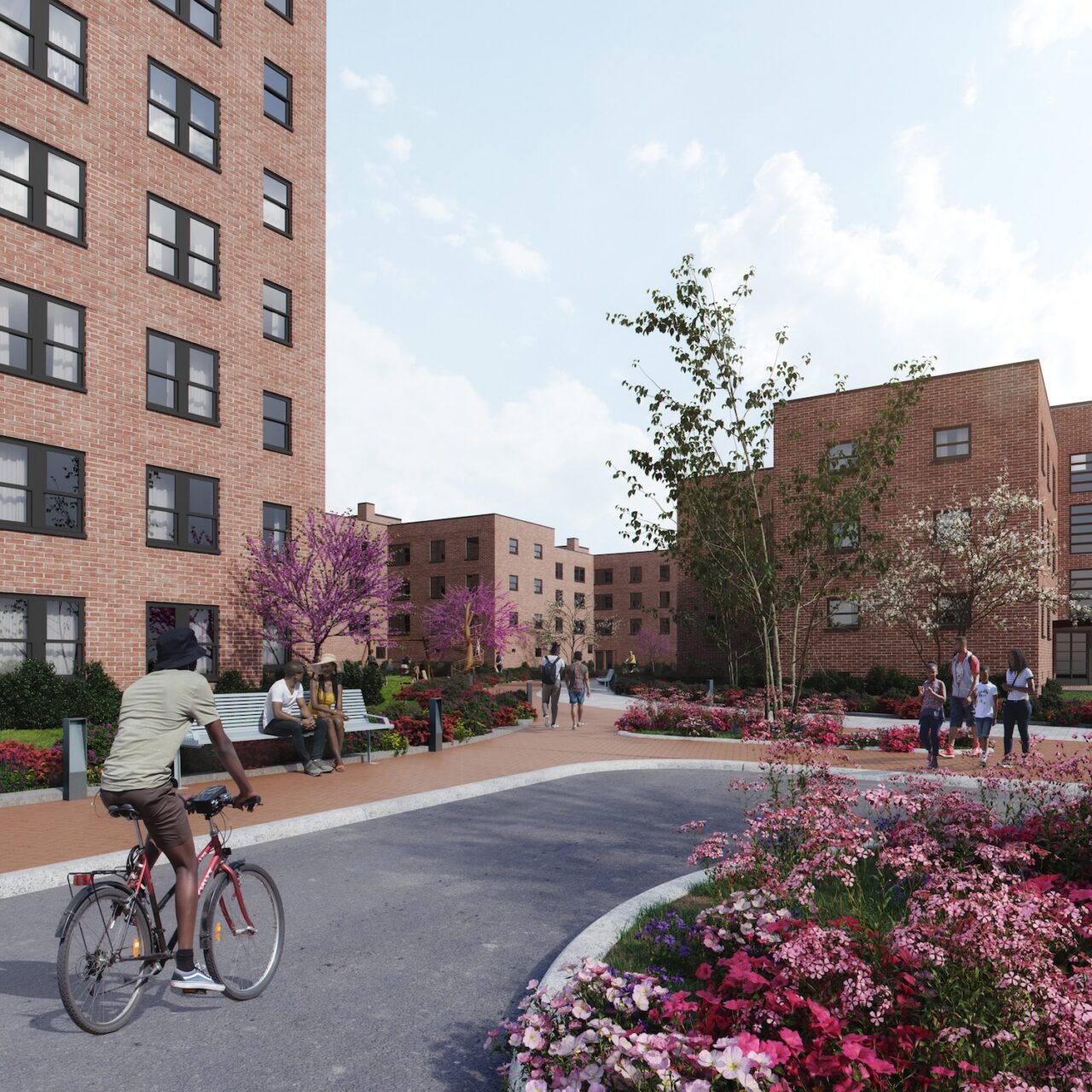
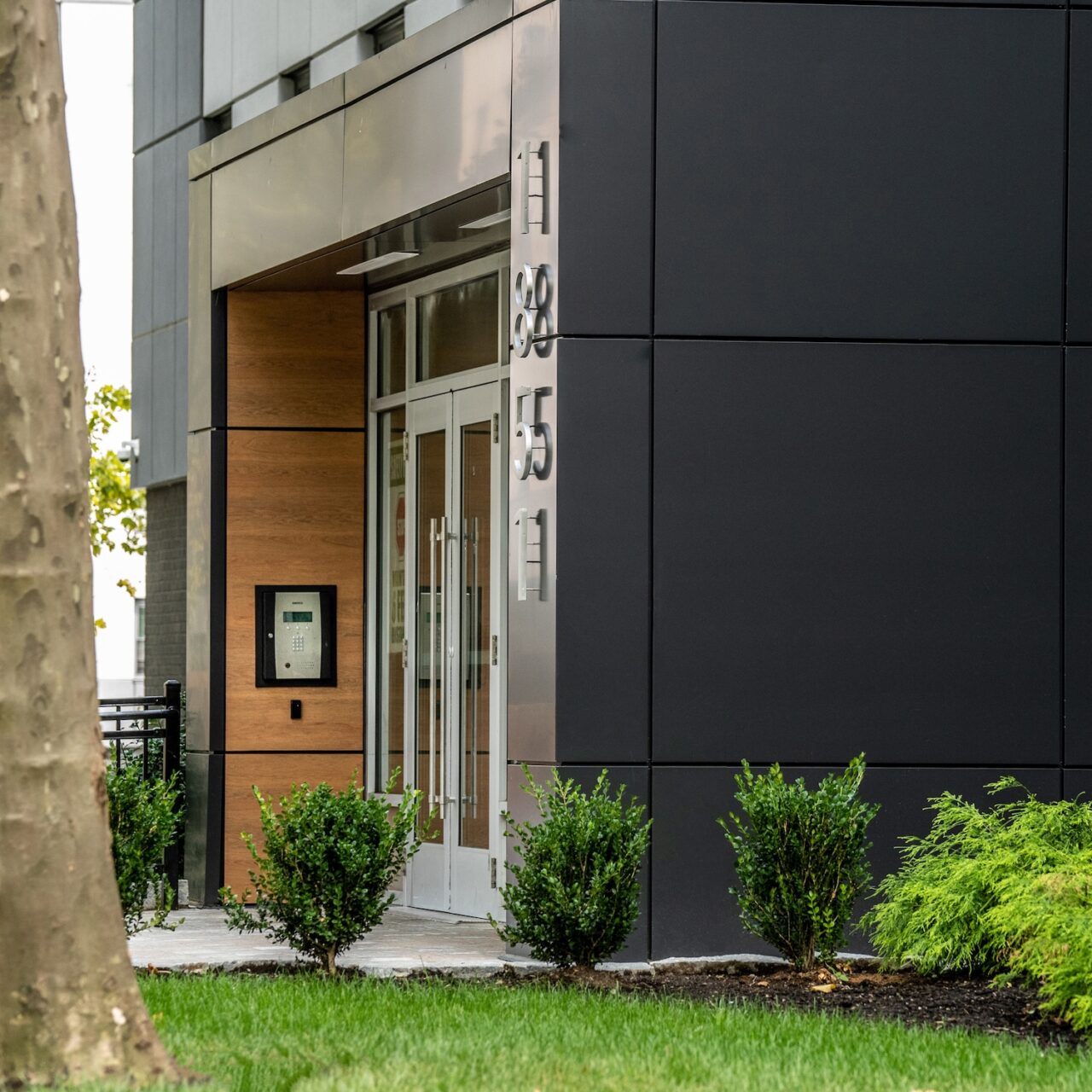
One of the strongest cases for NYCHA’s potential under any new form of management is the pair of projects on opposite sides of Schieffelin Avenue in the northeast Bronx. The 12-building, 441-unit Baychester Houses were decrepit when Camber Property Group, L+M, and MBD (initially, though not officially, “Mid-Bronx Desperadoes”) Community Housing took over management of Baychester and the nearby Murphy Houses under PACT in 2018. The buildings were water-damaged and moldy, security was poor, NYCHA’s management was unresponsive, and tenants did not have an association. C+GA completed renovations with tenants in place in 2020, making Baychester one of the system’s success stories. “It now features new glazed entrances, lobbies, and recycling rooms; a dedicated space for the new tenants association; a new community plaza; a better-fenestrated and safer laundry facility; and an upgrade from institutional-looking masonry to waterproof, energy-efficient exterior insulation finishing system (EIFS) cladding.” Details such as seamless undermount sinks and high performance windows are comparable to market-rate housing, and the overhaul of electrical and mechanical systems has cut energy costs and reduced carbon emissions. The environmental performance is a model for systemwide upgrades. “The sustainability aspect of the project,” Kisilevitz comments, “has to translate into a healthier, more resilient, more comfortable home.”
At the 41-building, 2,035-unit Edenwald Houses, the borough’s largest NYCHA campus, residents began looking at Baychester admiringly, though looking at PACT with any degree of trust took longer. “In the beginning, they were scared to death,” recalls Edenwald Resident Association president Walter McNeil, who has lived there for 52 years and served as president for 32. Edenwald residents have a strong sense of identity, he says; though the project was initially intended as a transition to homeownership, “people are here for 20 to 30 years” and guard their community fiercely—especially since it usually draws publicity only “when there’s an emergency or something negative.” The firms proposing a PACT conversion (Camber, Henge, and Stuart Alexander and Associates) met with residents about concerns and design ideas over an extended period and gradually earned the status of allies. The TA selected them to begin renovations in 2023, choosing C+GA for a reprise of their Baychester work and L+M Builders Group as general contractor on a four-year projected timetable.
Edenwald, a landmarked development, will not receive the same EIFS overcladding as Baychester, Kisilevitz says, because historical tax credits of up to $5 million per building for preserving its exterior were too large to pass up. In other respects, the upgrades at Edenwald will resemble the results that residents see across Schieffelin. Improvements include window replacements, modernized elevators, a reclaimed senior center, and access to a new YMCA gym adjacent to the campus.
Although new construction for NYCHA such as Daniel Libeskind’s Atrium at Sumner Houses in Bedford Stuyvesant (covered in the Winter 2026 issue of Oculus, “When to Say Yes”), a 100-percent-affordable senior residence built to Passive House standards, can be visually arresting, renovation projects like Edenwald arguably do more to change the course of the system, even exerting influence beyond campus borders. The scale of NYCHA’s portfolio implies that by incorporating electrification and decarbonization into its upgrades, as recent research by the Climate and Community Institute suggests, NYCHA’s procurement power can have a hefty impact on the city’s environmental profile as well as residents’ quality of life.
Between what’s important to preserve in NYCHA and what needs rethinking—or a strong recommitment to funding it at the federal level, though few are wagering on that at the moment—the residents’ experience and judgment, particularly in choosing partners, could be the most reliable hand on the tiller. “There’s a lot of misinformation out there,” Watson points out, about PACT leading to sale of NYCHA assets. “The best way to communicate the opportunity for PACT and the Trust is by touring and meeting resident leaders who’ve been through it. There is absolutely no part of this moving towards any market condition; there are so many restrictions on PACT and the Trust, there should be no difference in rent calculations, no difference in rights and protections, and the best people who can share that information are tenants who have been through it.”
BILL MILLARD (“NYCHA Rethinks, Rebuilds, and Aims for Resilience”) is a contributor to Oculus, The Architect’s Newspaper, Metals in Construction, Architectural Record, and other publications. He is currently working with photographer Norman McGrath on Lead Us Out, a book about the past and current transformations of Penn Station.