


In my dreams, I imagine walking down Broadway, smelling the dizzying sweetness of ripe fruit, and reaching up to pluck a comely apple from a nearby tree. Farmstands with nutrient-dense greens grown on rooftops in Chinatown tell me of the season. Forest gardens, full of chestnut trees and serviceberry bushes, fill in the lines between housing complexes where water-thirsty grass once withered. New York City is rescued from its fate as a concrete jungle and returned to an edible food forest.
My vision for an edible New York City is not just a Willy Wonka Technicolor dream. It’s a design proposition for how cities can nourish people, ecosystems, and economies. Edible cities, defined by the consortium of European partners that make up the Edible Cities Network, are “designed and managed to support the production of locally grown food, with the goal of increasing food security, promoting health and nutrition, improving biodiversity, reducing food waste, and minimizing the environmental impact of food production and transportation.” Cities such as Detroit, Paris, Andernach (on the Rhine in Germany), and Todmorden (which birthed the U.K.’s Incredible Edible network) have created policies to promote and support urban agriculture initiatives. Currently, there are campaigns to pass “right to grow” laws across the U.K. to transform disused public land for food cultivation. Havana boasts that more than 50% of the fruits and vegetables consumed within the city are locally produced, a result of converting approximately 35,000 hectares into agricultural land since the 1990s. This transformation—prompted by the prolonged U.S. embargo—emerged through a combination of government support, state-run organopónicos, and community-led urban farming initiatives. By designing towards an edible city, we strengthen that city’s resiliency around climate, food sovereignty, and community.
Edible cities aren’t only delicious, they mark a shift in how people see themselves in relation to the built environment. Manhattan and its surrounds were once biodiverse ecological communities of streams, forests, and swamps tended by the Lenape people. As Eric Sanderson details in his wonderful 2009 book, Mannahatta, the island had 55 biological diversity zones—more per acre than Yellowstone. Under colonial influence, many of these streams were filled in, and the city’s forests were clear-cut to make room for farms. Despite the destruction of colonial-style farming, this history reminds us that the city is geographically situated to be fertile. In considering the future of New York City in relation to its bountiful past, we must conjure the sensorial joy and immediate urgency of engaging with a living world by tasting the literal fruits of its labor. As botanist and author Robin Wall Kimmerer asked in a recent conversation with the Museum of Science in Boston, “How are we going to fall in love with the world if you don’t pick berries?” What would New York City taste like if we allowed the landscape to breathe and become unruly? By reframing food as infrastructure, those of us who design the built environment have an opportunity to produce living infrastructures in which the urban landscape isn’t fixed, but returns it to a stewarded place, brimming with fecund possibilities.

The City and the Trees
In many ways, New York City leads the nation in sheer scale of urban agriculture activity. According to a 2012 Design Trust report in partnership with Red Hook’s Added Value Farms, there are more than 700 food-producing farms and gardens throughout the five boroughs, compared to Seattle and San Francisco’s 75. We can also boast of more than 900 school gardens, thanks to over a century of advocacy. In 1902, Francis Griscom Parsons, a Brooklyn-based mother of seven, founded an innovative children’s farm on a public lot in the neighborhood then known as Hell’s Kitchen. The initiative’s success catalyzed the school garden movement in New York City, rooted in the conviction that open space, the freedom to play, and agricultural education were vital to nurturing the next generation. More recently, a 2010 public-private partnership between GrowNYC, the environmental non-profit that runs many of the city’s farmer’s markets, and the mayor’s office, created an institutional framework for supporting school gardens through technical and material assistance, educational workshops, and curricula.
Community Gardens
Community gardens in New York City represent grassroots activism and resilience at its best. With the deepening financial crisis of the ’70s and a rash of abandoned buildings, neighborhood residents began to take over disused and neglected spaces that littered the city. Luis Torres and Jose Ayala began community gardening efforts in Loisaida in the early ’60s. Hattie Carthan formed a youth greening corps in Bed-Stuy for street tree stewardship in 1971 to resist the negative effects of redlining. Through community organizing, more than 1,500 trees were planted in less than a decade, transforming the neighborhood, improving quality of life and property values, and creating policy change by establishing a tree matching program. The “Green Guerillas,” a band of guerilla gardeners, began greening the Lower East Side and East Village through radical acts of civil disobedience: throwing seed bombs over the fences of vacant lots, planting sunflowers in street meridians, and putting flower boxes on the window ledges of abandoned buildings. In 1973, with a coalition of neighbors, they took over a lot on the Bowery and Houston, which later became the first officially recognized garden in New York City.
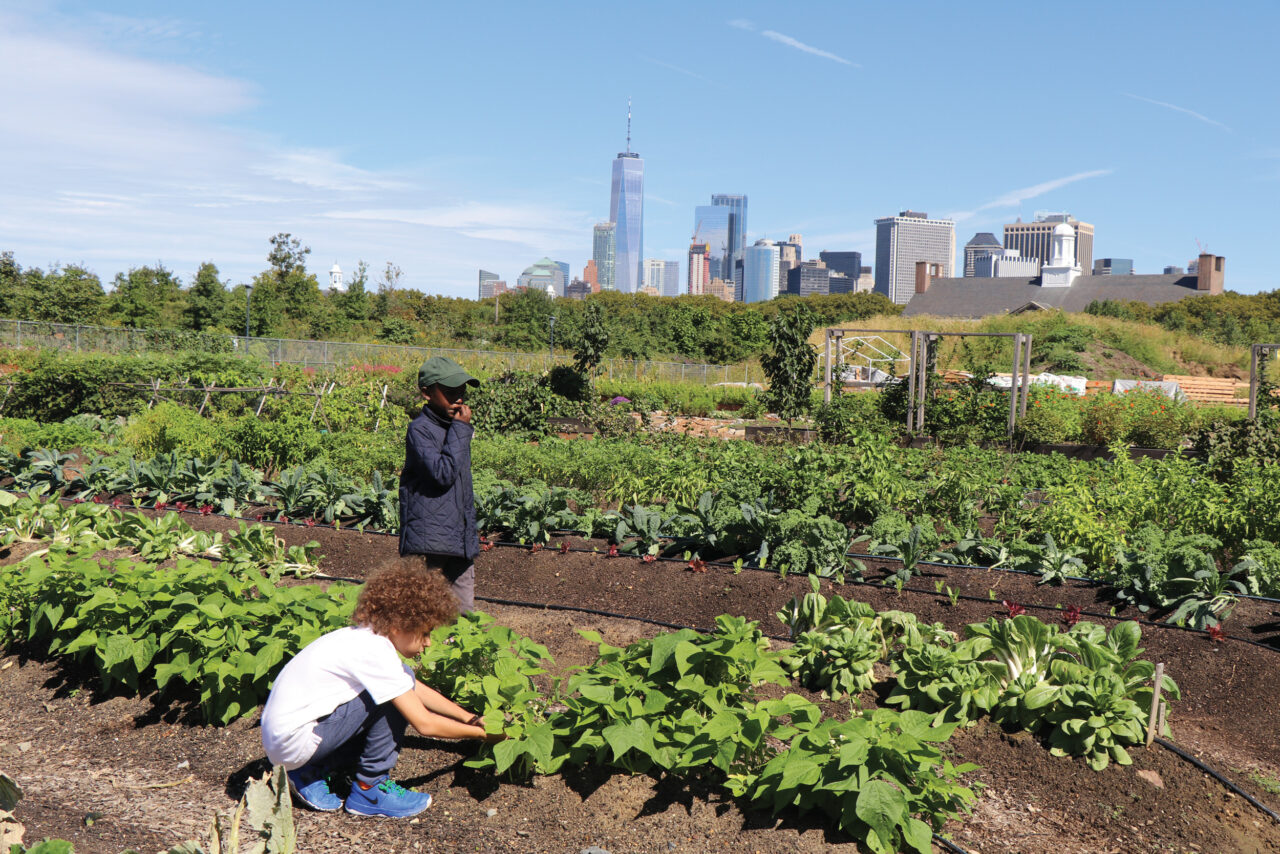

The history of NYC’s community gardens—where the tensions among land stewardship, development, and community intersect—underscores the question of who gets to decide the future of New York City. In 1999, then Mayor Rudy Giuliani created a plan to auction off 112 community gardens to real estate developers. Hundreds of gardeners organized their communities to fight the mayor’s plans and save their gardens, ultimately suing the city. In 2002, then Mayor Michael Bloomberg signed the Community Gardens Agreement with then Attorney General Eliot Spitzer, preserving an additional 198 gardens. Of the original 114 gardens under threat, the Trust for Public Land saved 69 gardens, and Bette Midler’s New York Restoration Project took over an additional 51. Today, community gardens remain a place for rest and both physical and spiritual nourishment—a rare third space for people to gather and find fellowship. These green spaces (over 550 are registered with New York City Park’s GreenThumb program) are being upheld as a model for “nature-based solutions” for climate resiliency.
Considering Agricultural Waste
If we think of the food web as the web of life, we must also consider the ways we can compost death to generate life. The architectural materials researcher, Mae-ling Lokko, is advocating for the creation of a culture of care when dealing with biomass for building applications—biocomposites for interior, exterior, and structural applications. With the building and construction sector already responsible for 37% of global CO2 emissions, transforming our relationship with waste is critical to our future. “There’s a whole world to care for,” when it comes to collecting biomass from myriad, diverse sources in and around the city, Lokko says. Whether it’s from urban forestry, peri-urban farms, or timber plantations, municipal waste coming from hospitality and homes, or invasive species growing in and around the rivers or water bodies in the city, “our agricultural industries are not mature enough to care about the quality of their waste,” she says.
Top-down approaches—as we’ve learned from our largely failed efforts to recycle things like plastic, paper, and glass—are expensive, inefficient, and intensive. As Lokko understands, when it comes to creating value for biomass, the question lies with how we organize at a local-to-regional level. “A lot of work is trying to figure out where we have some degree of control—from rural, urban farms to neighborhood waste-collection systems. We can put in rituals of, say, separating certain types of biomass streams because the scale of people working on these farms is more manageable and in close contact with each other.” Collaborators of Lokko, like professor Jennifer Pazour of Rensselaer Polytechnic Institute, are looking at organizing people at a grassroots level and decision-making for logistics and supply-chain challenges. “When we start to look at biomass, it’s a really interesting case study, because all of a sudden we have to organize people who are essentially at the other end of the material value chain: users, urban farmers, homeowners. How do we organize ourselves around the rapid, high-quality collection and transformation of biomass materials that leave our spaces?”
What Lokko is pointing towards is a new role for architects—not just as agents for value generation, but participation. Alice Rawsthorn, in her 2018 book, Design as an Attitude, advocates for interdisciplinary experts to apply the tools of their various practices to projects that help us make sense of the world around us, and turn these observations to our advantage. And what better thorny problem to address than how living in relationship with our food can help us shift our relationship with waste?

Urban Farms
This question of who charts the future of the city was in the foreground when I first began reporting on food systems in 2010, and witnessed a great hype around a more tech-enabled food future in New York City. Investment from City Hall, real estate developers, and venture capital poured in to jumpstart the future of urban agriculture. As Henry Gordon-Smith, founder of the agtech consultancy Agritecture recalls, “It was a really exciting time. A lot of these new urban ag companies were private and using new technologies—they had different needs, different technologies, and there was no place for them in the historical context of urban ag in New York City.” Vertical, aquaponic, container, and rooftop farms captured the imagination of speculators and entrepreneurs alike. These larger operations promised economic development, technology-enabled innovation, and local jobs that bridged agriculture and precision manufacturing. But for many of these operations, the future of feeding the city was something that needed to be charted by private interests, reliant on investment capital. The city was slow to support these agtech companies, so when the money ran out, so did the momentum. Many of these upstarts have since shuttered, including Kimbal Musk’s Square Roots container farm, and some have stalled out, like Sky Vegetables, the 8,000-square-foot farm on the NYCHA-situated Arbor House in the Bronx. But many are still in operation today—including Gotham Greens’s distributed network of urban greenhouses, Brooklyn Grange’s rooftop operations in former industrial landscapes like the Navy Yard and Sunset Park, and Newark-based vertical farm, AeroFarms—despite the slowdown of investment capital.
In 2013, Yemi Amu established Oko Farms, New York City’s first and only publicly accessible outdoor aquaponics farm on a disused lot in Bushwick. With a professional his-tory rooted in food and education, Amu had years of experience working in an interdisciplinary manner with city agencies, schools, and non-profits to lead growing and nutrition initiatives. Since then, the farm has taken on different forms under different land conditions, including 10,000 square feet on the East River shorefront in Williamsburg, and its current iterations across a residential space in Flatbush and a commercial space in Bushwick. But the heart of Amu’s operation remains dedicated to education, production, and research. Her hybrid model represents a sustainable vision for how urban farming should be integrated into the fabric of the city, and why Oko Farms remains a vital model for the future of an edible city.
“I see empty spaces as potential for food. I’ve grown in so many different places—schools, residential houses, museums, food pantries, community gardens and youth centers,” Amu reflects. “In addition to places like hospitals and grocery stores, these are all places where we could grow food and where open space exists. Our current farm in Flatbush is a residential building where they installed an A-frame greenhouse extended from the building.” Like the community gardens that came before, Oko Farms’s radical history of reclaiming space for food production while simultaneously providing opportunities for intergenerational knowledge sharing and innovation has become a hyperlocal model for how New York City is thinking about the future.

Towards Relational Architectures
Despite a network of community gardens, urban farms, and farmer’s markets, our city lacks the infrastructure to provide any semblance of food security at a neighborhood, borough, or municipal scale. Adding to this urgency is the fact that an estimated 14.6% of New Yorkers are food insecure, compared to a national rate of 13.5%. This translates to 1.2 million people who cannot access enough food to meet their daily needs, many of whom are children. Even with robust changes, urban agriculture will not be able to fully meet the consumption demands of city dwellers, but an edible city will provide steps toward that goal, bringing us a new relationship to the foods we eat and their seasonality, as well as to one another. The challenge is how to use the tools at our disposal—utilizing disused spaces, integrating agriculture-friendly infrastructure in city planning and real estate development, and implementing a pro-urban agriculture policy—to support a vision of a more delicious future.
New York is only now working to establish a centralized and comprehensive approach to urban agriculture. Established in 2022, the Mayor’s Office of Urban Agriculture was created by city council mandate, and oriented its mission by laying out the myriad benefits of urban ag in its first official report: “Urban gardens and farms aren‘t just places for respite. They also absorb stormwater, reduce outdoor temperatures, and create cleaner air.” It is the first step in creating a plan for greening and feeding the city but, in many ways, the mayor’s office is playing catch-up with grassroots and private organizations that have been advocating for a more edible city for decades.
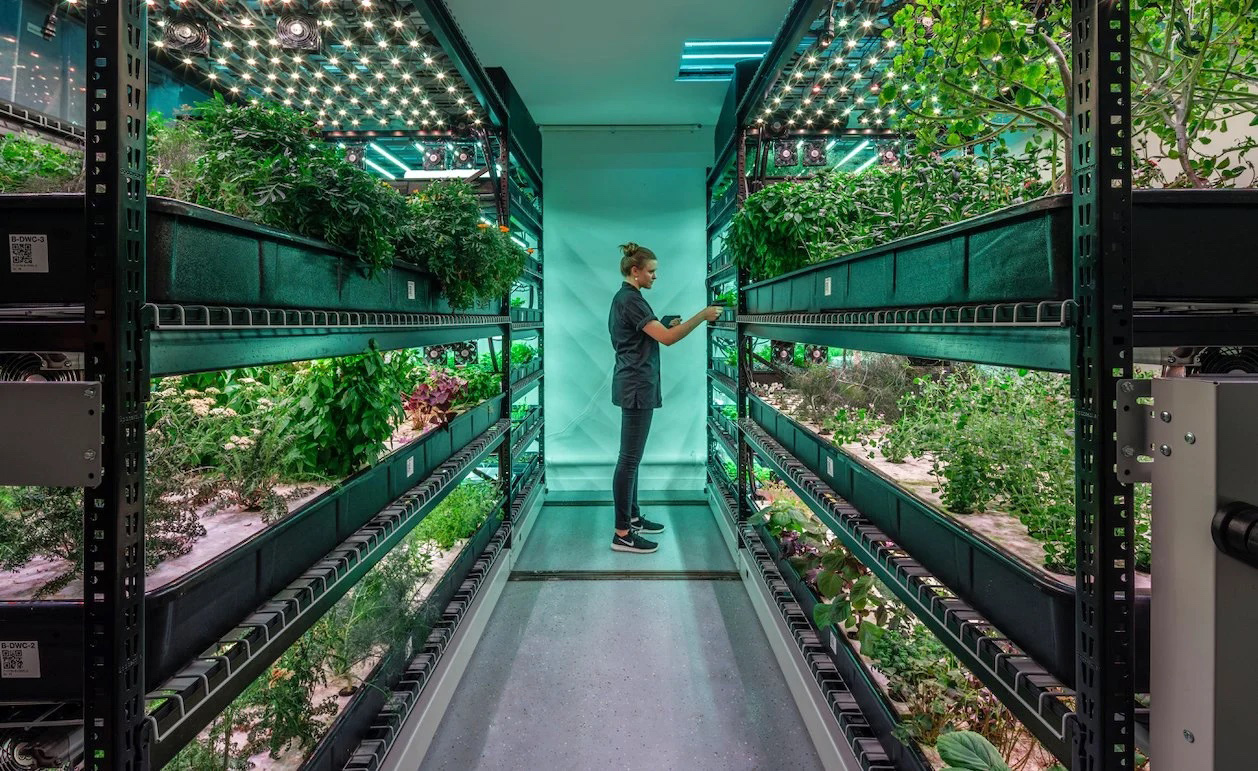
Gordon-Smith, of Agritecture, envisions an edible New York City where 5% of the city’s square footage is dedicated to growing food: “There are big opportunities for clusters of urban farms to leapfrog each other—not just in production but in value processing, training centers, and markets.” Gordon-Smith has been advocating for a plan with the city to implement a special zone where maximum incentives are put into an area that both needs reliable access to nutrient-dense, culturally appropriate foods and also has viable space available to develop urban agriculture. He continues, “There is a perspective that is also resilience-based—each borough needs to have some farms and skills to have resilience shocks in the systems. How could these farms work together? How do buildings integrate them better? How do water, energy, and waste all fit into that?” Both Gordon-Smith and Amu see the opportunity to transform disused spaces—food distribution hubs like farmer’s markets, hospitals, schools, large corporate sites, hotels—into sites for production and food infrastructure.

Architects have a unique opportunity to design these encounters within our built environment. “When we talk about bringing food to where people are, having architects and designers prioritize green spaces in construction is a simple first step,” Amu says. “When architects are considering water runoff, solar, heating, or insulation, they can incorporate a weight-bearing green roof or a food-producing backyard or basement as answers to some of these challenges.” These “nature-based solutions” are nothing new, and the call for individual architects to respond in these ways can feel a bit Sisyphean—like asking people to stop using plastic straws to solve the problem of microplastics. But, as Gordon-Smith notes, “There is policy to support these efforts; zoning is there, and there are credits in green infrastructure builds that are sufficient. But leadership is missing.” Architects have an opportunity to provide that leadership to intentionally design these encounters—just like the berry-picking that Robin Wall Kimmerer describes. The moment is ripe to usher in a paradigm shift in how people relate to the city.
In my neighborhood in Central Brooklyn, my years of writing about food systems have now crystallized into Field Meridians, an artist collective rooted in Crown Heights, with a vision to plant a publicly accessible food forest in our community. Also known as forest gardens, food forests are biodiverse plantings of edible perennial plants and guilds of fruit- and nut-bearing trees designed to mimic natural forests. Last winter, I held weekly meetings at which neighbors and potential collaborators came together to dream about how we might accomplish this feat. More than 300 people participated over the course of 14 weeks, and together we established a roadmap for decision-making, a rubric for site evaluation, a design, a selection of plantings, a management plan, and a community engagement plan. Our vision is to collectively steward land, increase tree canopy for better social outcomes, and offer a model for climate resiliency rooted in community care. Whether or not we accomplish our dream, sowing seeds of possibility with this collective of architects, planners, policy experts, community organizers, artists, and farmers feels like the most vital work at a moment often dominated by despair—and doing so over a delicious bite grown in the city we love is a healing, Wonka-esque antidote.
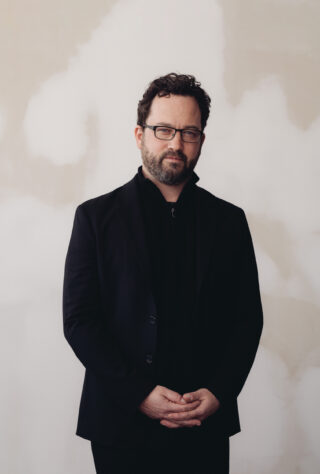
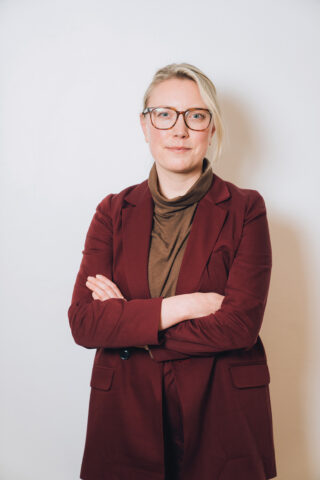
LINYEE YUAN (“Vision of an Edible New York”) is an educator, editor, and cultural organizer. She is founder and executive director of MOLD and Field Meridians, an artist collective committed to strengthening local food ecologies in Central Brooklyn.