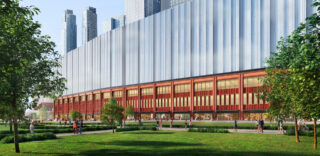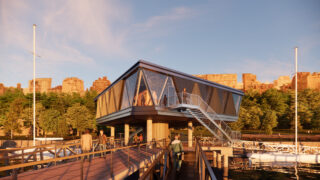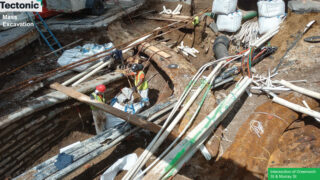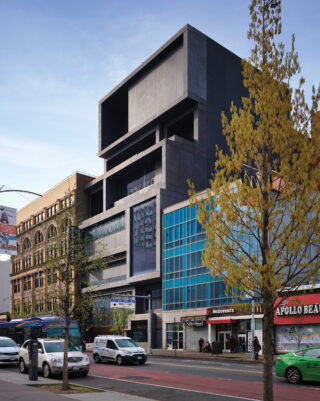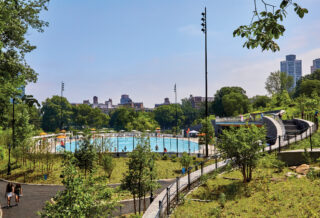






Thirteen years after Superstorm Sandy devastated the region, a series of ambitious coastal resiliency projects are starting to transform low-lying areas along Lower Manhattan’s shoreline with a ring of parks, playgrounds, pedestrian walkways, and bikeways that protect adjacent communities from coastal flooding and sea-level rise. These include the recently completed South Battery Park City Resiliency Project and the East Side Coastal Resiliency Project. Other projects planned for North/West Battery Park City, Battery Park, Lower Manhattan’s Financial District, and the Two Bridges neighborhood will provide a contiguous, multilayered coastal flood protection system from Chambers Street on the west side up to 23rd Street on the east side of Manhattan—the Big U, as it was dubbed.
Earlier this year, the New York State Department of Transportation initiated community outreach on planning studies to reconstruct the West Side Highway (Route 9A) from Battery Place up to 59th Street. At community workshops, participants expressed support to include coastal flood protection measures that integrate with the adjacent Hudson River Park as one of the project goals. Meanwhile, low-lying coastal areas in East Harlem along the East River and Harlem River remain vulnerable to the same flood and sea-level risk hazards, but with no detailed protection system proposed until summer 2025.
Stepping back to 2017, the U.S. Army Corps of Engineers (USACE) initiated a comprehensive coastal flood protection study called the NY & NJ Harbor & Tributaries Study (NY/NJ HATS) to provide flood protection for sea-level rise and coastal flood risks to the year 2100 for the entire New York and New Jersey Harbor region. The initial feasibility study included one option, among others, for a massive levee and operable
flood gate stretching across the mouth of the New York Harbor from the Rockaways in Queens to Sandy Hook, NJ. The second round of the feasibility study, released in 2022, highlighted the need for near-term implementable strategies by selecting an option with a more localized approach to flood protection based on a combination of seawalls, floodwalls, landscaped barriers, and other flood-control elements. The selected NY/NJ HATS option recommended a continuous seawall and/or floodwall to protect the shoreline of East Harlem from 88th to 165th streets.
Fast forward to this July, the USACE released a follow-up Actionable Elements Draft Report that proposed three localized near-term projects: a wetlands and beach sand restoration project at Oakwood Beach, Staten Island; a stabilization, widening, and deepening of the East Riser tributary to the Hackensack River in an industrial area of the Meadowlands, NJ; and an off-shore seawall or inland seawall running from 150th to 165th streets on the East Harlem shoreline. This last element would be the first segment of the East Harlem coastal protection system to be completed.
The Harlem River Actionable Element project would protect the New York City Housing Authority’s Polo Ground Towers and its adjacent Rangel Houses facilities. This site, which lies within a low-lying flood zone at the foot of the High Bridge Park bluffs, was subjected to coastal flooding during Superstorm Sandy in 2012, and is cut off from direct access to the Harlem River waterfront by the six-lane Harlem River Drive. The USACE proposed two barrier options to work in combination—an offshore seawall and an inland floodwall with operable flood gates across the Harlem River Drive and on/off ramps.
The combination of Harlem River Drive and the flood barriers would further block access and views, separating the Polo Grounds/Rangel Houses community from the waterfront. While an earlier iteration of the USACE study incorporated a prototype elevated pedestrian and bike esplanade on top of the floodwall, this integrated concept was not pursued with the latest proposal, effectively leaving a gap in public access to the Harlem River from 145th Street to 163rd Street.
It is encouraging that the USACE is moving forward into more detailed design studies for its resiliency projects. However, the draft report flew under the radar with limited outreach to local community groups, legislative representatives, and advocacy organizations, and an abbreviated 30-day public review period to comment on the proposed designs.
Unfortunately, by adopting a reductive approach to implementing flood protection along the East Harlem shoreline, the USACE is missing out on lessons learned from other urban coastal resiliency projects along NYC’s shoreline. These other waterfront interventions provide park-like settings with waterfront access to adjacent neighborhoods, incorporate pedestrian and bike esplanades, and tackle challenging environmental hazards—all while protecting vulnerable communities from sea-level rise and coastal storms. These complex urban infrastructure projects were many years in planning and construction with robust community outreach and sometimes contentious debate, and even some setbacks along the way. We should not deny the communities of Harlem the benefits from the same community-
driven design process.
Every site that is vulnerable to sea-level rise and coastal flooding is unique, with its own constellation of opportunities and impacts. The question that all coastal flood protection projects need to answer is: Is holding back floodwaters enough…or is enough too little?
Stay tuned for more debate on this question when the next phase of the NY/NJ HATS Actionable Elements study is released in January 2026.