

Friends:
It’s a difficult time. Many of us feel rising anxiety and concern about the state of our democracy, with the ongoing attacks on our civil institutions, the federal incursions into our cities and streets, and the increasingly dark nature of our national discourse, among other developments. I believe the radicalization of our national discourse is amplified by our reliance on social media as a primary conduit for news, information, and dialogue—its predisposition to elevate our most extreme moments and to generalize from them. I crave optimism and continue to find comfort in our community and the vibrancy of this city. As you know, I believe deeply that one critical ingredient in the remedy to break this dark spell is the time we spend together in person in our neighborhoods, streets, and public places, and that those spaces be safe and welcoming for all.
Together in public we discover a common humanity, question the city’s spaces, navigate our differences, reinforce social bonds, share a cultural life, and engage in political debate predicated on an ability to disagree civilly. As designers of the physical fabric of our city, we create public spaces to provide the arena for this vibrant public life promoting social resiliency. All this gives me faith that New York City remains a model for inoculating us against our current national malaise.
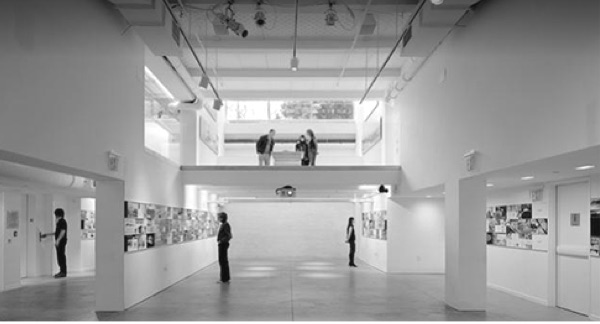
If you have not yet had the opportunity to come down to the Center for Architecture to see the exhibition Searching for Superpublics, I invite you to do so. I produced the exhibition as part of my presidential year, and it was designed and curated by New Affiliates. It advances the premise that our public realm is the infrastructure of our civic, social, and cultural life. It takes stock of how large, connective public spaces have been conceived, created, programmed, and maintained in the decade or so after Superstorm Sandy, George Floyd’s murder, the pandemic, and other transformative events. It examines the stakeholders and the current “superheroes” reimagining and maintaining the public realm.
The exhibition proposes three concepts that continue to reshape and invigorate our public life:
Connectors are large-scale physical pathway networks linking traditional parks and outdoor gathering spaces across neighborhood boundaries. These are interwoven today with projects addressing coastal resiliency, pandemic response, infrastructure repair, pedestrian safety, and initiatives for public health, and are exemplified in projects underway like the Queensway and Greater Rockaway Coastal Resilience plan, Broadway Vision, Reimagine the Cross Bronx Expressway, and the Staten Island Bluebelts.
Temporals are designed, time-based programmatic transformations of our streets into pedestrian public spaces: the DOT’s 34th Avenue Open Streets program, Paseo Park in Queens, the New York Marathon, and Pride.
Constellations are systems or infrastructures, distributed across the street networks and public spaces of the city, providing comfort, orientation, and support for a vibrant public life. These are represented by the city’s active plans to engineer the networks like the Urban Forest Plan, raising the city’s tree canopy coverage from 23.4% to 30% in the coming years, and the initiative to increase the inventory of public restrooms across the five boroughs.
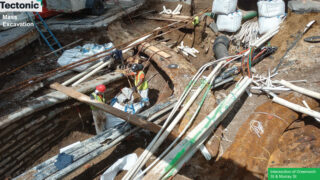
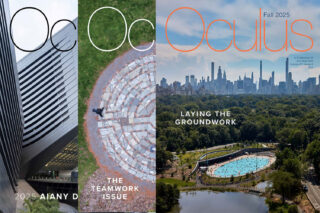
I’m excited that the content of this issue of Oculus is resonant with the themes of Searching for Superpublics, focusing on all the infrastructures that make our public life together in the city possible. It offers a deeper dive into the systems that underpin, connect, and give vitality to our public realm: public space infrastructure and pedestrianization efforts throughout the boroughs, the major public transportation projects happening right now, efforts to create “food forests,” and the Department of Design and Construction’s work to improve subsurface utilities throughout the city in response to our changing climate.
Let’s be active together this fall, supporting each other, speaking out, and sharing our lives in public to build our strength and resiliency.