
Info
-
Co Chairs
-
Nadine Berger, AIA, LEED AP, WELL APCo-Chair
-
Ian Wach, AIACo-Chair
-
Kuan-Ju Chen. AIAOutreach
-
Inês RaposoMedia Communication
-
Johannes BuchnerMedia Communication
-
-
Contact
-
Special Projects
-
Social Media


Upcoming Events
-
Mon, 10/19, 6:00pm
Topics
-
June 15, 2026
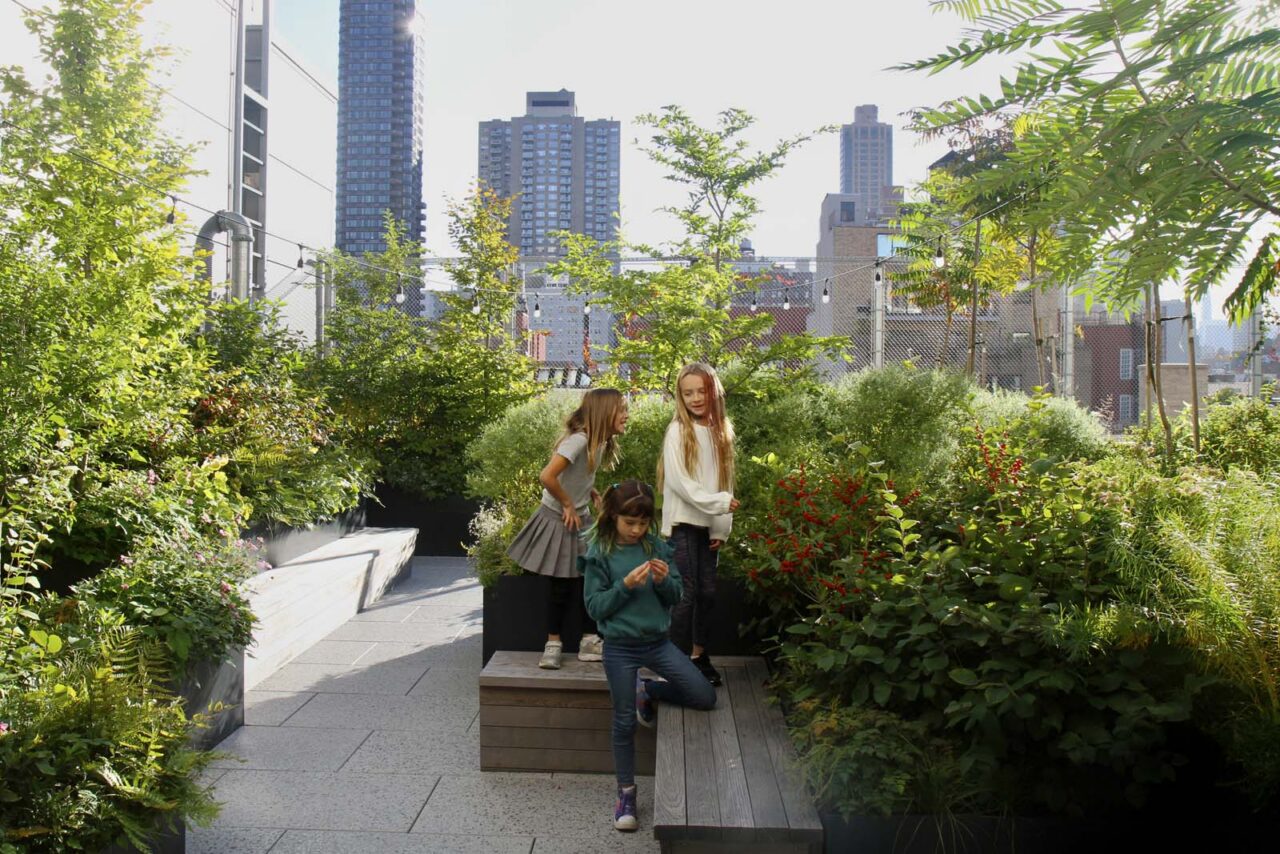
![Image by: New York Green Roofs]() Image by: New York Green Roofs
Image by: New York Green Roofs![Image by: PLASTARC/ AIA SS+A]() Image by: PLASTARC/ AIA SS+A
Image by: PLASTARC/ AIA SS+A![Image by: PLASTARC/ AIA SS+A]() Image by: PLASTARC/ AIA SS+A
Image by: PLASTARC/ AIA SS+A![Image by: PLASTARC/ AIA SS+A]() Image by: PLASTARC/ AIA SS+A
Image by: PLASTARC/ AIA SS+A![Image by: PLASTARC/ AIA SS+A]() Image by: PLASTARC/ AIA SS+A
Image by: PLASTARC/ AIA SS+A![Image by: PLASTARC/ AIA SS+A]() Image by: PLASTARC/ AIA SS+A
Image by: PLASTARC/ AIA SS+A![Image by: PLASTARC/ AIA SS+A]() Image by: PLASTARC/ AIA SS+A
Image by: PLASTARC/ AIA SS+A![Image by: PLASTARC/ AIA SS+A]() Image by: PLASTARC/ AIA SS+A
Image by: PLASTARC/ AIA SS+A![Image by: PLASTARC/ AIA SS+A]() Image by: PLASTARC/ AIA SS+A
Image by: PLASTARC/ AIA SS+A![Image by: PLASTARC/ AIA SS+A]() Image by: PLASTARC/ AIA SS+A
Image by: PLASTARC/ AIA SS+A![Image by: PLASTARC/ AIA SS+A]() Image by: PLASTARC/ AIA SS+A
Image by: PLASTARC/ AIA SS+ABy Melissa Marsh
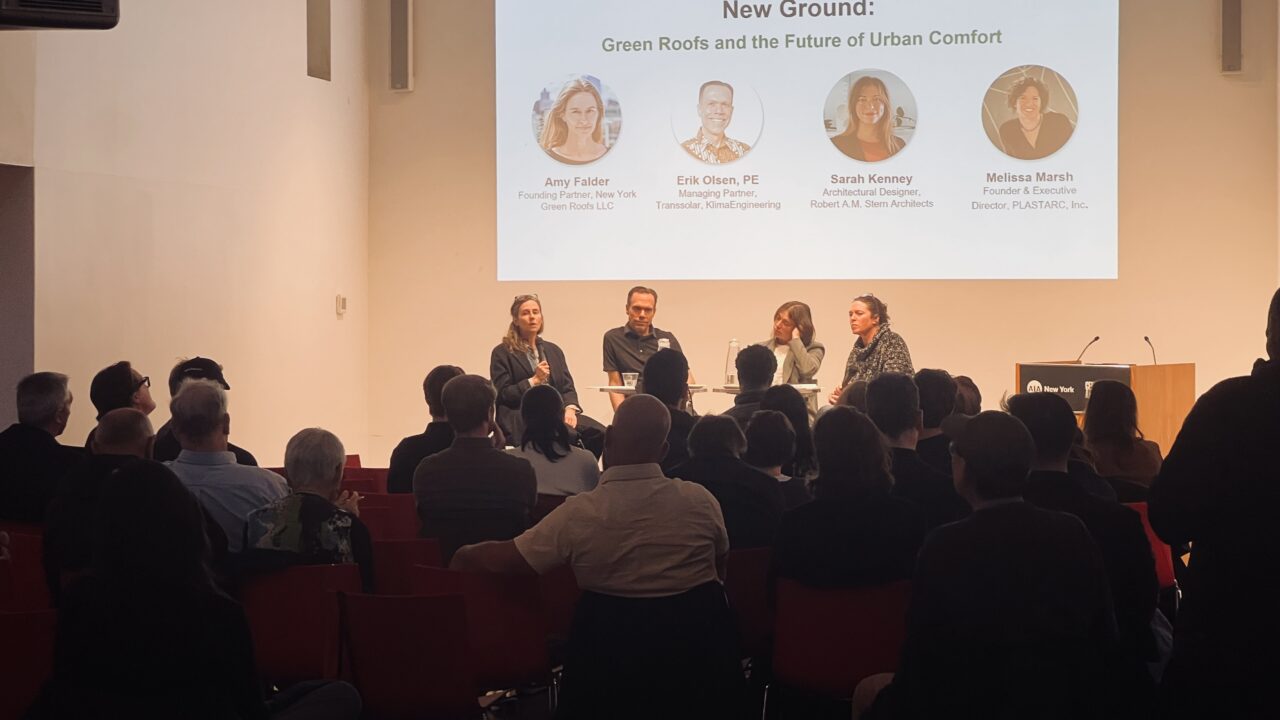
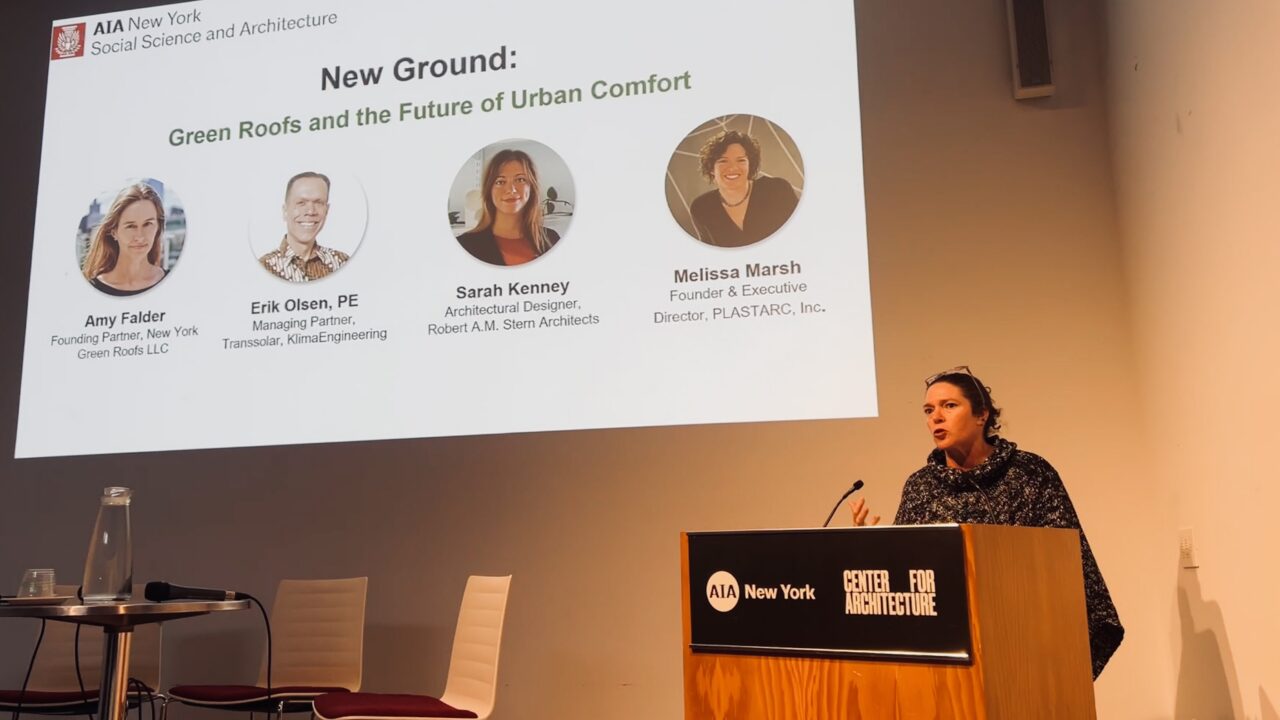
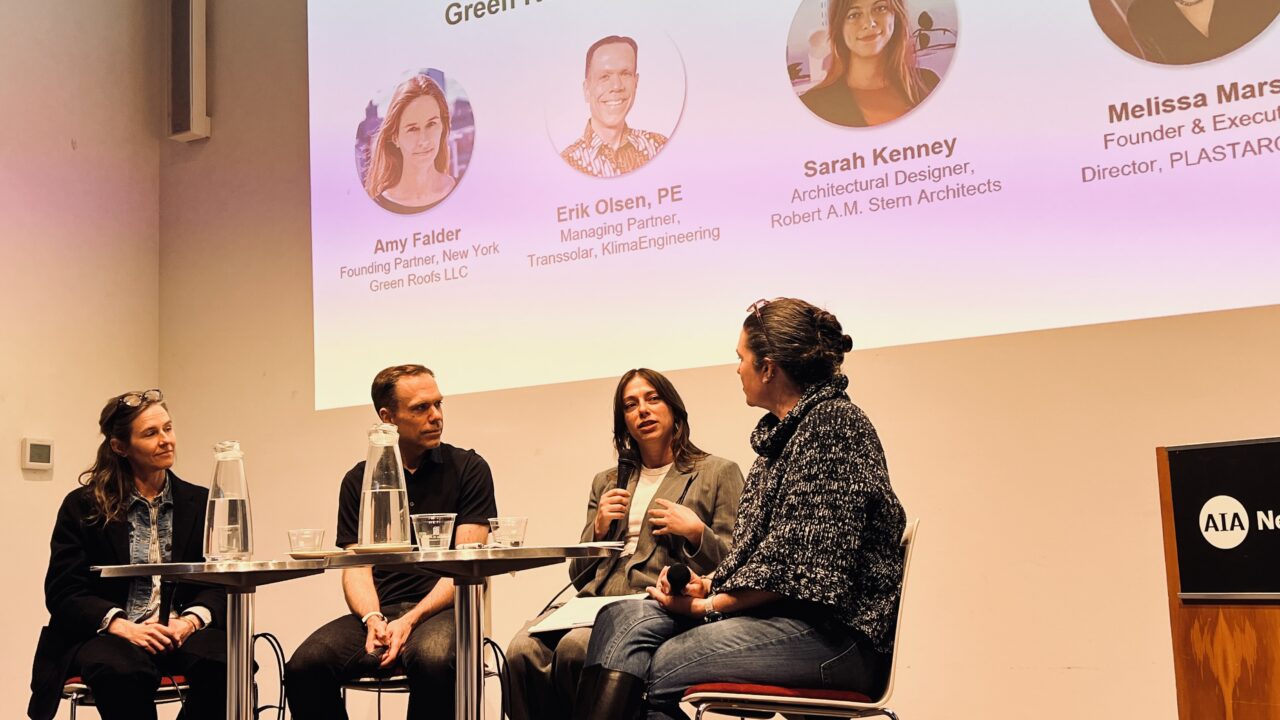
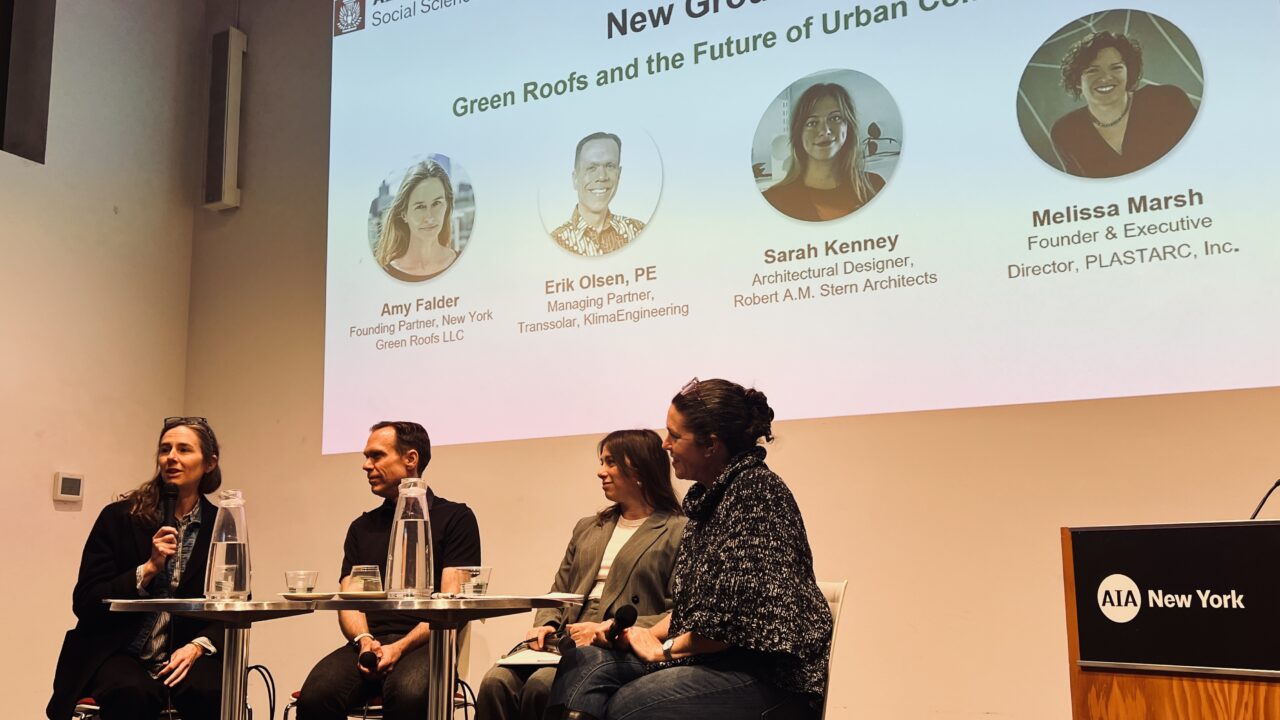
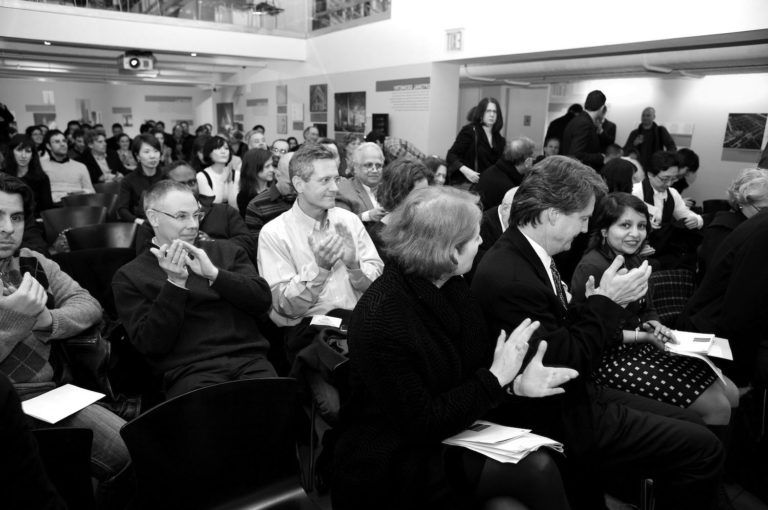
On the eve of Earth Day 2026, a crowd filled the Center for Architecture to talk about something most New Yorkers never see: the roofs above their heads.
The event, “New Ground: Green Roofs and the Future of Urban Comfort,” organized by the AIANY Social Science and Architecture Committee, asked a deceptively simple question: What could our rooftops be doing for us that they aren’t doing now?
Opening the evening, committee co-chair Nadine Berger framed the stakes in human, not technical, terms.
“Urban comfort is not really a luxury… It’s actually a condition for participation.”
Linking the topic to AIA New York’s 2026 presidential theme by Mark Gardiner, “Repair: Democracy and Urban Space,” Berger suggested that green roofs can help repair our relationships to the climate, the city, and one another. Too often treated as technical add-ons or visual perks, they also raise questions about access, equity, and public health.
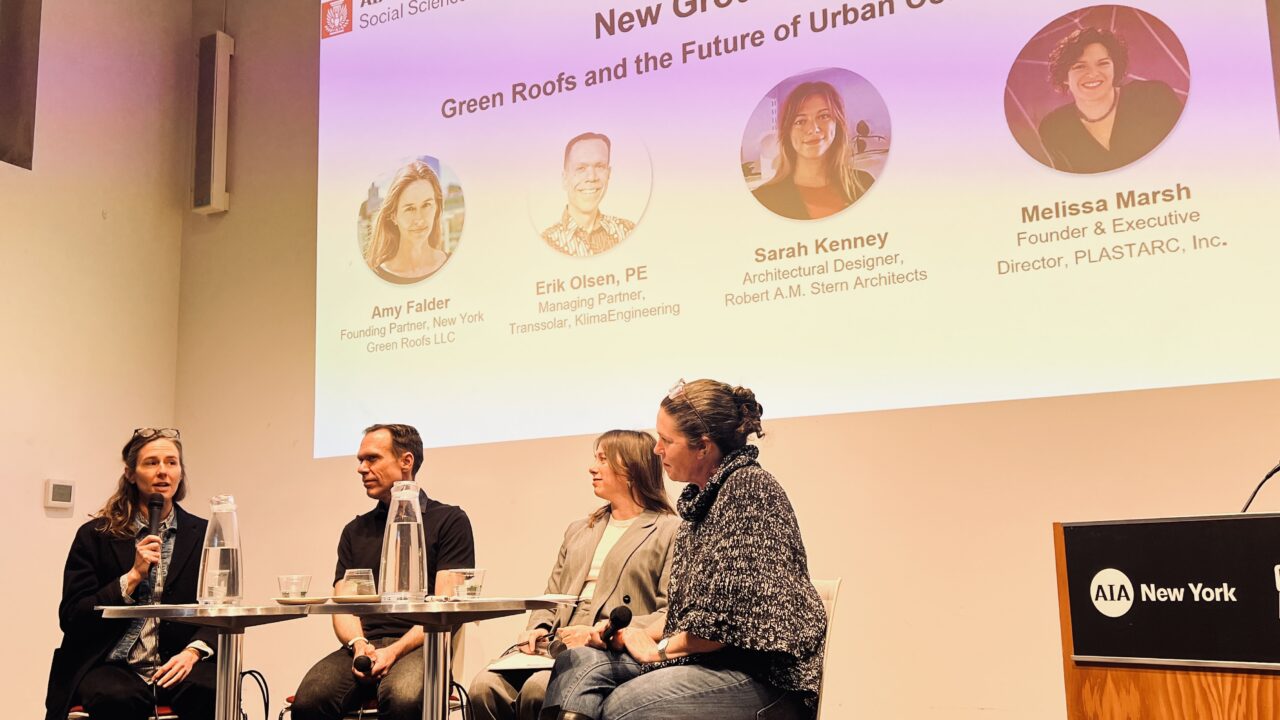
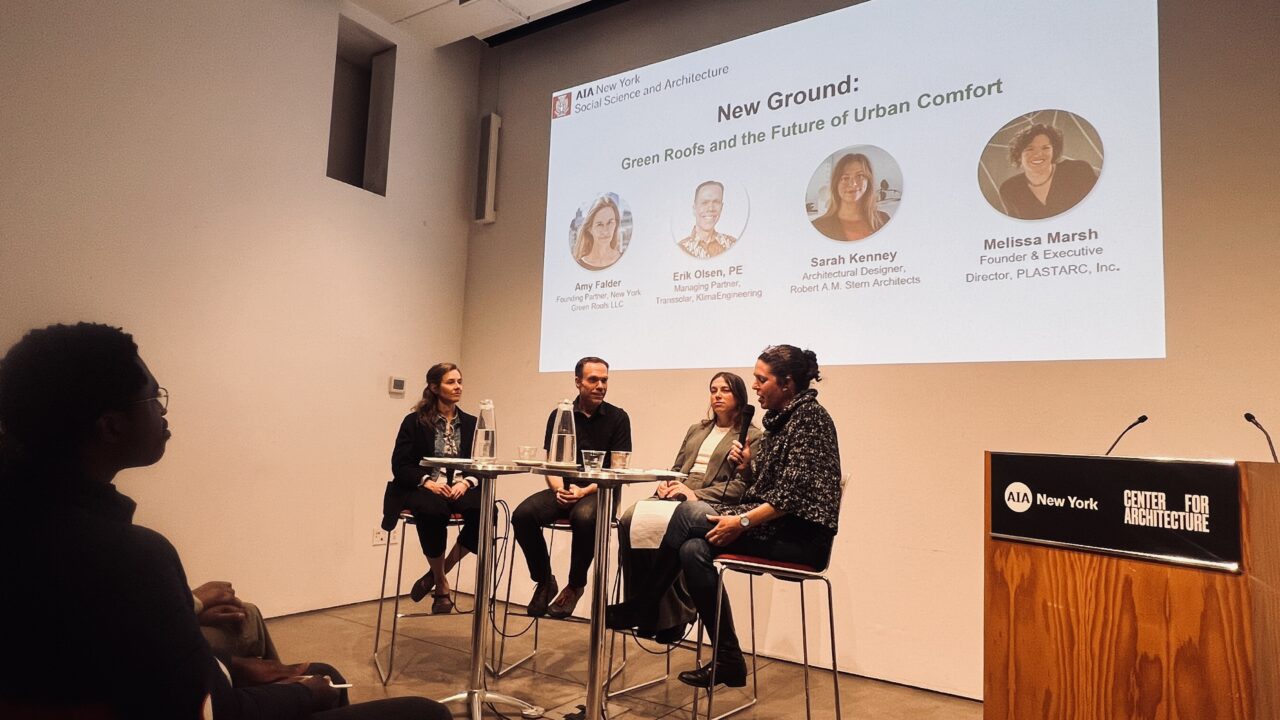
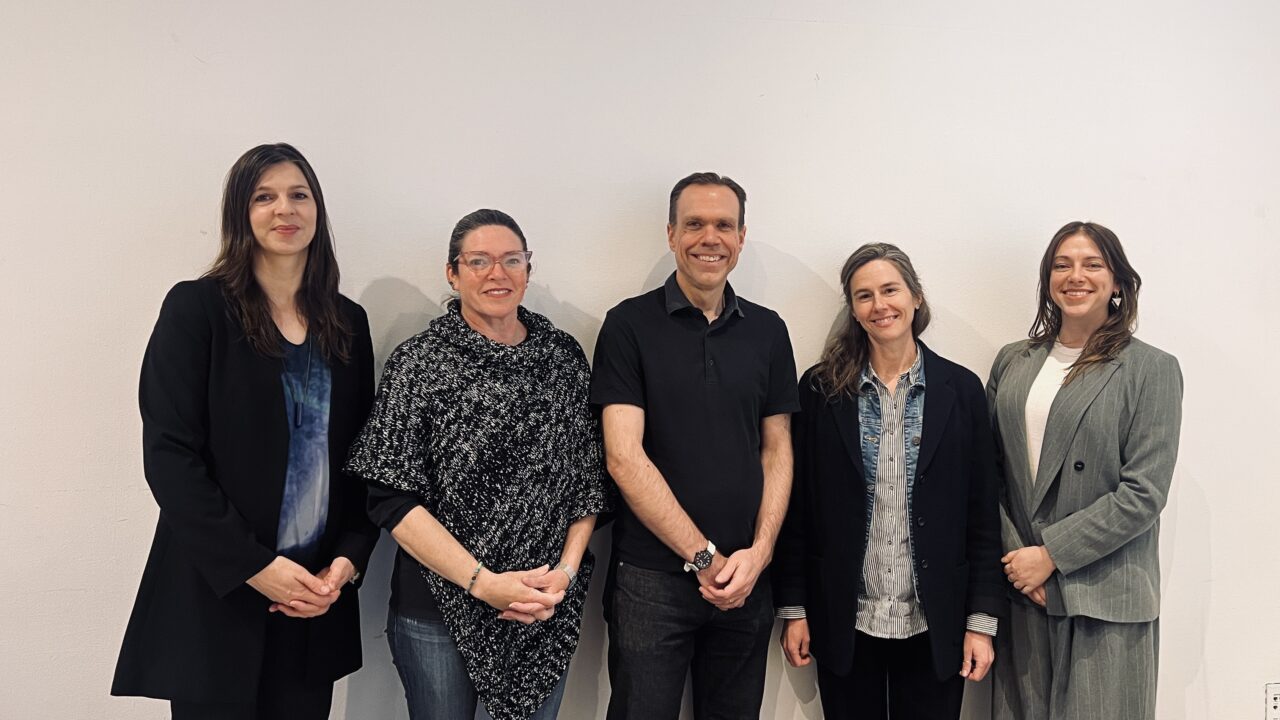
Moderated by Melissa Marsh (PLASTARC), the panel brought three lenses to that idea:
- Practice & implementation – Amy Falder, founder of New York Green Roofs
- Climate engineering & comfort science – Erik Olsen, managing partner at Transsolar
- Research & policy – Sarah Kenny, architect and landscape architect studying NYC school green roofs
Together, they made the case for treating the roof as civic ground.
From Token Green to Social Infrastructure
With more than a decade of rooftop work behind her, Amy Falder described green roofs as spaces that perform financially, ecologically, and socially. They extend roof membrane life, reduce cooling loads, and improve solar panel efficiency. They absorb stormwater and cool overheated surfaces. And they give people access to nature in a city where ground-level open space is limited.
“Human performance metrics—this one is often undervalued. Access to green spaces changes how people feel, focus, and function.”
Her projects range from the nearly 7-acre Javits Center roof, which has helped cut the building’s energy use by 26%, to school and residential roofs that double as classrooms, playgrounds, and quiet thresholds between city and home.
“These roofs can be expensive,” she acknowledged, “but they’re also social infrastructure.” Falder warned against ‘postage-stamp compliance’—tiny green rectangles drawn on otherwise bare roofs to meet the letter, but not the spirit, of NYC Local Laws 92 and 94. “If you have a 2000 square foot roof but the green roof is only 300 square feet,” she asked, “why bother?”
Shade, Heat, and Who Gets to Cool Off
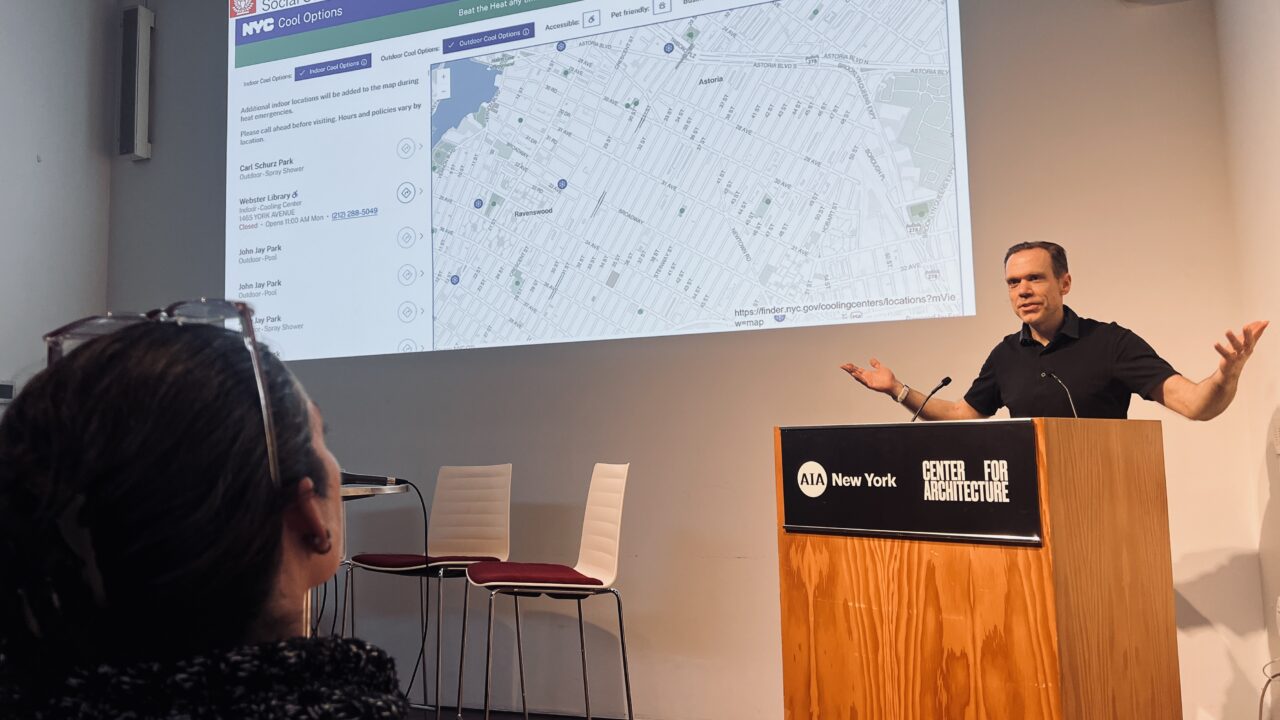
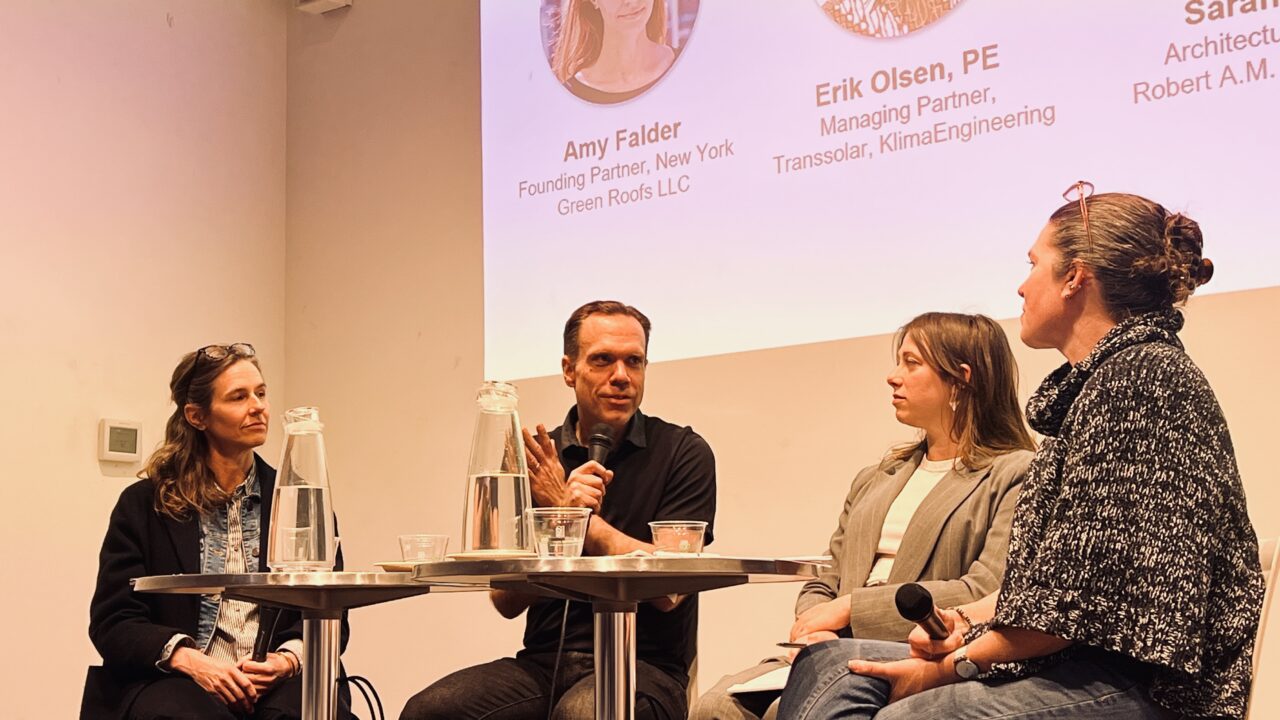
Erik Olsen shifted the focus from citywide averages to personal experience. As New York heats up, he argued, the question becomes: Where do you go to escape the heat? In practice, people seek shade first. Yet, he noted, many municipal heat campaigns show people in full sun, often spraying themselves with water!
He sees rooftops as a largely untapped network of refuges, especially in heat‑vulnerable neighborhoods. But access is uneven. Describing a lush rooftop at a luxury hotel abroad, he asked pointedly:
“How do we make an urban retreat less of a luxury, and more of a human right?”
Olsen outlined the physics of outdoor comfort—solar radiation, surface temperatures, humidity, air movement—and showed how green roofs can cool the “fifth façade.” Vegetated surfaces stay close to air temperature, while dark membranes can be dramatically hotter, and white ones can offer unbearable glare.
Counting What’s Missing
For Sarah Kenny, the missing piece is often simply that roofs aren’t being built green at all—especially in schools, which could arguably be benefiting the most.
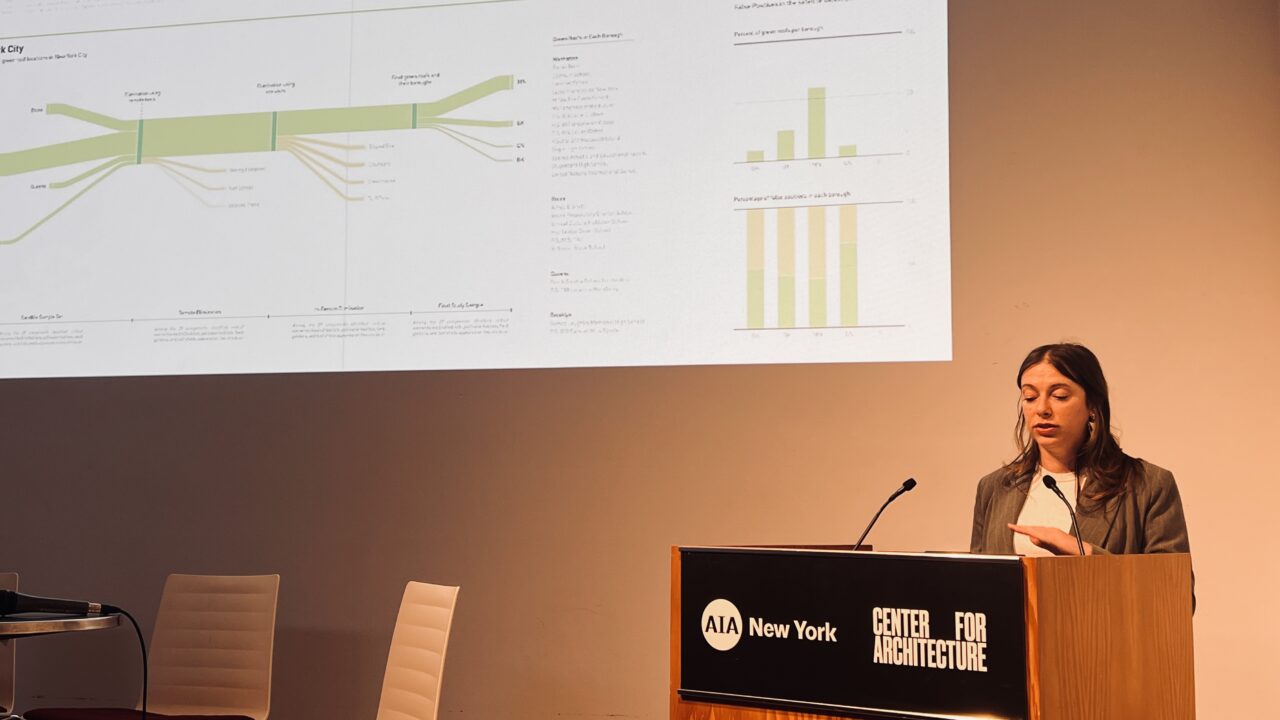
Her research team used satellite imagery, site visits, and interviews to answer a basic question: How many NYC public schools have green roofs? The verified answer: 24. They then mapped five recurring intentions for usage— agricultural, educational, ecological, infrastructural, and recreational—and found that while education is the dominant stated goal, ecological and infrastructural benefits emerge almost inevitably whenever a roof is thoughtfully designed.
“Whatever your primary design intention, meaningful infrastructural and ecological impact appear inevitable.”
Kenny’s team cataloged 27 common components—orchards, pollinator gardens, weather stations—that form a kind of kit-of-parts for high-impact school roofs. She also showed how small tweaks to tax abatement language could double the number of qualifying roofs without changing performance requirements.
Urban Greenscapes as Civic and Cognitive Infrastructure
Guiding the discussion, Melissa Marsh repeatedly brought the conversation back to people and metrics: how these spaces affect learning outcomes, cognitive performance, stress, and social connection—and how those “soft” outcomes can and should be measured alongside energy and stormwater. Drawing on her work at PLASTARC, she positioned green roofs not just as climate devices, but as human capital infrastructure that can support attention, well-being, and belonging.
By night’s end, one idea had crystallized: if New York is serious about climate resilience and democratic public space, the roof can no longer be treated as leftover real estate. It is essential infrastructure—and shared civic ground.
-
January 20, 2026
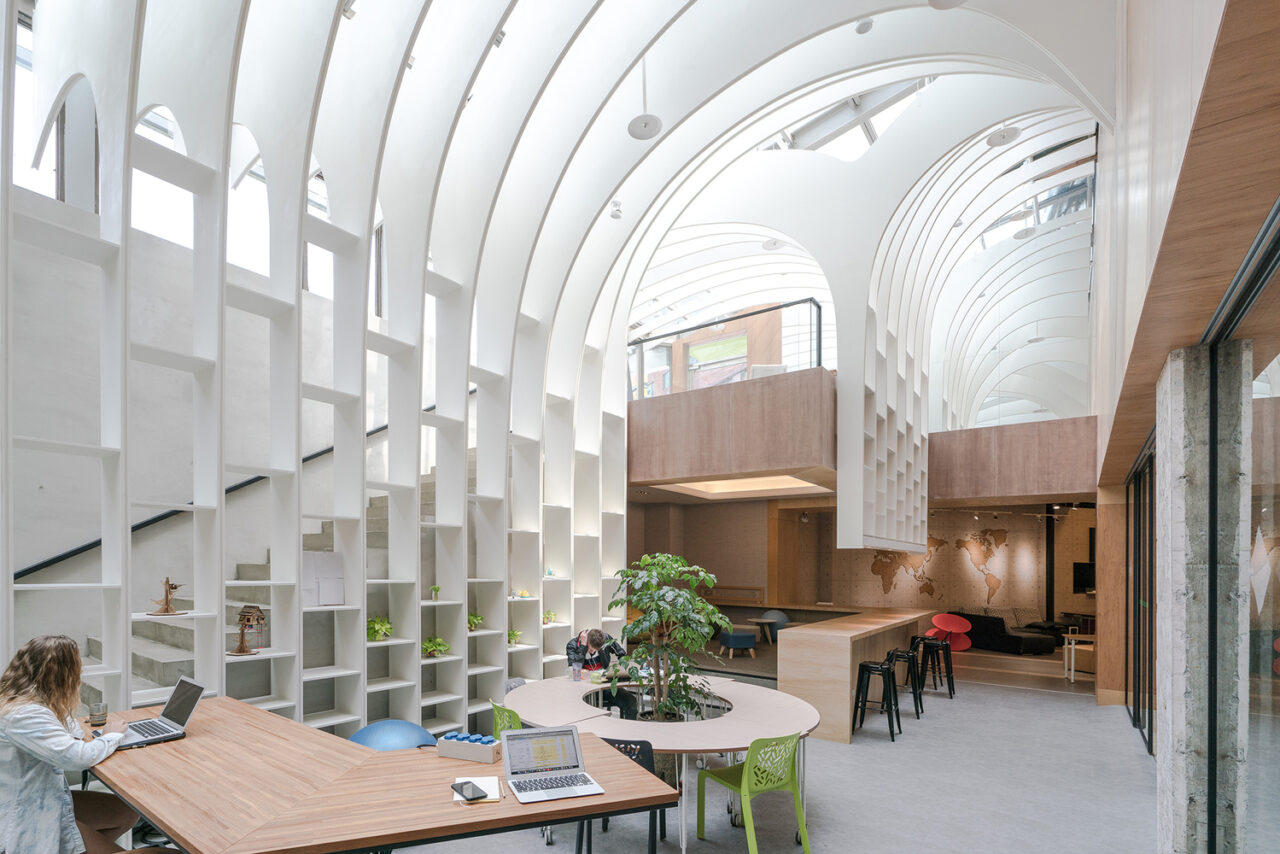
![Rain of Light by Yuan Architects. Photo: Max Lee.]() Rain of Light by Yuan Architects. Photo: Max Lee.
Rain of Light by Yuan Architects. Photo: Max Lee.by Aashna Bajaj
The second installment of the three-part series, “What Design Can Do: Bridging Human Experience, Neuroscience, and Architecture,” took place at the Center for Architecture on July 16, 2025. This series explores how design can integrate insights from neuroscience and architecture to advance evidence-based, human-centered design that supports well-being.
After the first event introduced foundational principles and case studies, a panel discussion, moderated by Margaret O’Donoghue Castillo—Chief Architect of the New York City Department of Design and Construction—focused on the ways that neuroscience can be used to elevate human experience in architecture. Three panelists—architect Suchi Reddy, lighting researcher Dr. Mariana Figueiro, and Milton Shinberg, an architect and educator—emphasized the urgency behind shaping the next frontier of ethical, evidence-based design.
Castillo introduced Active Design 2.0, a soon-to-be-launched revision of the city’s 2010 Active Design guidelines that expands the category of “health in design” to include physical activity and emotional well-being. A 14-year life-expectancy gap across New York’s neighborhoods offered a clear reflection of how inequality is embedded in our built environments, and how more holistic design can be used to improve lives.
Castillo illustrated this through DDC’s collaboration with the Department of Health and Hygiene, where community partnership emerged as a foundational design principle. She also revived the intent behind Bloomberg’s Plan NYC, emphasizing how proximity to inviting public spaces can measurably strengthen social connectedness. She pointed to the Far Rockaway Library as a project that puts this idea into practice.
With this opening, the audience was challenged to consider a paradigm-shifting question: What would happen if every design decision prioritized measurable mental health outcomes as highly as energy savings or carbon use?
Architect Suchi Reddy, founder of Reddymade, an NYC-based architecture, design, and public art studio, illustrated this fusion of art and neuroscience by presenting her collaborative projects with clients like Google and Johns Hopkins. In her experiment, A Space for Being, visitors moved through three sensory environments while biometric sensors measured heart rate, skin temperature, and conductivity. The results showed how spaces literally shape our nervous system. Another insight came from Reddy’s prototypical hospital room for the Kennedy Krieger Institute in Baltimore, which revealed a striking relationship between environment and physiology: the caregiver’s stress directly amplified the child’s stress. Reddy’s provocation to the audience was simple but profound—if we know this, how do we design environments to actively reduce external stressors and prevent cortisol spikes?
Dr. Mariana Figueiro, a professor at Mount Sinai’s Light and Health Research Center, explored the nonvisual effects of light: its influence on circadian rhythms, cognition, mood, and immune regulation. She shared field studies linking daylight exposure in classrooms to delayed melatonin onset, sleep disruptions, and even increases in childhood myopia.
Architect and educator Milton Shinberg, author of People-Centered Architecture: Design, Practice, Education, revealed how neuroscience has reshaped his 45 years of practice and pedagogy. From designing schools to teaching sensory perception, Shinberg uses cognitive science to understand how form, acoustics, and texture influence attention and learning. His assertion that “architects are humanists who don’t know enough about humans” struck a collective chord.
Shinberg illustrated this through a school project in Washington, DC, showing how shifts in tone, spatial permeability, and the activation of surrounding urban space can strengthen community connectedness and encourage intuitive movement through the interiors.
He shared how he brings this lens into his teaching as well, including a course in which students designed for a blind music composer—an exercise that required them to rethink space through non-visual cues and sensory hierarchy.
Researchers like Vittoria Falchini at Foster + Partners are hoping to use the pillars of Neuroarchitecture to create an “architecture of empathy.” And as neuroscience continues to inspire creativity in architectural design, more spaces will be designed to calm cortisol levels, enhance memory, and foster empathy.
As this series advances, the charge is clear: design is not only about form and function, but about the nervous system, cognition, and community. The evening underscored a pragmatic path forward, in which neuroscience literacy is embedded in every step of the design process. By integrating human factors expertise into their designs, architects can confidently create spaces that uplift people’s physical and mental health. With neuroarchitecture as a central foundation, the environments we design should—and can—help people and communities thrive.
Watch the full event recording: What Design Can Do: Bridging Human Experience, Neuroscience, and Architecture – Center for Architecture, AIANY Social Science and Architecture Committee, July 16, 2025
About the Author
Aashna Bajaj is an Architectural Designer at AECOM NY, a Neuropsychology Researcher and a committee member. A Pratt Institute Grad, Aashna’s research focuses on how neuroscience and behavioral economics can strengthen the way we design and evaluate spaces – translating scientific insights into design frameworks with measurable advantage.
-
November 18, 2025
![Photo: Francis Wu]() Photo: Francis Wu
Photo: Francis WuAlan Chan, Associate at di Domenico + Partners, traced the evolution of the Chinatown Night Market at our October committee meeting. Chinatown Night Market is a grassroots activation launched in 2021 to reclaim Forsyth Plaza as a safe and welcoming gathering place during a moment of crisis. The market came out of the Van Alen Institute and Urban Design Forum Neighborhoods Now initiative, in collaboration with di Domenico + Partners, Think!Chinatown, and Asian Americans for Equality (AAFE). The initiative transformed the underused plaza into a vibrant cultural space using community-led, iterative design. Alan shared how partnering with local organizations lead to unstructured engagement with community members that shaped culturally relevant programming that was tailored specifically to Chinatown. Furthermore, each iteration of the market was informed by insights gained from observations and intercept surveys to improve crowd flow and better activate the existing plaza.
A major theme was capacity-building and advocacy. Alan and team created templates, workflows, and planning tools that enabled community partners to run the market independently, while collecting metrics to demonstrate its social and economic impact. The project illustrates how public-space activations can be both inclusive and adaptive, amplifying community voices and showing the city what infrastructure and support are needed. The Chinatown Night Market ultimately stands as a model for responsive, culturally grounded placemaking rooted in collaboration, observation, and continuous refinement.
Photographer: Francis Wu
-
November 2, 2025
![Image: Becoming rent ABLE]() Image: Becoming rent ABLE
Image: Becoming rent ABLEAt September’s Social Science and Architecture Committee meeting, Lorraine Woodward, Founder and CEO of Becoming rentABLE, spoke from her own experience as a person with a disability and as part of a family that has long dealt with the limits of accessibility. Her organization identifies and verifies accessible short-term rentals, setting clear criteria that help travelers find housing suited to different physical and neurodiverse needs. From this perspective she showed how thoughtful design enables freedom, independence and participation, and how its absence limits them. Drawing on stories from families she has met through her work, she showed how verified accessible rentals can be life-changing, restoring independence and freedom of movement. Her platform addresses a major gap in the short-term rental market: out of 1.5 million listings, only about 1,500 are accessible. Woodward explained that accessibility is not a fixed state but a range of needs covering mobility, vision, hearing, neurodiverse and age-related conditions that require adaptable design. She noted that many improvements can be made flexibly and at reasonable cost, tailored to individual properties, showing that inclusion creates measurable economic value. She pointed out that accessibility is becoming a significant growth field as demographic change increases demand for adaptable housing and travel options. Her talk invited the group to look beyond the limits of inaccessibility and to see the opportunities in inclusive design. She also offered to share material for future workshops to strengthen knowledge and practice in accessibility. Her work showed the committee how a hands-on and well-structured approach to accessibility can achieve tangible results at an impressive scale. We thank Lorraine Woodward for sharing her inspiring work and perspective with our committee.
-
September 23, 2025
![Image: Sarah Kenney]() Image: Sarah Kenney
Image: Sarah KenneyAt our August meeting, we were pleased to feature Committee member Sarah Kenney, designer and researcher, whose work investigates the global cut-flower industry through an architectural lens. She holds master’s degrees in both architecture and landscape architecture and has presented her research internationally and published on the topic, showing how architectural analysis can reveal hidden social and political systems. Her talk, Conflict Bloom – Flowers Under Siege in Kenya’s Lake Naivasha Region, introduced the framework of Floritecture as an approach to examining the designed and controlled spaces of flower production. Informed in part by an early background in floristry, she brought a first-hand sensitivity to flowers as materials of design and labor. Drawing on her on-the-ground research in Naivasha, she showed how the lightweight construction of the greenhouses and the infrastructure of roads, power lines and water systems extend well beyond the farms into surrounding settlements. Houses have been built along these networks, making clear how production landscapes and material practices shape everyday life and exposing the contradictions of an industry where beauty and violence, empowerment and inequality coexist. Her presentation sparked an intensive discussion on the broader structures behind global trade, a theme that continues to engage the Committee. We thank Sarah for the unique insight she shared through her framework of Floritecture and her field research, which provided a distinctive perspective and illuminated how global supply chains shape social and material realities.
-
September 2, 2025
![Image: Busra Berber.]() Image: Busra Berber.
Image: Busra Berber.At our June meeting, we welcomed Busra Berber, architect and PhD researcher at The Bartlett, UCL. Her doctoral project, Sensory Experience in Human–Building Interaction, investigates how media architecture and digitally enhanced environments shape emotional and sensory experience. Using physiological data such as heart rate and skin temperature, she develops methods for quantifiable evidence of visitor responses, measuring and interpreting emotional effects in architectural settings. Positioned within the field of Human-Building Interaction, her work focuses on exhibitions and immersive installations, where she explores how visitors react to media-integrated spaces. While her research is grounded in these specific contexts, the findings open broader perspectives on designing sensory-driven and human-centered environments. The presentation sparked a lively exchange within the committee, with members reflecting on how these methods might inform practice and research in architecture more broadly. We thank Busra Berber for sharing her work and engaging with the committee in such an inspiring way.
-
June 20, 2025
![Image by: What Design Can Do]() Image by: What Design Can Do
Image by: What Design Can Do![Image by: AIA SS+A]() Image by: AIA SS+A
Image by: AIA SS+A![Image by: AIA SS+A]() Image by: AIA SS+A
Image by: AIA SS+A![Image by: AIA SS+A]() Image by: AIA SS+A
Image by: AIA SS+A![Image by: AIA SS+A]() Image by: AIA SS+A
Image by: AIA SS+A![Image by: AIA SS+A]() Image by: AIA SS+A
Image by: AIA SS+A![Image by: AIA SS+A]() Image by: AIA SS+A
Image by: AIA SS+AAIANY’s Social Science and Architecture Committee Launches “What Design Can Do” Film Series with Insightful Discussion
by Sarah Kenney
On April 1, 2025, the American Institute of Architects New York (AIANY) Center for Architecture hosted the first installment of its three-part series titled What Design Can Do. Organized by the AIANY Social Science and Architecture Committee, the event featured a screening of the short film What Design Can Do, created by architectural critic and scholar Sarah Williams Goldhagen and architect Sarah Robinson. The film highlights the powerful role of architecture and evidence-based design in promoting human health and wellbeing—emotionally, cognitively, and physically—through the lens of neuroaesthetics.
Nadine Berger, Global Associate and U.S. East Lead at iLAB | Buildings + Places and Sustainability Director for Urbanism, Advisory + Planning (UAP), opened the evening with introductory remarks. Berger framed the event as the beginning of a broader conversation about the ways in which design can serve as a tool for public health. With approximately 60 attendees—primarily architects, but also members of the general public—the hybrid event emphasized the growing public interest in the intersection of neuroscience, architecture, and wellness.
What Design Can Do urges viewers to see architecture not as a purely aesthetic endeavor but as a critical component of public health infrastructure. The film introduces the concept of neuroaesthetics—the study of how environmental aesthetics affect the brain—and presents examples of spaces that foster healing, learning, and community cohesion. The film also delves into biophilic design, showing how features such as natural light, greenery, and outdoor views can reduce anxiety, speed up healing, and lead to measurable cost savings in healthcare settings. As Goldhagen narrates in the film, “Design heals—when done well, it can remap the brain for better outcomes.”
The film Illustrated these ideas through multidisciplinary case studies, including the design of Maggie’s Cancer Centre, where the layout provides comfort and emotional reprieve through spatial arrangement. Other featured examples include a UK school study in which classrooms designed with neuroaesthetic principles reportedly increased student learning gains by an additional academic year over the traditional model. Urban and housing projects in New York City and London were also cited as successful models for how community-centered planning can create restorative, interactive environments in historically underserved areas.
Following the film screening, the discussion was moderated by Ian Wach, Design and Construction Project Manager at About the Work. The conversation focused on how the medium of film can be used to communicate spatial experiences that are often difficult to translate through words or static visuals. Wach invited Goldhagen to reflect on her process as a filmmaker, asking, “How do you communicate the impact of space when it’s so inherently experiential?” Goldhagen responded, “We didn’t want to make it about the architect. We wanted the buildings to become the characters in the film.” She emphasized the importance of visual storytelling in making research-driven design accessible to a wider audience.
The public Q&A session focused on two key themes: the need for greater collaboration between scientists and designers, and the role of building codes in scaling design interventions. Goldhagen expressed concern over the disconnect between academic research and architectural practice. “Architects can become the intermediaries between neuroscientists and built outcomes,” she said, urging the profession to more actively partner with researchers. She also proposed that building codes evolve to include biophilic and neuroaesthetic principles, ensuring that these beneficial strategies become standard practice rather than isolated innovations.
The evening concluded with a hopeful outlook: a call for more integrated design practices that prioritize the human experience from the start. “We need to reframe design not as luxury, but as essential to our mental and physical health,” Goldhagen noted.
Speaker Bios
Sarah Williams Goldhagen, Ph.D. is a former Harvard professor and a leading voice in neuroaesthetics and architectural criticism. She serves on the Executive Advisory Board of the International Arts + Mind Lab at Johns Hopkins School of Medicine and the boards of the Academy of Neuroscience for Architecture (ANFA) and the Centre for Conscious Design. Her book Welcome to Your World received the 2017 Nautilus Book Award for its contributions to social and environmental justice.
Ian Wach is a Design and Construction Project Manager at About the Work, where he leads initiatives focused on design equity and inclusive development. Wach has a background in architecture and project management, with experience bridging design and advocacy.
Upcoming Events
Join the AIANY Social Science and Architecture Committee for the second installment of What Design Can Do later this spring. These events are open to professionals and the public alike. Visit calendar.aiany.org for details and registration.
About the Author
Sarah Kenney is an architectural designer based in Manhattan. With a background in landscape and critical research, Sarah focuses on the intersections of design, research, and social equity.
-
April 30, 2025
![Image: Building Equity Standard]() Image: Building Equity Standard
Image: Building Equity StandardWe’re pleased to have welcomed Victoria Lanteigne, PhD, WELL AP, founder of the Building Equity Standard, to our latest committee meeting—a framework designed to embed equity throughout the design process. Victoria shared how the standard supports teams in translating equity goals into design outcomes through adaptable tools, community-driven guidelines, and measurable benchmarks. While its primary focus is on guiding the design process from the outset, the framework can also be used to assess completed projects. She shared powerful examples, including a school modernization in East Austin and the redesign of Harvey Milk Plaza in San Francisco—demonstrating how structured equity strategies can lead to more inclusive, accountable, and meaningful spaces. Victoria’s talk pushed us to reflect on how equity shows up in our work—and reminded us that making it real means making it intentional, every step of the way.
-
March 28, 2025
![Image: Ana Rolim]() Image: Ana Rolim
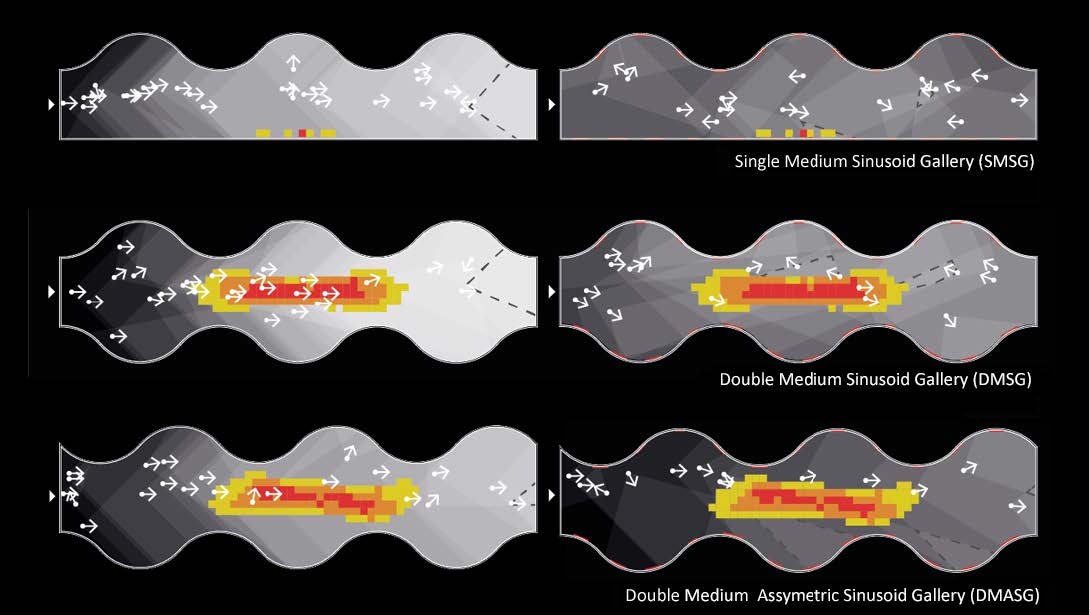
Image: Ana RolimAt our monthly committee meeting, Ana Rolim, PhD, shared her research on how museum layouts shape visitor behavior. By combining Space Syntax with cognitive neuroscience, Ana’s work revealed how spatial design affects movement, attention, and interaction within galleries. Through VR simulations and computational analysis, she provided valuable insights into how architectural design influences human experience. We’re grateful to Ana for offering such a thought-provoking session, inspiring us with new perspectives on the powerful connection between space and behavior, leaving us with much to consider and discuss moving forward.
-
February 28, 2025
![Humble Design]()
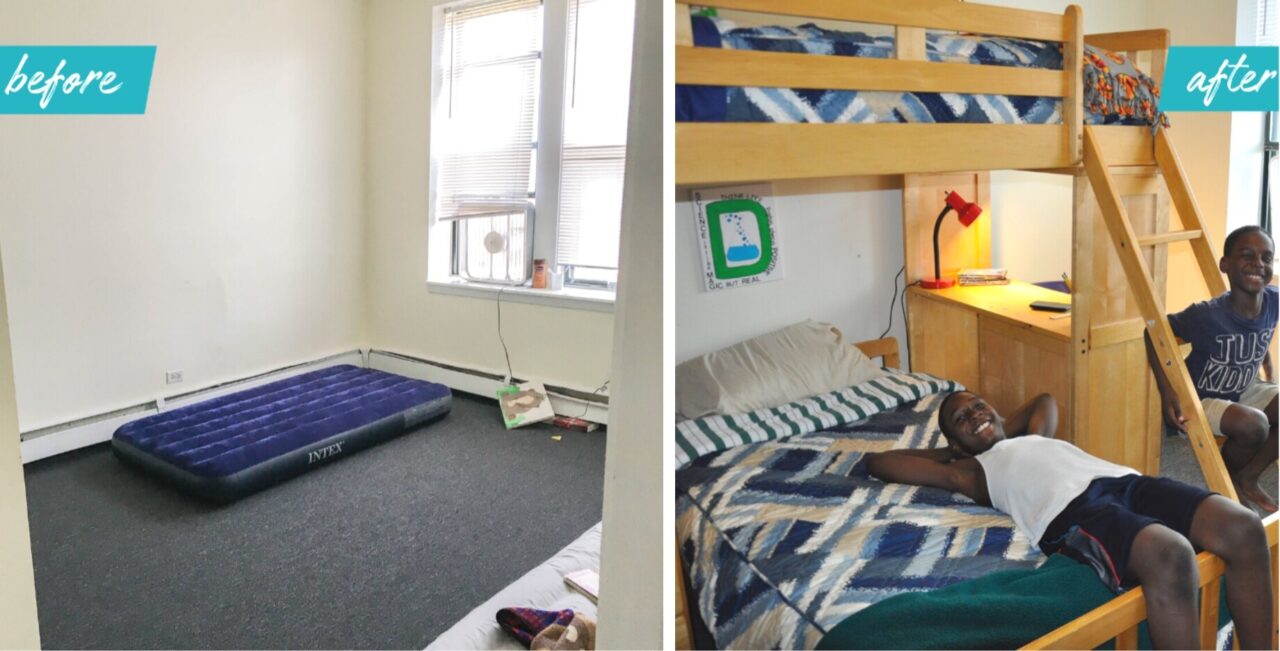
Today, at our Social Science and Architecture Committee meeting, we had the privilege of hearing from Michelle Marshall, NCIDQ of Humble Design. Humble Design goes beyond furnishing homes—they offer a holistic approach that includes not only designing and providing essential items but also mentorship, life skills coaching, and connections to community resources. This comprehensive support helps families transition out of homelessness and rebuild their lives with stability and dignity. A huge thank you to Michelle for sharing this inspiring work with us!
-
December 11, 2024
![AIA HH DALTILE SCHLUTER JPEG]()
Join us at our AIANY Cross-Committee Happy Hour, December 12, from 5:30–8:00 pm!
Daltile/Marazzi Studio, 49 East 21st Street. RSVP here.
-
October 2, 2024
![Image: PLASTARC]() Image: PLASTARC
Image: PLASTARCby Rebecca Lipsitch
In the wake of revelations about hidden labor abuses in certified industries, Melissa Marsh, founder and CEO of PLASTARC, moderated a crucial panel discussion on “Action and Impacts to Advance Equity.” This event marked the final installment of the three-part series “Forced Labor in Supply Chains,” which was inspired by the work of the Design for Freedom movement at Grace Farms aimed at eliminating forced labor in building material supply chains.
The three panelists brought together an assortment of diverse perspectives. Sara Grant an architect, planner, and partner at MBB Architects, is focused on creating equitable, healthy and sustainable environments. Billie Faircloth is the co-founder and research director of the Built Buildings Lab, which highlights the value of existing buildings in the public consciousness, global sustainability practice, and policymaking. Pins Brown is a seasoned expert in business and human rights with 25 years of global experience, focusing on improving working conditions across diverse industries, and is currently a freelance consultant on business and human rights and the Chair of the UK-based Food Network for Ethical Trade.
A key takeaway from the panel is the need to address forced labor throughout a building’s entire lifecycle. Just as environmental impact is assessed across the full supply chain, we must examine each stage—from material extraction to construction—to effectively combat forced labor in the building industry. Faircloth spoke about creating methods for designers to assess the risk or likelihood of forced labor in building materials manufacturing, and noted that a consistent challenge has been gaining a comprehensive view of the entire supply chain and creating measurement systems for each stage.
All three panelists emphasized the importance of taking action with available resources, despite complexity and uncertainty. Brown quoted tennis player Arthur Ashe : “Start where you are, use what you have, do what you can,” stressing the need for simplicity to drive action. Grant reinforced this, highlighting architects’ and designers’ ability to make decisions amid complexity and without knowing “everything,” likening it to a good design process. The panelists agreed that to create meaningful, timely change, one must act on current information and make informed estimates, rather than waiting for perfect knowledge. They highlighted the importance of bottom-up approaches.
Grant stressed the need for everyday actions like auditing pay scales, compensating interns, and regularly checking for equity. This ensures organizations address immediate issues, while also tackling larger problems.
Similarly, all panelists, particularly Grant, highlighted the value of building diverse teams that include members from the communities being studied. Brown reinforced this point, explaining that workers often hesitate to answer survey questions, especially when unsure about the questioner’s motives. She noted that outsiders inquiring about worker safety can seem intrusive or even put workers at risk. Therefore, it is critically important to hear directly from impacted communities, despite the challenges in conducting such field research ethically and safely. Including team members who can relate to vulnerable employees is crucial for effective social safeguarding and gathering authentic insights.
During the Q&A portion, an audience member asked about technologies and methods used for gathering sensitive information and community perspectives, without direct interaction. Brown pointed towards the benefits of apps that both train and survey employees at the same time, in order to decrease fear and increase trust early on. Marsh highlighted Sourcemap, a software that does just that, by comprehensive supply-chain mapping, enabling companies to gain visibility and trace and verify their entire supply chain, from raw materials to finished products. Sarah Williams, of MIT’s Civic Data Design Lab, combines her expertise in computation and design to develop communication strategies that expose urban policy issues for wide audiences and promote civic engagement.
The panelists’ acknowledged that this is a complex challenge. Faircloth highlighted the value of being wrong, viewing it as a sign of asking the right questions. Grant invoked the Zen proverb, “Chop wood, carry water,” stressing the importance of daily, consistent effort. This philosophy underscores the need for persistent action, regardless of political shifts.
About the Author:
Rebecca Lipsitch is a socio spatial intern at PLASTARC, entering her senior year of college at NYU Gallatin School of Individualized Study. She appreciates the alignment of qualitative and quantitative research, is fascinated by how human connection is impacted by the spaces we design and create, and hopes to create a more just and ethical society through design. -
September 24, 2024
![Image: PLASTARC]() Image: PLASTARC
Image: PLASTARC![Nina Cooke John | “Shadow of A Face,” Studio Cooke John, 2023 |Photo: Roxane Carré]() Nina Cooke John | “Shadow of A Face,” Studio Cooke John, 2023 | Photo: Roxane Carré
Nina Cooke John | “Shadow of A Face,” Studio Cooke John, 2023 | Photo: Roxane Carré![Diana Kellogg | “The GYAAN Center,” ‘Phase One: The Rajkumari Ratnavati Girls School,’ 2021]() Diana Kellogg | “The GYAAN Center,” ‘Phase One: The Rajkumari Ratnavati Girls School,’ 2021
Diana Kellogg | “The GYAAN Center,” ‘Phase One: The Rajkumari Ratnavati Girls School,’ 2021![Panel discussion: Nadine Berger, Nina Cooke John, Diana Kellogg |Photo: Roxane Carré]() Panel discussion: Nadine Berger, Nina Cooke John, Diana Kellogg | Photo: Roxane Carré
Panel discussion: Nadine Berger, Nina Cooke John, Diana Kellogg | Photo: Roxane Carréby Roxane Carré
Kicked off by Evie Klein, Assoc. AIA,—architect, planner, and environmental psychologist as well as founder of the AIANY Social Science and Architecture Committee—the “Forced Labor in Supply Chains: Examples of a Humanely Built Environment” panel was the second of a three-part series. Led by Sharon Prince, CEO and founder of the Grace Farms Foundation, which intersects nature, arts, justice, community, and faith, the Design for Freedom movement began in 2020: it stands as a “radical paradigm shift to eradicate forced labor in building materials’ supply chain, as demonstrated in its toolkit. Through the kit, architectural studios and firms at any scale can learn more about where their materials come from, who produces them, and how to do away with involuntary work.
This panel spotlighted humanely-built projects by architects Nina Cooke John, AIA, founding principal at Studio Cooke John Architecture and Design, and Diana Kellogg, founding principal at Diana Kellogg Architects. Specifically, it presented concrete ways in which to actualize architects and urban designers’ “moral and ethical responsibility to end forced labor” – per moderator Nadine Berger, architect and sustainability manager at AECOM iLab and SS+A Committee co-chair.
For example, Studio Cooke John’s “Shadow of A Face” (March 2023) in Newark, New Jersey, representing social activist Harriet Tubman, exemplifies humanely-built design. The monument also embodies Studio Cooke John’s mission to transform relationships between people and the built environment, through a multidisciplinary approach and inclusive placemaking. Lastly, the project’s humane construction reflects its role as a physical emblem for Civil Rights and Women’s Rights, characterized by Harriet Tubman—lead social activist in the movements—and replacing a Christopher Columbus statue.
Additionally, Diana Kellogg’s non-profit GYAAN Center in India—a multi-structure campus and women’s community space —represents humanely-built architecture. More than simply using responsibly-sourced materials, the project serves a greater purpose: its first phase, the Rajkumari Ratnavati Girls School (2021) “serves hundreds of local girls below the poverty line in the region” with “tools to further their education and independence.” The project also raises awareness about gender equality in India.
Looking back, Kellogg states that collaborating with Grace Farms and, specifically, with its Design for Freedom toolkit, changed her approach to architectural projects. Indeed, Kellogg now states two non-negotiables in future works: (1) a social giveback and (2) adherence to the Design for Freedom principles.
Echoing Kellogg, Cooke John stressed how important being part of the radical paradigm shift towards humanely-built environments is. In particular, Cooke John pinpointed how conversations with fabricators, instead of just contractors, is crucial for humane building. Personally, Cooke John noted that her (“small”) design firm approached the Design for Freedom principles through a material-tracking spreadsheet. Cooke John explained how working with Grace Farm representatives and with the toolkit had made material tracking more manageable; as a tip to other practitioners, Cooke John mentioned that collaborating with a LEED consultant helps ensure a smooth process. Further, Kellogg advised young architects and current practitioners to start their projects with the Design for Freedom principles, sharing how material selection, or constraints, boosts creativity.
Lastly, to guarantee humane building, both Kellogg and Cooke John reported having been especially mindful of including local culture and residents throughout the design process. Indeed, Studio Cooke John’s “Shadow of A Face” (2023) is part of a larger initiative to include communities in urban design processes and in a city’s socio-cultural fabric; Cooke John spotlighted the initiative, “Will You Be My Monument” which intends to “celebrate Black girls” and ask “What stories should be told in public spaces?” To this end, Cooke John shared how Newark residents had been invited to inscribe their own stories onto the Harriet Tubman monument for representation and collective memory.
Moreover, according to Cooke John, the Harriet Tubman monument has become more than architecture: in enabling local residents to “recognize[] their own stories in front of Harriet Tubman’s historical legacy,” the structure transformed into “a place of collective memory across space and time.” Adding to the monument’s significance in the public realm, Cooke John shared how “Shadow of A Face” (2023) has become “a place for community, performance, and occasional protest” instead of being just a park in which people walked through. Cooke John ended by underlining the importance of community engagement inside architectural and planning processes within urban areas to enable “feelings of ownership” from communities and residents. On this, Cooke John stated that “the city landscape… becomes activated only once the community activates it.”
As another perspective on humanely-built architecture, Kellogg shared wanting the GYAAN Center to be a home for young Indian girls living under the poverty line to pursue their education and independence. Precisely, the Center was to be a refuge where the girls could feel “safe, comfortable, nurtured, and free” (Kellogg, 2024). To ensure the project respected cultural norms and values, or pushed against them to support the DforF movement as well as benefit the girls (i.e. eradicating forced labor, including youth work), Kellogg’s team included local Indian women. Notably, Kellogg shared that during interviews the girls attending the Rajkumari Ratnavati Girls School reported “(…) f[eeling] safe there.” Since then, attendance has broken records for local schooling: a testament to the school’s purpose, need, and success as a learning haven.
To continue moving toward sustainable practice and social equity, organizations and practitioners in architecture need to examine their supply chain, reflect on material sourcing, and adhere to humane design principles all-around—Grace Farms’ Design for Freedom toolkit, easily accessible for download at the link, is a great place to start.
If you are interested in continuing or joining the conversation, please see below for the other events in the three-part series and information on joining the SS+A committee:
- Forced Labor in Supply Chains: Taking Action (the 3rd event of the series) [July 8th, 2024]
- Join the monthly Design for Freedom Office Hours. These calls are open to the public and happen on the first Thursday of each month at 12:00pm ET.
- Join the monthly AIANY Social Science + Architecture Committee committee meetings. They are open to the public and typically take place from 8:30 am–10:00 am ET on the fourth Friday of each month.
About the Author:
Roxane Carré is an independent researcher, freelance creative, and interdisciplinary strategist. Roxane is a recent graduate in sociology, economics, and psychology from Barnard College of Columbia University and holds certifications in urban planning & design from the Harvard Graduate School of Design and sustainable & strategic design from IE University, Madrid, Spain. At AIANY | Center for Architecture, Roxane is a member of the Social Science and Architecture Committee and acts as a liaison between the Interiors, Committee on the Environment (COTE), and Future of Practice committees, easing communications and event planning. Next, Roxane will be pursuing graduate studies in urban design, overseas. -
April 5, 2024
Please join us for the AIANY Social Science and Architecture Committee’s Spring Happy Hour, to be hosted at Savant’s beautiful experience center in SoHo!
Whether you’re a member, a friend, or just curious about what we do, we’d love to see you there.
Please RSVP by April 9 if you think you’ll be able to attend (not required, just to give us an idea about numbers!), and feel free to forward this message or bring along friends who might be interested too! The more, the merrier.We look forward to seeing you there!
Cheers,AIANY SS+A -
February 12, 2024
![Confronting Modern Slavery in Construction Supply Chains Image 01]()
![Confronting Modern Slavery in Construction Supply Chains Image 02]()
By Ian Wach
How is modern slavery embedded in the built environment? More than 12 common building materials—including timber, copper, silicone, and PVC—are at risk for forced labor in their supply chains.
Bringing awareness to this issue and highlighting potential solutions was the purpose of the Social Science and Architecture Committee’s event Forced Labor and Supply Chains: Its Prevalence and the Design for Freedom Movement, which took place at the Center for Architecture on December 12, 2023. This was the first event in a series of panels and workshops designed to invite stakeholders in the building industry to think about ways to reduce the ethical footprint of our buildings by working to eliminate forced labor.
This series kicked off showcasing the work of Design for Freedom, a movement to create a radical paradigm shift and remove forced labor from the built environment. Design for Freedom emerged from the Grace Farms Foundation, whose mission is to end modern slavery and foster more grace and peace in our local and global community. Sharon Prince, CEO and Founder of the Grace Farms Foundation, initiated Design for Freedom following a series of conversations around ethical sourcing, after realizing that designers often do not know where the materials used to construct their designs come from and under what conditions workers produced them.
Today, Design for Freedom engages with a broad spectrum of professionals and students to address the problem of modern slavery in the built environment. This entails architects, engineers, owners, construction teams, suppliers, and academics in order to extend the conversation to the entire building ecosystem.
In light of these roots and to kick off this series, Social Science and Architecture Committee member Nadine Berger (Sustainability Senior Manager at AECOM) introduced the speaker, Brigid Abraham (Design for Freedom Project Manager at Grace Farms). Abraham brings experience in architecture and information science, as well as a passion for architectural research, to furthering the goal of Design for Freedom.
Abraham discussed that modern slavery is defined as situations of exploitation that persons cannot refuse or leave because of threats of violence, coercion, deception, or abuse. According to the 2023 Global Slavery Index by Walk Free, an international human rights group working to end slavery, there are 50 million people living in modern slavery. Forced labor, which Abraham described as a subset of modern slavery, can be identified by factors including “restrictions on workers’ freedom of movement, withholding of wages or identity documents, physical or sexual violence, threats and intimidation or fraudulent debt from which workers cannot escape,” according to the International Labor Organization. There are an estimated 28 million people living in forced labor.
Abraham continued by stating that construction is the second most at-risk sector for forced labor, following manufacturing. This includes site work, as well as the procurement of the various raw and composite materials used in construction. Material procurement, which accounts for about 45% of construction expenditures, is obfuscated through a complex network of subcontractors, manufacturers, and raw materials producers. Construction lags behind other sectors, such as agriculture and clothing manufacturing, in terms of awareness of issues of forced labor and working conditions in the supply chain.
Moreover, Abraham posited that forced labor in construction also intersects with the decarbonization movement. For example, the Global Slavery Index identified solar panels as one of the five most valuable high-risk products for forced labor. To ensure we are on a path towards ethical decarbonization, the Design for Freedom lens asks us to identify and eliminate exploitative labor practices, as well as ecologically harmful processes, in raw material extraction, manufacturing, and construction.
Given the complexity and scale of the issue, Abraham listed a series of avenues being pursued by Design for Freedom and others, including:
- Embedding standards in existing codes of conduct and industry certifications: Design for Freedom worked with the AIA on the Social Health and Equity section of the AIA Materials Pledge. Design for Freedom is also in conversations with the U.S. Green Building Council, Health Product Declaration Collaborative, and WELL.
- Technology for Supply Chain Mapping: Companies are providing novel approaches to understanding and identifying potential issues in the supply chain. Altana AI is developing tools for companies and customers to understand their supply chains. Fair Supply provides ESG compliance assessment tools that help identify supply chain risks for forced labor.
- Laws and Regulations: The German Supply Chain Act in 2023 suggests the potential for additional regulation in the EU. In the U.S., the Uyghur Forced Labor Prevention Act created a framework for the Customs and Border Protection to impound and reject products and materials made with forced labor originating from the Xinjiang Uyghur Autonomous Region.
- Dialog with Manufacturers: In November 2023, Design for Freedom held an Ethical Supply Chain Forum to bring the manufacturing community into the conversation. Manufacturers can be hesitant to pull out of certain regions and economies. It is important to note that this is not the intent of Design for Freedom. An ideal next step for manufacturers is to seek remediation in their supply chains by ensuring freedom of movement and adjusted living wages.
- Pilot Projects: Design for Freedom’s pilot program currently includes 8 projects located in the U.S., the UK, and India. For each pilot, Design for Freedom acted as a collaborator advising on ethical and transparent materials procurement. The new round of pilots for 2024 will be announced at the 3rd Annual Design for Freedom Summit.
Additionally, Design for Freedom has created a series of resources to help spread awareness of the issue of modern slavery in the built environment. Their resources page contains a list of reports and statistics. Furthermore, the Design for Freedom Toolkit provides a deep dive on the 12 at-risk building materials and points to strategies for design and construction professionals to mitigate their use of materials created with forced labor.
If you are interested in continuing or joining the conversation, please see below for a list of upcoming events:
- March 11, 2024 – Forced Labor in Supply Chains: Examples of a Humanely Built Environment (the second event of this series)
- March 26, 2024 – 3rd Annual Design for Freedom Summit
- Join the monthly Design for Freedom Office Hours. These calls are open to the public and happen on the first Thursday of each month at 12:00pm ET.
- Join the monthly AIANY Social Science + Architecture Committee committee meetings. They are open to the public and typically take place from 8:30 am–10:00 am ET on the fourth Friday of each month.
About the Author:
Ian Wach is a researcher and strategist with a background in real estate and architecture. He is a member of the Social Science and Architecture Committee and works as a Senior Consultant at Buro Happold.
-
October 16, 2023
![Toward an Architectural Education with an Awareness of Advocacy Event Photo 02]()
![Photo: Kuan-Ju Chen]() Photo: Kuan-Ju Chen
Photo: Kuan-Ju ChenArchitecture is a potent instrument for addressing societal, cultural, and environmental challenges. As practitioners, we can leverage design to tackle issues like climate change, inequality, and urbanization, crafting solutions that empower and uplift – and architects will need to do even more of this in the future.
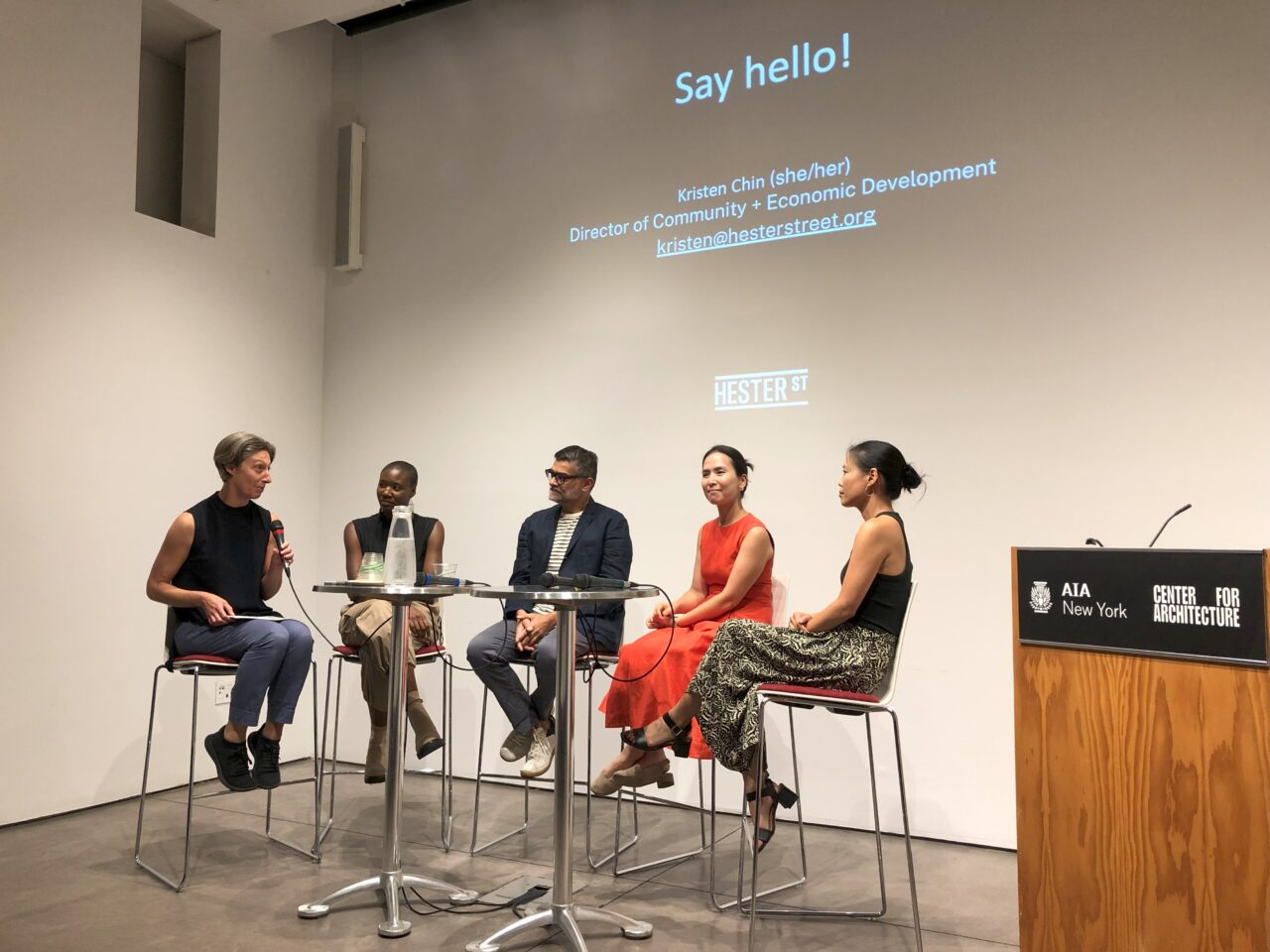
On September 15, 2023, the Social Science and Architecture Committee hosted a panel titled Toward an Architectural Education with an Awareness of Advocacy. This gathering brought together architects, educators, and students to explore the pivotal role of advocacy in architectural education. Their insights shed light on the challenges faced by architectural education and the innovative approaches required to address them.
Committee member Sara Grant (Partner, MBB Architects) moderated, and our panelists were:
- Kelsey Jackson, M. Arch Candidate at Columbia GSAPP; Junior Designer, FXCollaborative
- Jieun Yang, Founding Principal, Habitat Workshop; Assistant Professor, CUNY New York City College of Technology; Leadership Group, Design Advocates
- Sanjive Vaidya, Chair of the Department of Architectural Technology, CUNY New York City College of Technology; Board of Directors, The Architectural League of New York
- Kristen Chin, Director of Community and Economic Development, Hester Street
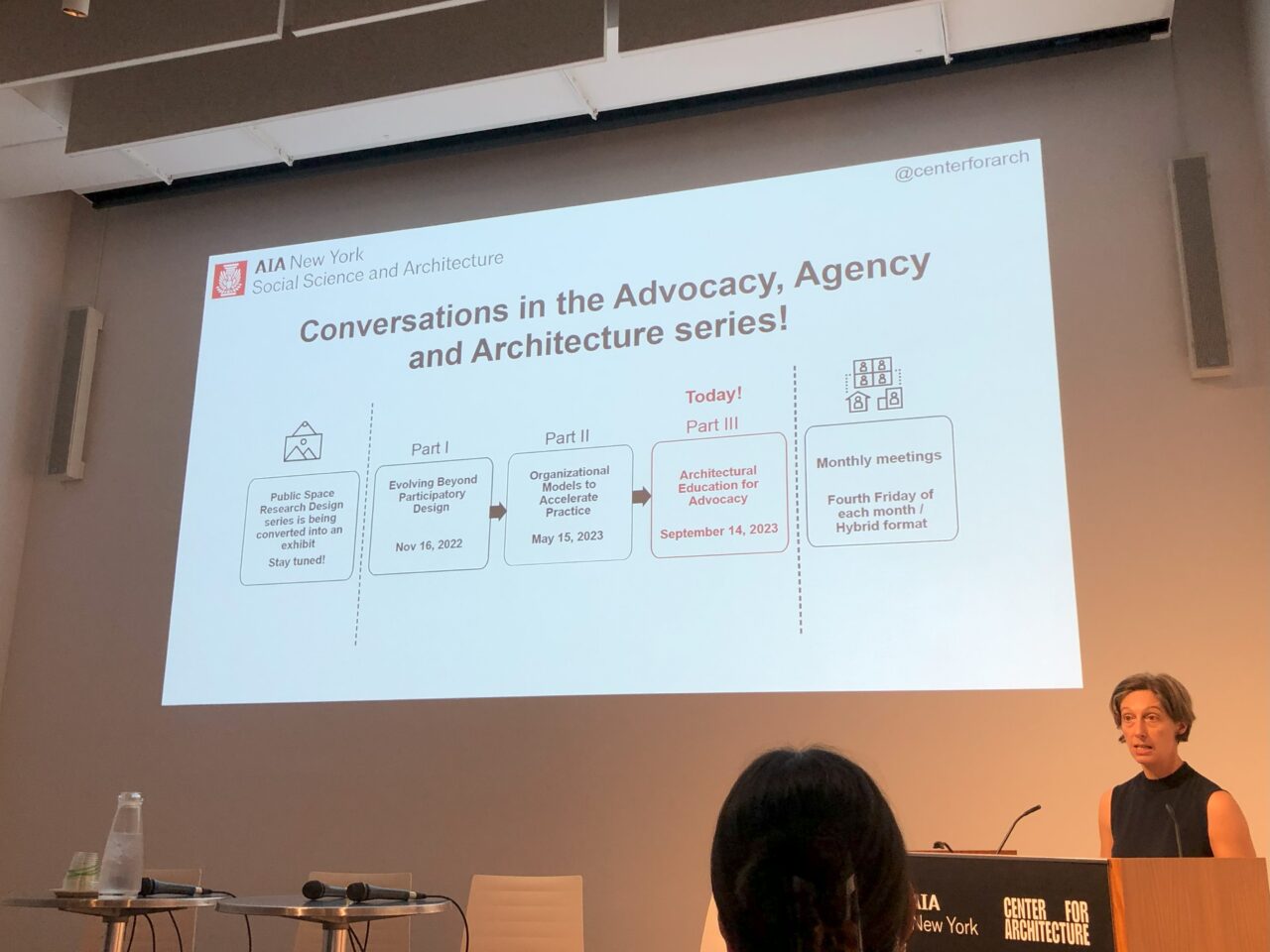
This panel was the third and final event of the Advocacy and Agency in Architecture series, the first two events of which looked at architects’ advocacy in their work impacting communities (“Evolving Beyond Participatory Design”), and architects advocating for themselves through non-traditional organizational models (“Organizational models – Acceleration in Practice”).
Architectural education has traditionally focused on technical skills and design principles, with the demands of accreditation failing to leave room for much else. However, the profession needs to adapt so that it – and its newest generation – are equipped to address the myriad of global climate and social crises that continue to emerge, impacting the built environment.
Kelsey, who is taking a year off from her architectural master’s program, had felt that her architectural studies were disconnected from both her individual interests as well as what was happening in the world. This was in stark contrast to the progressive primary school in Spain where she had worked, where students were encouraged to take control of their own learning. The focus was on nurturing agency and self-confidence, allowing students to set the agenda and teach classes, emphasizing the value of collective capacity.
The lessons learned from this pedagogy serve as a foundation for reimagining architectural education: encouraging students to learn through exploration and self-discovery, and ultimately preparing them for the dynamic and evolving field of architecture.
Jieun’s experience with Habitat Workshop and CUNY highlighted the importance of engaging students early in their architectural education. She discussed her pre-college program that introduces students to architecture through the use of simple prototyping materials and practical experiences such as taking time to understand and document their neighborhoods and working with local community organizations, using the city as a laboratory. For many students who believe “there’s nothing” in their neighborhoods, Jieun pushes them to look again: “There’s got to be something.”
In her eyes, architecture is a form of inviting relationships. Her approach not only provides a solid foundation for future architectural studies but also demonstrates to students a new way of seeing and thinking about the world around them and how they can have a tangible impact.
Sanjive, the architectural department chair at City Tech, highlighted the unique opportunity and responsibility of his program, given the extreme diversity of his students. The discussion raised questions about how to reframe architectural education, shifting from a focus on final products to celebrating the process, and how to make space amidst stringent accreditation requirements for needed changes – such as developing skills for critical inquiry, or ensuring the diversity of the student body is represented in the available coursework.
Recognizing that anyone coming into architecture has optimism and hope, Sanjive sees it as the responsibility of architectural programs to steward and cultivate that hope. Equipping students with the ability to ask meaningful questions and seek answers is an essential skill for tomorrow’s architects, as they are increasingly expected to be problem solvers who must help our society adapt to a changing world.
Kristen, representing Hester Street, highlighted the significance of community-centered design and exposing architecture students to this process, with the goal of architects being more aware of the communities they serve, particularly in underrepresented areas. Hester Street is engaging students in this practice through a new paid fellowship program called the Jim Diego Fellowship. She noted that there is a lack of design firms that truly represent the communities they work with.
Architects need to understand that their role goes beyond creating structures; they are catalysts for change and transformation. Inclusivity is key, ensuring that materials for engagement are understandable, accessible, and applicable to the communities they serve. Building relationships with community members is paramount to effective and ethical architectural practice.
As the architecture profession evolves, so too must architectural education. There is a need to teach students alternate modes of practice, focusing on programmatic longevity and adaptable design thinking, if architecture is to stay relevant in the future.
Architects must be prepared to engage with community members and empower them to have agency over their built environment – and that must start in students’ formal architectural education. Architecture is no longer just about designing beautiful structures; it is about empowering architects to shape a better world. We must cultivate the next generation of architects who can ask meaningful questions, build relationships with communities, and embrace an ever-changing landscape. It’s about training architects to understand the value of vulnerability, and recognize that building relationships is as important as constructing buildings.
In this vision of the future, architects lean into their role not just as designers but also as changemakers. It’s a future where architectural education is not limited by tradition and stifled by standards but is dynamic, inclusive, and responsive to the changes our society needs from architects. In this future, architects are better equipped to create a built environment that truly protects and serves the needs of all, and provides a place for all to thrive.
For those interested, please consider joining the conversation by:
- Attending our upcoming public events. Our next event series kicking off on November 2nd, will focus on the prevalence of forced labor in building materials – and what you can do about it. Details will be posted to AIANY’s Calendar prior to each event.
- Joining the AIANY Social Science and Architecture Committee Monthly committee meetings. They are open to the public and typically take place from 8:30am-10am on the fourth Friday of each month.
About the Author
Kate Ganim is a designer and strategist with a background in architecture. She is currently a co-chair for the AIANY Social Science + Architecture Committee and a Strategy Director at Artefact.
-
September 15, 2023
![Design Firm Organizational Models And Their Role In Workplace Satisfaction Event Photo 003]()
![Design Firm Organizational Models And Their Role In Workplace Satisfaction Event Photo 002]()
![Event Photos]()
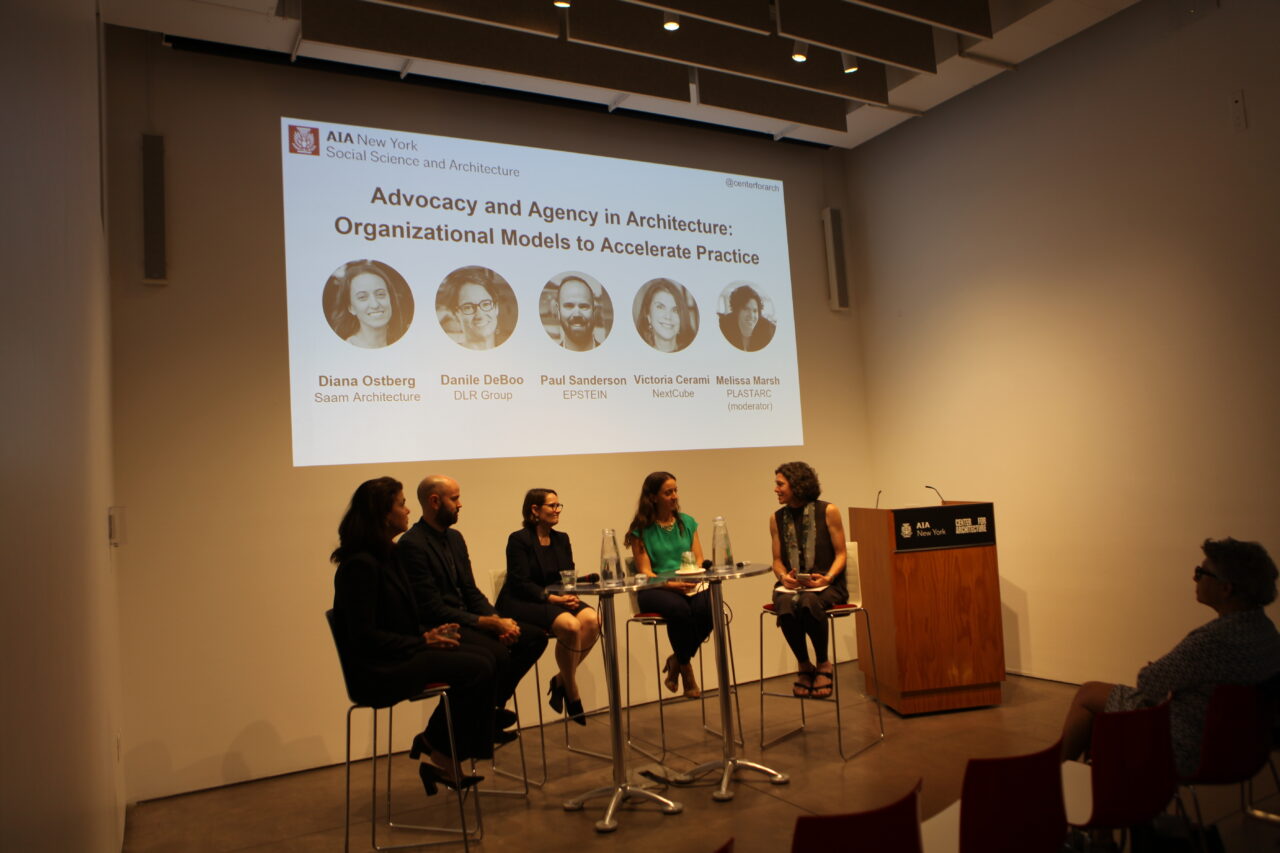
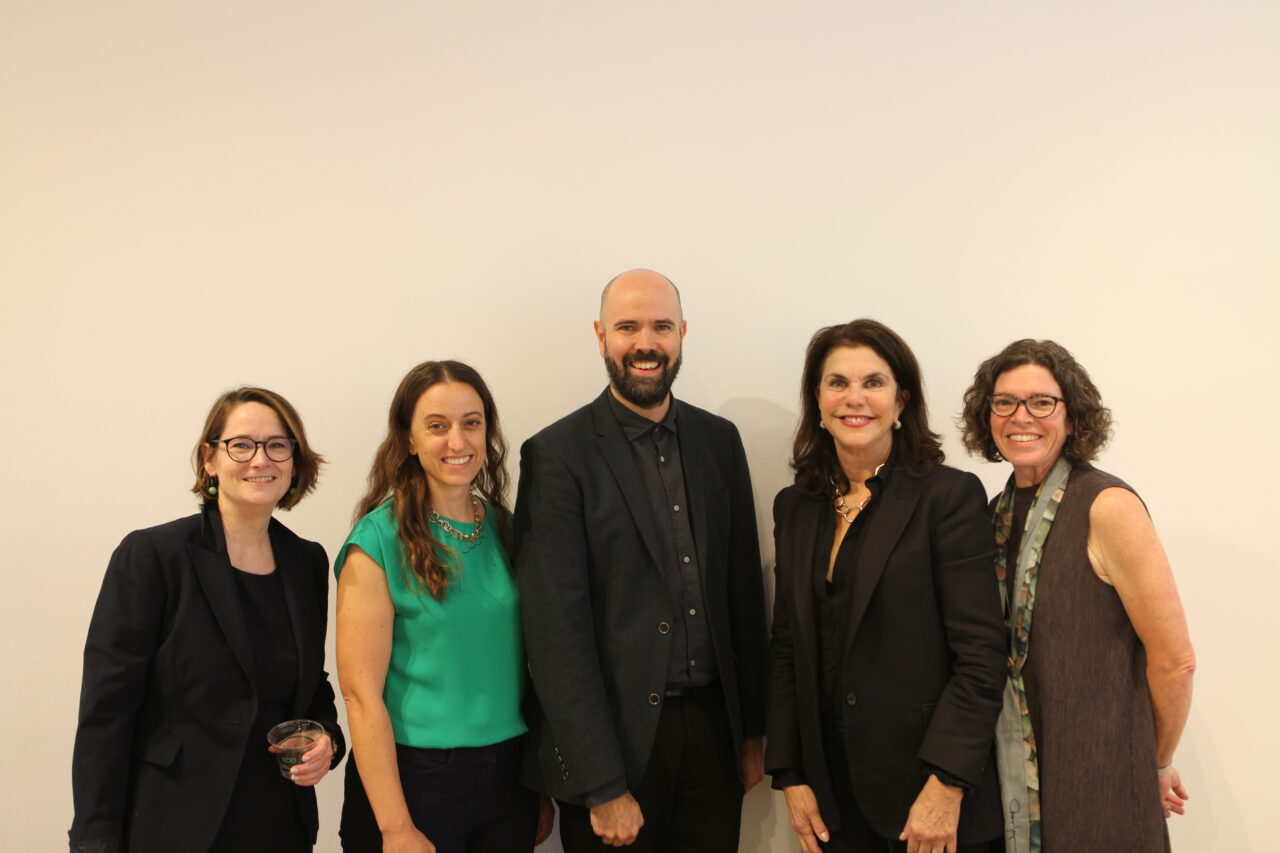
The May 2023 edition of our AIANY Social Science and Architecture Committee conversation series, “Advocacy and Agency in Architecture,” was titled Organizational Models – Acceleration in Practice. The goal of the evening was to highlight the organizational models that help guide the architecture and engineering practices of four different firms. Each of these firms’ business models prioritizes an abiding sense of respect and trust, along with an open acknowledgement of employees’ need for work-life balance.
The purpose of the panel was to discuss how we design organizations so that people’s work reflects the modus operandi of the firm, with a specific focus on the interplay between an organization’s structure and the work that its practitioners get to do, including the design solutions they produce. We asked whether more progressive business models change a practitioner’s experience and commitment to do their best work. Melissa Marsh, PLASTARC founder and co-founder of AIANY’s Social Science and Architecture Committee, moderated the four-person panel of design professionals, who addressed these questions by reflecting on the organizational models that shape their practices.
Diana Ostberg, COO of Saam Architecture, a 15-year-old WBE based in Boston, shared some of the innovative methods that Saam has implemented within the framework of a traditional ownership structure. Most importantly, she emphasized Saam’s “flat hierarchy” and how its radical transparency and flexibility help to shape its work culture. Employees have the choice to work remotely or in person, and they also have the ability to flexibly plan their schedules, so long as they remain accountable to their clients and colleagues. The availability of unlimited PTO, she noted, has not led to abuse of the policy. Furthermore, every employee is able to take advantage of their principals’ accessibility by meeting with them on a regular basis.
Ostberg also noted that the acceptability of working remotely has allowed Saam to expand geographically and attract employees from across the country. While redefining the physical office has led to less in-person collaboration, the firm has implemented new programs—such as peer groups, quarterly in-person meetings, and firm-supported dinners—that serve to foster connection. This employee-sensitive organizational structure has resulted in a 91% retention rate, and the Saam CO2 emissions footprint has been greatly reduced by hybrid work opportunities.
Danile DeBoo, Director and Educational Leader for DLR Group, pointed out that DLR’s organizational structure is rooted in its Employee Stock Ownership Plan (ESOP). She shares the firm’s philosophy that when you own a firm, you buy into its thinking. She argued that DLR is an overarching business, which is organized as an ESOP and happens to oversee a design firm. Both the business and the design firm aspire to elevate the human experience through design, and the overall business priority is to “focus on how to make things better.”
Founded in 1966, DLR currently has 30 compact offices in the United States. As such, the company represents itself as a small firm with a big footprint that can influence policies happening across the US. DeBoo also shared that no employee owns more than 3% of the firm, which ensures the existence of a level playing field. Moreover, every five years the firm hosts a planning exercise that attracts 100% participation—an impressive figure for a company with more than 1,400 employee-owners. The firm’s equitable philosophy and commitment to improving the world is also manifested in its community impact: DLR donated over $1.6 million in fiscal year 2022 and logged over 3,000 hours of volunteer hours in 2022. These contributions came about as a result of decisions made by employee-owners in the spirit of teamwork
Paul Sanderson, Director of New York Operations for Epstein, spoke about the evolution of the firm’s organizational structure and culture. Though Epstein was originally a family business that was passed down from father to sons, it is now also 100% employee-owned, with an ESOP organizational model similar to DLR’s. As employee-owners, each practitioner at the firm tries to address their client’s needs with the question, “what does the owner need for this project to be successful?” The goal is to align the client’s needs with those of all participants and stakeholders in order to create a more holistic solution. Additionally, Epstein nurtures a mentoring environment in which colleagues support one another. This serves to enable each employee-owner to follow a personal learning path that they can pave for themselves. Epstein’s inclusive and cohesive project solutions aptly reflect its culture of cooperative and supportive learning.
Victoria Cerami offered a very different perspective. Although she served as Chief Executive Officer of Cerami & Associates for 37 years, she has segued into a new venture—a social enterprise start-up called NextCube—that she hopes will nurture “active caring.” While at the firm she inherited from her father, Cerami spent much of her time building and cultivating client relationships. She also helped staff members become technical experts and thought leaders in acoustical and audiovisual consulting, along with a suite of IT and security services. Her modus operandi was to chase people and tend to them, without chasing money—a more humanistic approach to client relations.
Since the start of her career, Cerami had noticed that people frequently gave her help without an expectation that she would ever reciprocate. This realization led her to recognize that the act of helping others can evoke a personal sense of joy. It occurred to her that such “micro-exchanges” exemplify what she has come to call “active caring.” While employee engagement implies the existence of a hierarchy, active caring presents a different kind of tool for interpersonal connection. NextCube aims to further the belief that “active caring” can be foundationally built into a business model if its owners proactively choose to adopt its precepts. Toward this end, NextCube is creating a new certification category, called HUMANKIND Certification, that works much like the sustainability certifications offered by LEED. According to Cerami, “becoming a certified HUMANKIND company” is a way to “normalize active caring” in the workplace and make it a “place where people want to come to work.”
After presenting individually, the panelists took part in a discussion that was moderated by Marsh. The conversation, which orbited around business structures and approaches to employee accommodation, shed light on a shared ethos amongst the panelists’ respective firms. All three resoundingly agreed that inviting workplaces must cultivate trust, flexibility, human kindness, transparency, sharing across distances, mentorship, and connection.
Sanderson noted that while an ESOP business structure often embraces many of these workplace priorities, a sense of trust on its own doesn’t necessarily result in a fully transparent organization. DeBoo agreed with this statement, but noted that trust is the cornerstone of DLR’s ESOP structure. When employees are also the owners, she asserted, they are expected to collectively determine their organization’s direction, and they therefore must trust one another to succeed. Ostberg added that at traditionally-structured firms like Saam, an inviting workplace can only exist when leadership first openly espouses its foundational priorities. As firms continue evolving, it’s possible that progressive organizational structures such as employee ownership will only represent a component of their evolution. Perhaps future firms will also adopt philosophies of pervasive kindness and proudly bear a HUMANKIND certification, or ones like it, such as the B Corp Certification.
Event attendees were surveyed afterwards, and the response was largely positive. Some suggestions for future events included a greater focus on research, along with a panel exploring organizational models for engagement with consultants and contractors. The AIANY Social Science + Architecture Committee welcomes all input for future events.
Want to Join the Conversation?
The AIANY Social Science and Architecture Committee meets monthly. Meetings are open to the public and typically occur at 8:30 am on the fourth Friday of each month.Thanks again to our panelists:
Diana Ostberg, COO, Saam Architecture
Victoria Cerami, Founder NextCube, CEO Emeritus Cerami Associates and Angel Investor
Paul Sanderson, AIA, Vice President, Director of New York Operations, EPSTEIN
Danile DeBoo, Northeast Region Higher Education Sector Leader, DLR GroupMelissa Marsh, Assoc. AIA, Founder, PLASTARC
About the Author
Maura Smotrich is a freelance architect, planner, Forest and Nature Therapy Guide and Trails Consultant with her own company, Nature Therapy Placemaking LLC. -
March 7, 2023
Project Description:
From late 2021 through spring of 2022, the AIANY Social and Architecture Committee hosted three virtual, public-facing events as part of committee’s “Public Space Research + Design” series. The three events focused on climate change, safety and security, and gender and sexuality, shedding light on social injustices and inequalities in New York City’s built environment and data and research methods to support more equitable and inclusive design outcomes. Especially in lower income neighborhoods, built environment conditions perpetuate the social, economic, and health inequities.
The committee feels the information gathered in these events should be shared to a larger, multidisciplinary audience to illustrate how more inclusive pre-design research can result in the creation of more equitable built environments.
Role Title: Grant Implementation Coordinator
Role Description:
The AIANY Social Science and Architecture Committee is looking for someone who shares our enthusiasm and passion for sharing the lessons from the Public Space Research + Design series to act as a Grant Implementation Coordinator to facilitate the collection of data and media from the events and develop the content into a traveling exhibition. The Grant Implementation Coordinator will work with volunteers from the Committee Excellence Grant (CEG) working group to identify and follow up on actions required to complete the information gathering and synthesizing process.
Key Responsibilities:
- Create a project
- Schedule working group meetings for project team You will be responsible for setting the agenda, assigning follow-up action items, and following up on delivery.
- Create a system to organize the project data/research.
- Work with the project team to develop the exhibition
Required Skills & Abilities:
- Strong organizational
- Ability to work well with and provide support to other team members as
- Ability to review and synthesize volumes of information and draw out common
Support & Compensation:
- Opportunity to be mentored by senior industry leaders and gain experience in project
- Stipend of $1,000.
Length of Appointment: March-June 2023, with the potential to extend through 2023 pending additional funding.
Time Commitment: Funding allows for remuneration for approximately 50 hours concluding June 30, 2023.
Location: Remote with the opportunity to meet in-person.
Application: Please send CV to the following committee members by March 15, 2023.
- Fauzia Khanani, [email protected]
- Kuan-Ju Chen, [email protected]
-
November 26, 2022

A recent conversation at AIANY’s Center for Architecture called Evolving Beyond Participatory Design explored ideas about how architects can act as advocates and agents for change both within the field and within the greater community, whether through elevating the voices of marginalized communities or fighting for just working conditions.
Melissa Marsh, PLASTARC founder and co-founder of AIANY’s Social Science and Architecture Committee, moderated a panel of design professionals tackling community agency from various angles and at different points along the process. Christine Gaspar, a community-engaged design practitioner, noted that public participation for certain communities may include processing past harm at the impetus of decision-makers and allowing space for them to work through this trauma in an engaged process. Building professionals working within these communities need to find ways to use these difficult perspectives.
Gaspar worked for seven years rebuilding low-income communities after Hurricane Katrina with the Gulf Coast Community Design Studio, a project of Mississippi State University’s architecture program. Since then, she worked for thirteen years at CUP, a design studio that focuses on culturally relevant, easily accessible campaigns to help the public understand their rights, policy debates and more. CUP partners directly with community members–organizers, designers, artists, students–to create these impactful materials. Designers need to reframe the way they present work to marginalized communities–have less of an “isn’t this great” and more “what are we missing?” approach, according to Gaspar.
Community involvement from start to end and allows for more place to plug in, according to Alexa Gonzalez, the Principal at the Hive Public Space. Her work focuses on the power of public spaces to create memories and connections, while evolving the identity and impact of each community. Genuine, engaged conversation with community members creates ownership and incentive for everyone. Often people limit their choices in participatory work by thinking of it in terms of a short-term project, rather than a long-term process. “Our roles in… facilitating public spaces should be simply connecting the dots. It’s important to reassure those who are on the ground and already doing the work that we’re there to amplify their voices and their efforts,” she said. Successful participatory work is about building processes, not products.
Marsh draws a distinction between art and architecture: Architecture is art that people occupy, and architects are responsible for the safety of the occupants. She asks, what is the purpose of a space when people occupy it?
Cheriyah Wilmot, a B.arch Honor Student at the NYC College of Technology and President of NOMASNYCCT takes this further: What does community culture look like in NYC? And how do we represent that in the built environment? How do we design for a specific culture or multiple cultures? What is the difference between place-making versus place-saving?
She discussed making the design process transparent and accessible to the public. This broadens the perspective of inputs that designers have access to and offers unique angles, such as an analysis of history or demographics. Sometimes pushing the conversation into uncomfortable categories are necessary, according to Gonzales.
However, people who attend meetings are not often representative of the whole community or are simply the loudest voices. And some people have trouble making community meetings work, in-between jobs and childcare. Gasper notes that one way to value community members’ time and particular expertise is to pay people to participate in a project.
In the context of community collaboration and transparency, it’s important that communities see an image of the end project. This shows them that the architects and designers not only listened to what they had to say, but took it on board and followed through. A one-size-fits all design is antithetical to true participatory design. Smaller steps throughout the process, taken together, builds trust and commitment to the project even after a project is finished.
Want to Join the Conversation?
The AIANY Social Science + Architecture Committee meets monthly. Meetings are open to the public and typically occur at 8:30 am on the last Thursday of each month.Thanks again to our panelists:
Christine Gaspar, Faculty Design Futures Student Leadership Forum
Alexa Gonzalez, Principal at the Hive Public Space
Cheriyah Wilmot, B.arch Honor Student at the New York City College of TechnologyAbout the Author
Michele Rafferty is a freelance content coordinator working with PLASTARC, a consultancy dedicated to increasing the flexibility and desirability of space using social research and occupant engagement. -
October 18, 2022
 Education of the Architect: Radical vs. Incremental Change Photo: Ekam Singh & Monty Rush
On September 27, 2021, the AIANY Social Science and Architecture Committee (SSAC), the AIANY Emerging New York Architects Committee, and the AIANY Diversity and Inclusion Committee presented a virtual roundtable conversation, “Education of the Architect: Radical v. Incremental Change,” which brought together pedagogy and practice. Students, educators, and firm partners gathered online in conversation as participants and attendees to discuss the education of the architect.
Moderator Peggy Peña, an architectural intern at Ami Gross Architects, began the discussion by highlighting her experiences as a recent graduate from New York Institute of Technology. Bz Zhang, who teaches architecture at University of Southern California and organizes with Design as Protest and Dark Matter University, noted that while we think of the word “radical” as meaning “drastic” or “extreme,” etymologically it means “at the root of,” meaning that radical change means change at the root of an issue.As for “incremental change,” Peña and Zhang both proposed “getting the discipline out of the way”—merging independent and radical thought with current curricula in lieu of perpetuating colonial or white-centric ideology in day-to-day teaching.
Colin Koop, a partner at SOM New York, mentioned the importance of a methodical approach for any kind of change to occur. He spoke from his experience improving promotional cycles at SOM, pointing out how data collection and transparency are key in creating an equitable work environment. Dialogue with different groups of people is essential to bring change to education and the discipline.
The discussion touched on the calls for change spurred by the murder of George Floyd in 2020, placing conversations around inclusion and diversity the profession in the context of the current American zeitgeist. Koop noted how these systemic events highlight the need for radical change instead of incremental change. In response to the question of what kind of change, radical or incremental, is more effective, Zhang responded that such a question suggests an idea of “quantity of change,” while the real question revolves around power: Who can make necessary change? Catherine Cathergoon, a BArch candidate at Pratt Institute, advocated for a balance between both radical and incremental change, encouraging a feedback loop—looking at how small changes affect the larger systems.
The group also identified some fundamental flaws in architectural education: eurocentrism, limited outlooks, and a lack of communication. Peña noted how diluted the term “radical change” has become in the context of the Eurocentric model of architectural education, especially in light of the momentum required to make change in society. Speaking from their experience as a queer person of color, Zhang discussed the normalized nature of racism and how momentum for change must be rooted in community values to fully serve those who need it most. Koop spoke about the role of professional environments in investing, monetizing, and funding this kind of momentum. He went on to distinguish between low-hanging fruit—such as displaying the Pride logo in the workplace—and high-hanging fruit—advancing LGBTQ+ employees to the highest levels of leadership. both are necessary, one requires far more institutional change.
The meaning of change has shifted for Cathergoon during the pandemic, but she is able to find support in like-minded people that advocate for progress. She highlighted the need for more people of color in roles of authority in schools, as well as the need for studio work to engage more fully with the site and the people impacted by architectural development, rather than just focusing on form and function.
Zhang discussed their work with Dark Matter University, where they have sought to amplify voices of color and diverse perspectives with platforms of team-teaching and a course called “Foundations of Design Justice.” Dark Matter has a majority BIPOC faculty and a multi-university student base.
Meanwhile, Koop noted that his education largely focused on students becoming sole practitioners. This approach did not reflect the reality of the professional environment, where architectural designers primarily work in teams. As a student, he never engaged with a community during reviews or while working on a preservation project, which he found disappointing and felt would have rounded out his education. He later noted that as a practice, SOM strives to address community engagement by maintaining it as a part of their design fee, reiterating how positive change is happening—albeit more slowly than we’d like.
There is a lack of design education outside of university and a lack of understanding in the general population regarding the role of designers in the architectural process. This could perhaps be remedied by early architecture education in schools.
Zhang and Koop both experienced unhealthy work environments very early in their careers, which fostered a culture of long hours, all-nighters, and no free weekends. After Cathergoon noted how this mentality is fostered in university architecture programs, all panelists advocated for a healthier school culture to create a healthier office culture.
Many participants also proposed developing a more holistic approach to studio review formats so that they could include community members or potential inhabitants. There was broad agreement thatimplementing this change would make the design process more effective.
While Chattergoon lamented the disconnect between practice and pedagogy, she remained hopeful that equitable representation could allow younger professionals to thrive. She defined the role of an architect in two words: vision and sight, a dichotomous relationship between the imagined and the concurrent reality. Her hope for conscious and equitable change, was more than just a sentiment—it was a call to action.
Koop encouraged professionals to mentor rising professionals from completely different backgrounds to encourage diversity and inclusion at all levels.
The conversation concluded with the opening sentiment of reimagining the word “radical” and its role in architectural education. Through this conversation between students, educators. and working professionals, a number of strategies and ideas came forward to change the culture and education of the architect towards a more inclusive future.
Want to Join the Conversation?
The AIANY Social Science + Architecture Committee meets monthly. Meetings are open to the public and typically occur at 8:30 am on the last Thursday of each month.
Panelists:
Catherine Chattergoon, B. Arch Candidate and Student Advisor to the Dean, Pratt Institute
Colin Koop, AIA, Design Partner, SOM
Peggy Peña, Assoc. AIA, NOMA, Architectural Intern, Amie Gross Architects; Co-Chair, AIANY Diversity and Inclusion Committee; Co-Chair, NYCOBA NOMA Project Pipeline
Bz (Brenda) Zhang, Assoc. AIA, NOMA, Citizen Architect Fellow, University of Southern California; Core Organizer, Design As Protest Collective; Core Organizer, Dark Matter University
Colin Koop, AIA, Design Partner, SOMAuthors:
Ekam Singh is an architecture student at Pratt Institute and a fellow of the New Voices in Architecture Journalism program (The Architect’s Newspaper/Pratt Institute).
Monty Rush is a Pratt student with an interest in construction and a fellow of the New Voices in Architecture Journalism program (The Architect’s Newspaper/ Pratt Institute).
-
June 27, 2022
Text by Michele Rafferty
The latest conversation in our Public Space series, Tracing Gender and Sexual Inequalities, examined how leveraging data, research, and informed collaboration can create more just public spaces that elevate rather than alienate marginalized communities. The conversation addressed questions such as: At what point does public space become hostile to certain gender and sexual identities? How can reviewing existing data help us understand the absence of, and create more, opportunities around advocating for positive change?
“Societal attitudes towards public spaces have long been plagued by binary thinking,” noted Fauzia Khanani, AIA host and the founder of Studio Fōr. “Inclusive design offers a powerful tool for disrupting this cycle”—and for creating spaces that unify and heal.
Amy Rosen, a sociospatial designer with PLASTARC, asked, “What if architecture and design were void of gender, sexual, and racial oppression?” Gender stereotypes shape the way we design our societies, and society often relies on these stereotypes to comprehend people and construct spaces, Rosen pointed out. But what if, instead of exploiting people, design embraced the variability of human expression?
“There is value in speaking directly to people, just as hard metrics help us get a picture of how people interact with spaces,” they said. “The value of data becomes clearest when we actually use it.”
But, Rosen cautioned, data has limitations and must be approached thoughtfully and interpreted with context and nuance. Otherwise, “solutions” may be tone-deaf or address only symptoms rather than root causes.
A.L. Hu, a writer and design initiatives manager for Ascendant Neighborhood Development referenced Kevin Guyan’s book Queer Data: Using Gender, Sex and Sexuality Data for Action. Historically queer people have been counted mostly in data related to criminal acts, such as criminalized sex or cross-dressing, as well as in a corpus of data addressing illness and disease. In relation to queer people, data was often collected to document evidence of what those collecting it considered to be problematic. Hu posed the question, what would a paradigm of data collection that serves the interests of queer people actually look like? “The big question of queer data is ‘who’s it for?’ and ‘who does it serve?’” they emphasized.
The 1966 Compton’s Cafeteria Riot, a fight between trans women and police at a 24-hour cafe in the Tenderloin district of San Francisco, is an example of blurring the boundary between public and private space, as well as safe and unsafe space.
The police saw the riot as a violent disruption by a group of “crossdressers.” But for the queer community, the drag queens who frequented the cafe were reacting to long-running harassment from the police which had been happening all summer.
“The riot was as much a reaction to the situation in that cafeteria that night, as it was to years of queerphobic policing throughout the city of San Francisco,” said Hu. The fact that the riot spilled out into the public setting of the street underscored that the conflict was not just a private matter between the customers and the management of the cafe, but a public one between queer people and the city…The public show of queer solidarity and care in the streets made it queer vigilantism. The riot called into question [whether] queer people are ever safe, in private or public, who gets to take up space, and who gets to be part of the public.”
The research of Victor Gonzalez, a recent graduate from Colorado University Boulder and the Executive Chair for the American Institute of Architecture student JEDI committee, focuses on sexual racism in public spaces. Gonzalez found there was a consistent pattern of sexual racism at queer bars and clubs in Denver. Sexual racism, is the “set of negative sexual attitudes, sexual exclusion, or fetishization of those who are non-white,” he said. Physical spaces cannot be racist in and of themselves, but they can provide spacial and territorial conditions for sexual racism to thrive.
There are no quick fixes for the problem but Gonzalez discovered some correctives that can be integrated into the built form itself, to counteract the effects or dissuade the presence of sexual racism. One bar, called Pride & Swagger, had posters at its entrance condemning racism and other forms of discrimination. This set a tone about the type of space that would exist inside the building.
Jennifer Gardner is a design strategist who works at the US Office of Personnel Management, a government agency that uses human-centered design to help other agencies privilege human needs in policy and service design. “What makes a vibrant public space?” she asked. “Why do we even want to be in public spaces in the first place?”
She has frequently used an ice-breaking activity where she shows a series of pictures of public spaces to people, in order to understand what appeals to them about these spaces. Many people liked the warmth and color of an environment or the closeness of the people in the images. In some cases, what drew them to the scenes were that the people in the photos reminded them of their own family. “This sort of observational data is essential for urban design,” Gardner said.
Planners play an important role in making public spaces accessible to those who aren’t typically present or visible. This is also an important consideration for community-based organizations, led by and advocating for groups typically left out of the decision-making process, when they lobby for investment to support their self-led programming. Data about public space can be a powerful tool in this evaluation process
Gardner is currently designing a “public life data protocol,” which could enable the wider use of data to inform public spaces, with the goal of shifting historic biases against people-centered design in policy decisions. This data-collection tool, which will be open, adaptable, and usable by anybody, should encourage more democratic participation in public space, illuminating blind spots we may have by informing our decision-making through evidence, rather than anecdote.
Brittni Collins, assistant director at Times Squares Arts, offered an example of an inclusive use of public space—a three month installation in Times Square called “A Fountain for Survivors” by the artist Pamela Council. The “Survivors” in the piece’s title is left open for self-identification, and the structure itself is 18-feet tall, a cocoon-like hooded shell, filled with exuberant color, housing a fountain. For Council, fountains function as “living sculpture” and make unique contributions to public spaces through “working in culture’s meeting places, as gathering places, and places where people make wishes, giving people this buoyant sense of hope…”
When collecting data, researchers must attempt to observe and understand behavior without judging the people engaged in it. This is inherently challenging, but according to Gardner, her open protocol is designed to guard against biases.
“There are some huge ethical questions around surveillance, period,” said Gardner. To illustrate, she discussed how one company that uses visual capture to build data profiles of spaces may use invasive data, such as faces, whereas another may use more nondescript identifiers, such as the width of shoulders.
The responsible use of nuanced data to create more inclusive and safer spaces is a key concern of these panelists, as is cultivating a genuine sense of community rather than, in Rosen’s words, “a pandering, even if well-intentioned, one imposed from above.”
According to Gonzalez, it’s important for designers to avoid egotistically making the final decision on what a space should be, ignoring the input of the communities that inhabit it. “I think that’s where a lot of the errors happen,” he said. “Just as important as all your data analysis and preparation before building a space, is to leave those final decisions to the communities you’re building for.”
Want to get involved?
The AIANY Social Science + Architecture Committee meets regularly. Meetings are open to the public and typically occur at 8:30 am on the last Thursday of each month.
Jennifer Gardner is an urbanist and civic designer whose work promotes equity and opportunity through sustainable, human-centered design and policy. Gardner works as a design strategist at the Lab at OPM, an interdisciplinary team of consultant designers supporting federal government organizations to transform their programs, processes, and people through human-centered design. Gardner has an MS in City and Regional Planning from Pratt Institute and a BA in English Literature from Cornell University.
Victor Gonzalez is an emerging Mexican architecture professional currently practicing in Denver, Colorado. He currently serves on the AIA Colorado J.E.D.I. Committee and as the executive chair for the national AIAS J.E.D.I. Taskforce.
A.L. Hu is a queer, nonbinary, transgender Taiwanese-American architect, organizer, and facilitator who lives and works in New York City. Hu was a 2019-2021 Enterprise Rose Architectural Fellow and they are currently Design Initiatives Manager at Ascendant Neighborhood Development in East Harlem. Hu writes the not-so-regular Queer Agenda newsletter, and provides brainpower and energy for Queeries, an ongoing community-building initiative for and by LGBTQIA+ architects and designers. They received a Master of Architecture from Columbia University GSAPP.
Amy Rosen applies integrated design methodologies to everything they do—seeking opportunities to tie architecture into systematic and fluid urban networks. Rosen is an advocate for the power of design to inspire, to unify, and to heal. Using their architectural education as a backbone, Rosen incorporates equity and social sustainability into their design process.
About the Author
Michele Rafferty is a freelance content coordinator working with PLASTARC, a consultancy dedicated to increasing the flexibility and desirability of space using social research and occupant engagement.
-
April 22, 2022

Text by Michele Rafferty
An online program hosted by the American Institute of Architects New York Chapter (AIANY) and its Center for Architecture addressed public space research and design, exploring how to gauge security inequities and create inclusive and equitable public spaces.
“I would be remiss to say that every single person in New York City experiences public space in the same way when it comes to safety and security,” said moderator Fauzia Khanani, the Principal Architect of the award-winning New York firm Studio Fōr and the co-chair of the AIA New York’s Social Science and Architecture Committee. “Historically, the needs and perspectives of every community member have been rarely considered and incorporated into public space design.”
She encouraged the group to consider how design decisions and data can lead to creating equity in public spaces.
Linnea Tillett, the founder of Tillett Lighting Design and Associates, has lectured widely on the subject, asking whether it is possible to design a nighttime public space where everyone feels safe and secure. “My vigorous answer,” she said, “is no,” because feelings of personal safety are “deeply complicated and personal… but, design research and implementation do have the potential to create nighttime spaces which are warm and welcoming.”
Sharon Cotton, Tamara Greenfield, Layman Lee, and Isabel Saffon gave a collaborative presentation on how civic engagement can help drive the implementation of public health and public safety measures. An active community member in the Wagner Houses, a public housing development in East Harlem, Cotton has participated in community service going back 20 years as a member of the Neighborhood Watch; her most recent role has been as the Sergeant of Arms for the Wagner Tenants Association Board. Greenfield is the Deputy Executive Director of the Mayor’s Office of Neighborhood Safety. Lee is the Project Director of the Neighborhood Safety Initiative (NSI) at the Center for Court Innovation, a lead implementer of the Mayor’s Action Plan for Neighborhood Safety (MAP), and Saffon is currently the Associate Director of Neighborhood Equity Design at the Center for Innovation at the NSI, which also supports MAP, reimagining public safety through civic participation.
Greenfield spoke about how the NSI works to build out resident networks, which help transform public spaces into safe public spaces. The Mayor’s Action Plan, which the group works to implement, was selected in 2014 as a response to a spike in violence in New York City public housing. The NSI builds residence teams by recruiting 15 residents from each development, and providing training and stipends.
NeighborhoodStat events engage the community in building public safety decision-making processes through a participatory process. Part of this involves residents discussing how to best invest $30,000 of funds made available by the initiative in a way that improves public safety in their communities. Saffon and her team collect data at the NeighborhodStat events that they use to tailor the process to better fit a diverse community. The action plans resulting from this process are “quick, tangible wins while we wait for long term policy change to happen,” Lee said.
Cotton laid out the specifics of some of these action plan success stories at Wagner Houses, where at the time of its implementation, the median income was around $25,000 a year. A group of community activists cleaned up a green space. Before they took action, it was unsanitary and unsafe. At night it was dark, people slept there, and it was a haven for drug dealing. After consulting with the residents, they all decided that it was the area they wanted to make safer. So the resident-activists ran night and day audits to collect data on activity in the green space.
Since implementing their action plan, the space has hosted talent shows, food giveaways, school bag giveaways, Christmas giveaways, and a variety of programs that foster community gatherings.
The audience asked Cotton about difficulties she had faced in completing projects. She said getting the timing right was often a “Some took a year, some two years” situation and that MAP was the first time she really saw progress.
In response to a question about the best ways to collect data, Lee explained that, while surveys are a ubiquitous tool, they would often run into survey fatigue. One way to counteract this fatigue is by offering monetary incentives for survey participation and having dedicated people collect survey data. For example, at an event where they were handing out food and knew there would be a crowd, she would make sure there was somebody on the food line to hand out surveys.
“Designers can be advocates when they see things happening which are not to the benefit of most… communities,” Tillett said. Smart Lighting could potentially be used as a form of surveillance. She emphasized that “these are choices which should not be made without much cooperation and collaboration,” and that “designers… [need to be] willing to work within the institutions and not stand outside it.”
Join the AIANY Social Science + Architecture Committee or drop into one of our monthly meetings. They are open to the public and typically occur at 8:30 am on the fourth Thursday of each month.
About the Author
Michele Rafferty is a freelance content coordinator working with PLASTARC, a consultancy that uses analysis and data to help companies integrate their employees’ and clients’ needs, while organizing and leveraging their physical space. -
March 18, 2022
![Decorative graphic for Climate Inequities panel]()
Text by Jessica Morris
On November 18, 2021, AIA New York’s Social Science and Architecture Committee hosted the first of two programs in a series on Public Space Research and Design. “Gauging Climate Inequities” brought together a set of research and practice perspectives that articulate the complexities, challenges, and imperatives for designers working towards just practices. “Just Practice” is the 2022 AIANY Presidential Theme. The discussion outlined approaches to interdisciplinary design research that both question and aim to support the best practices in process, through critical analysis.
Researchers and invited guests included Helen Cole, a post-doc researcher at Barcelona Laboratory for Environmental Justice and Sustainability, Timon McPhearson, Professor of Urban Ecology at The New School, Ibrahim Abdul-matin, an urban strategist and the founder of Green Squash Consulting, and Jessica Elliot, an architect with Hart Howerton, a Culture of Health Leader, and the Chair of East Harlem Community Board 11 Environment Open Space and Parks Committee.
Abdul-matin and Elliot have a firsthand, community-based understanding of the challenges involved in choosing a site for public infrastructure and building support for or opposition to public investment, as well as the socio-cultural realities that inform cohesive neighborhoods as they address built-environment preferences.
Cole drew from research that aggregates public health and built environment data to determine who benefits from Green Infrastructure investment in neighborhoods that are, or are at risk of, gentrifying.
McPhearson’s presentation highlighted the stacked-deck of vulnerabilities that high climate risk and historically under-resourced communities often bear, while questioning engagement methods and the lack of rigor, intentionality, and consistency in scoping criteria for public investments.
The speakers each shared a published paper or document that anchored their perspectives. Taken together, the suite of provocative research calls into question what designers are capable of in practice.
Cole’s research on green gentrification finds that benefits are not equitable. For planners and designers, these implications may serve to inform early project-planning assumptions. The paper raises awareness of how health-based data can be applied to spatial analysis, as part of a body of research that serves to define difficult terms—such as “gentrification”—in a way that can be measured and approached intentionally.
McPhearson’s research on siting criteria (how/where a building is situated on it’s lot), the scoping and regulatory processes that serve to locate a project, posits a smart and well-timed opportunity to identify a critical gap in an equitable process that can be addressed intentionally. Through analyzing codified language in public documents that precede green infrastructure investment, a picture of priorities centered on hydrology and economics emerged. McPhearson suggests that if environmental justice is to be a primary motivator in deciding where to put green infrastructure in cities, there is much work to be done in anchoring that “commitment” in the criteria that paves the way for project implementation. Furthermore, engagement and pre-planning should be codified to improve the process, accountability, acceptance, and outcomes in communities that have been subject to past planning injustices.
This case study examines legacy planning practices and their evolution through one project’s decades-long planning and development, which highlights past injustices while pointing to the legal protections and processes which are now in place. These processes ensure more and better communication about public investment prior to implementation.
One of the recommendations from McPhearson’s siting research—to engage, inform, and partner with willing communities early in the pre-design process—would be a stark shift from the current status quo, whereby informational design reviews are delivered at public presentations, with little opportunity to incorporate meaningful feedback. This is the usual current practice, too-little, too-late approach, that community members know all too well.
It is fair to recognize and acknowledge the limitations of our agency partners, but also to assert the importance of funding pre-design research and engagement undertaken in partnership with cities and communities, by trusted community-based design and planning professionals. Pre-design research builds capacity, acknowledges and harnesses local expertise, and embeds the potential for the benefits of the investment to be received more willingly and more equitably.
So, what can designers do? We can continue to work, personally and professionally, to build trust within our multidimensional communities. We can engage creatively in the civic processes that exist around large-scale public investment. We can be critical in our design tactics and processes, in order to consider the implications of these and other research findings, while advocating for process audits and changes to the status-quo that will result in more equitable design approaches.
While architects and design teams are not always at the seat of power and are not solely responsible for allocating funding or controlling regulatory processes and implementation timelines, our expansive knowledge before, during, and after the impact-cycle of the work that we collectively engage is vital to success and this knowledge must inform and pervade every aspect of client and stakeholder engagement and design decision making. We should always approach design through this lens of research-based understanding.
Want to get involved?
The AIANY Social Science + Architecture Committee meets regularly. Meetings are open to the public and typically occur at 8:30 am on the last Thursday of each month.
Event panelists:
Ibrahim Abdul-matin, Co-founder, Green Squash Consulting; Board Member, International Living Future Institute; Board Member, Sapelo Square
Helen Cole, PhD, Co-coordinator for Urban Environment, Health and Equity, Barcelona Lab for Urban Environmental Justice and Sustainability (BCNUEJ), Institut de Ciència Ambiental i Tecnologia, Universitat Autònoma de Barcelona (ICTA-UAB)
Timon McPhearson, Director of the Urban Systems Lab and Professor of Urban Ecology, The New School; Research Fellow, Cary Institute of Ecosystem Studies, Stockholm Resilience Center, and the Beijer Institute for Ecological Economics at the Royal Swedish Academy of Science
Author:
Jessica Morris, Assoc. AIA is an independent design consultant and interdisciplinary professional working at the intersection of environment, cultural sustainability and human behavior. She engages in teaching, research and practice with a focus on innovative, integrated thinking across disciplines while reconciling relics of our pasts. She drives strategic advancement of client-side goals towards shaping healthy, mindful atmospheres in institutional, public and private realms. Since 2020, Jessica has Co-Chaired the AIANY Planning & Urban Design Committee.
-
February 14, 2022
![AIA MeasuringJustice]()
Text by Celic Ruiz and Beren Saraquse
The “Decolonizing Design Research” series explores the ways research can create and reflect anti-racism and justice values within space. The fourth and last workshop in the series, “Measuring Justice,” was held on May 3, 2021, and began with host Tanya De Hoog, a principal at the engineering consulting firm Thorton Tomasetti and co-chair of the AIANY Social Science and Architecture Committee, inviting the panelists and guests to define justice within an architectural context. How do we, as design professionals measure and evaluate justice?
The panelists included Taylor Holloway, a designer, architect, and social impact strategist, who applies design-driven approaches to promote equity in the built environment; A.L Hu, Assoc. AIA, a non-binary architect at the Solomonoff Architecture Studio and an activist fighting for racial, class, and gender justice in design; Andrea Kretchmer, a founding principal of the affordable housing development company, Xenolith LLC; and Matthew Clarke, the executive director of Design Trust for Public Space, a group that advocates for lively and equitable communities.
Holloway opened the workshop by sharing how her travels in South Africa via a 2013 AIA Chicago Martin Roche Scholarship helped her establish her own criteria for a “just” practice. She observed more established architects and designers working within this space and formed a three-part metric that looks at organizational structure, community engagement strategies, and project creation and implementation. She also shared from her work as a core organizer with Design as Protest (DAP) collective, a non-hierarchical, BIPOC-led, action-based collective of design professionals dedicated to justice in the built environment. DAP created the Anti-Racist Design Justice Index to track accountability within design institutions and provide guidance for a just design practice. The index is an interactive tool that offers direction for institutions in the form of steps that move a project towards equality, equity, justice, and liberation.
A.L. Hu, another DAP core organizer, continued the conversation by explaining how sharing queer architect experiences help increase workplace justice in th field. “Nothing about us without us” is a slogan that was previously used during the disability rights movement, and is now being used to continue fighting for justice in workplaces. Hu explains that increasing diversity creates equity and inclusion and posits that this increases profitability, as well. However, the results of the Equity by Design surveys indicate that gender and race diversity is not well-represented in the architectural profession.
After experiencing positive interactions in graduate school, Hu wanted to stay connected to other queer designers. They have shared their experience of being a non-binary architect in podcasts and symposiums, but they acknowledged that every person’s experience is different. This acknowledgment prompted the start of Queeries, a survey for LGBTQIA+ architects and designers to share and document their experiences in the workplace, school, and personal life. Hu’s goal is to use this data to create discussions and community for queer design professionals.
A lifelong advocate of equitable access, Andrea Kretchmer shared a just-housing model—a project that will provide 72 affordable units and support services for formerly incarcerated individuals and their families in central Brooklyn. These support services focus on creating opportunities for health, wellness, and physical fitness in the complex, which includes 7,000+ sq. ft. of green space, 10,000+ sq. ft. of community facilities, and 3,000+ sq. ft. for health service providers. The project will create opportunities for economic empowerment, in addition to equitable community.
The final panelist, Matthew Clarke, discussed how a project in Wenatchee, Washington shaped the way he thinks about just cities and spaces. While building a new park in a predominantly Latin community, the team directed their efforts to meet community members at events they were passionate about, rather than only engaging with the community in official project meetings. These events included Mariachi festivals that took place over the course of the year. Showing up helped the planning team gain more perspective and learn about their community’s values organically. Not only did this engagement create a group of leaders in the community that was able to advocate for their own needs and interests within the context of this project, but the group of leaders continued advocating for their community in other aspects, long after the project was over. An unexpected outcome of the project was that, following completion, voter turnout increased 300 percent. Clarke and his team realized that there’s no one way for measuring justice, and that some measurements may be less-expected and less straightforward than others. “Community engagement is not enough,” he said. “There needs to be a collective understanding of what is good for each community and their values.”
Breakout sessions were convened to further discuss how justice is and should be measured within the built environment. Groups were able to share examples and personal stories that integrated experience with process in the quest for just design. The sessions were more about framing questions rather than trying to find the “right” answer.
Participants asked, “Who is the who?” when deciding metrics, and can justice be quantified?” Hu asked, “What does a queer architect bring?,” and said that justice is a process that involves everyone bringing their whole self to the workplace. We highlighted the importance of representation metrics and the concept that design must help advance people through acknowledgment of diverse sets of needs.
Holloway mentioned the concept of broadening the lens of designers and architects, even at the level of asking who is left out of establishing what metrics are being measured in a project. The act of amplifying, diversifying, and bringing queerness (otherness) into the process begins to challenge the norm—the accepted idea of who the designer is and who the design is for. Within a project, designers’ agendas have to exist and magnify the representation of the voices from the community.
There is a collective sense of wanting to fix the oppressive systems that have been in place. As the discussion came to a close, the panelists were asked to share a call to action. Holloway asks more firms to use the Design as Protest index as a tool towards liberation. Hu wishes to continue their research through the documented experiences of LGBTQIA+ architects and designers via the Queeries survey, in order to create an index of personal experiences.
Kretchmer stresses the importance of not discounting the voices you hear speak out, in addition to thinking of outreach methods to target the people you are not hearing from. Clarke echoed a participant’s comment to embrace individuality and recognize humanity in the design profession.
Overall, the Measuring Justice workshop reflected on the concept that designers and architects aren’t doing enough. Just design not only involves the designer but the voices of the community that are not currently represented.
Panelist recommendations include:
For those interested, please consider joining the conversation by joining the AIANY Social Science + Architecture Committee monthly committee meetings. They are open to the public and typically occur at 8:30 am on the fourth Thursday of each month.
Panelists:
A.L. Hu, RA, AIA, NOMA, EcoDistricts AP, Design Initiatives Manager, Ascendant Neighborhood Development; Rose Fellow, Enterprise Community Partners; Core Organizer, Design As Protest; Facilitator, Dark Matter University; Member, The Architecture Lobby
Andrea Kretchmer, Principal, Xenolith Partners
Matthew Clarke, Executive Director, Design Trust for Public Space
Taylor Holloway, NOMA, Core Organizer, Design As Protest; Founder, Public Design Agency; Manager of Programs, Education, & Community Engagement, Prospect New OrleansAuthors:
Celic Ruiz is an architecture student at Pratt School of Design, who seeks to create a career around designing inclusive spaces.
Beren Saraquse is a graduating architecture student at Pratt School of Design, who seeks a career in designing engaging adaptive spaces.
-
January 28, 2022
![AIA CollectiveVoice]()
Text by Tanya de Hoog and Jeremiah Reilly
The third part of AIA New York’s Social Science and Architecture Committee’s “Decolonizing Design Research” series, on February 4, 2021, focused on the power of thought convergence in a community. This workshop, “Collective Voice,” was a conversation between diverse professionals who practice and research design, as well as experts from the government and activism sectors. The panelists come from various backgrounds and geographies. However, all of them are connected in their desire to create change through their involvement in the Design as Protest Collective—which its website describes “designers mobilizing strategy to dismantle the privilege and power structures that use architecture and design as tools of oppression.
The group discussed “collective voice” in the context of personal experiences and the impact of convergence, as well as in aspirations for future action. Moderator Fauzia Khanani, the founder of Studio Fōr, asked the panel to explore questions such as:
- Where do motivation and opportunity to join a collective come from?
- How can involvement in a collective impact professional practice?
- What is the most important call to action(s) from involvement in a collective?
Given the diverse backgrounds and different focus areas of the panelists, responses varied considerably.
“Community voice is all about building relationships, empowering the community, and elevating the lived experience,” said Sharonda Whatley, an urban planner for The City of Cleveland and one of the founders of Design As Protest.
The audience and panelists had the opportunity to interact and share personal experiences related to creating inclusivity, collaboration, and synergy. Each panelist led a break-out group focused on a particular area of interest.
Navjot Heer, a planner at Thrivance Group, moderated a discussion about dignity-infused community engagement. Christin Hu, a designer, and urban farmer, led a conversation about digital organizing. Chazandra Kern, a designer and project manager at LA-Más, led “Community Engagement to Ownership,” and Whatley took “Cultivating Community Voice During Change.” The digital whiteboards were not shared externally to create a safe space for everyone to contribute.

The workshop concluded with a call-to-action and some organizations for design professionals concerned about the white lens and over-representation of white practitioners in the design fields.
The panelist-recommendations include:
· Arch + Design Orgs on the BLM List
· Women’s Center for Creative Work
Want to get involved?
For those interested, please consider joining the conversation by joining the AIANY Social Science + Architecture Committee Monthly committee meetings. They are open to the public and typically occur at 8:30 am on the last Thursday of each month.
Event panelists:

Navjot Heer, EMUP; Planner, Thrivance Group; Art+Prop Co-Lead, Defund CPD Campaign; Core Organizer, Design As Protest
Christin Hu, MLA, BArch; Editor, Failed Architecture; Core Organizer, Design As Protest
Chazandra Kern, MArch; Program Manager + Design Lead, LA Más; Core Organizer, Design As Protest
Sharonda Whatley, MA in City & Regional Planning; Urban Planner, Cleveland City Planning Commission; Organizer, Design As Protest
Authors:
Tanya de Hoog oversees social impact for the engineering consulting firm Thorton Tomasetti. She has collaborated with teams worldwide to find creative solutions to homelessness, education, and health equality.
Jeremiah Reilly is a freelance architect in Brooklyn, NY with a background in healthcare architecture, urban planning, urban economics, and sustainable development.
-
April 23, 2021

Text by Michele Rafferty, PLASTARC
In December 2020, the AIANY Social Science and Architecture Committee (SSAC) presented the second virtual panel in its series, “Decolonizing Design Research.” The four sessions, organized by AIANY, PLASTARC, and Studio Fōr, examine the history of design research as a profession and push practitioners to investigate systemic and cultural causes of bias and inequity in design.
The virtual panel, “Activist Scholar,” focused on the role of researchers and academics in ensuring that conducting design research is equitable. One of the perks of the virtual forum was that the panel easily could—and did—include guests from communities all over the country. Panelists included Shawhin Roudbari, Assistant Professor of Environmental Design at the University of Colorado Boulder; Dr. Deshonay Dozier, Assistant Professor of Human Geography at Cal State Long Beach; and Joseph Kunkel, Design Director at the Sustainable Native Communities Design Lab at MASS Santa Fe, NM.
Moderator Gabriel (Gabo) Halili, a Designer, and Urban Planner, and a committee member of AIANY, began the session by talking about the meaning of ‘decolonizing.’; stressed that colonizing cannot be separate from the exploitation of people. Colonization embedded within the history of the US and the rest of the world, and New York City, where the event occurred, is built on Lenape land. Panelists affirmed the influence of architects on our cities—intentional or otherwise—and Halili explained that the way we make decisions on land use plants seeds ensuring we don’t perpetuate colonization.
Roudbari, a professor and the founder of the Spatial Justice Design Collective, felt passionate that architects must involve themselves in contentious political issues. He cited his projects combining archival research, sociological texts, and visualization through frames to examine how society views white supremacy in colorblind ways. His company has been working on creative collage projects that highlight the role architects play in social problems.
These projects have been stepping stones for more research on political engagement specific to the architectural profession. Roudbari contrasted two examples from the 2018 AIA convention—a women’s flash mob outside that addressed equity and discrimination within the architecture profession and a protest based on class inequality. The former greeted favorably, while some participants of the latter were denied from attending the keynote address.
Another project Roudbari worked on was the National Organization of Minority Architects (NOMA) project pipeline. NOMA was founded during the civil rights era to address racial inequality. It was instrumental in transferring the energy of the civil rights movement from the streets into the architectural profession. Roudbari talked about Jane McAlevey, a prominent advocate for organizing to attain social change, and John Wilson, who believes that working with existing systems is instrumental in transformation. Roudbari’s introduction segued into a discussion of Dozier’s work.
Dozier started her ethnographic fieldwork focusing on homelessness in skid row Los Angeles. Her work protected unhoused people’s property from threats like removal by the police, who funded $87 million to ‘take care of the problem. One of Dozier’s long-time goals has been to advocate for defunding the police. She believes that LA needs to house the homeless, and she hopes that these issues will resonate with urban planners, designers, and architects. Dozier is not convinced that these professions have the same vision that her organization does but is willing to continue her activism through conversations and education.
Kunkel’s approach harmonizes with Dozier’s vision. He is adamant that housing is a way to reflect identity and culture. Kunkel’s company collaborates with the community to promote justice and human dignity. However, he lives in Santa Fe, his work influenced by his own identity as a citizen of the Northern Cheyenne Nation. Kunkel tries to approach the topic by asking questions like: What does housing mean to you? What does home mean to you? How do we connect to this place? How is our identity attached to a site?
Kunkel’s work on the Wa-Di Housing Project, which included 41 housing units, explored how reflecting on the community’s values could boost healing and connection to place. Kunkel tried to accomplish this through conversations with the community and understand how people gather and work.
The presentations concluded with attendees splitting up into breakout rooms to discuss how their thinking shifted due to the presentations and to explore the power architects have to decolonize design. The conversation generated many intriguing conversations, many encouraging a bottom-up approach to design. Others encouraged their colleagues to look beyond euro-centric patterns not just in what they design but in how they organize their design practice. One attendee pointed to the example of Minangkabau architecture, which reflects a more matriarchal culture.
The Center for Architecture and the SSAC, situated at the intersection of architecture, social sciences, and design, frequently offer programs intended to help architects make positive social impacts through their work. As our society looks for solutions to entrenched social problems around race and inequality, design plays an important role. Please follow our discussion on this topic and others through the Social Science and Architecture Committee, and here.
-
December 18, 2020
In this time of seismic societal shifts due to the pandemic and spurred by the Black Lives Matter movement, the fields of architecture and design are questioning their role in this movement. Emerging conversations are examining the impact of architecture as a colonizing force. Minority and underrepresented practitioners’ voices are being more commonly elevated in these conversations to share their knowledge and lived experience with architecture and design’s predominantly white practitioners.
Architecture is reckoning with the oppressive role it has played and continues to play. Looking beyond the noticeable examples of jails and prisons, the discourse is questioning spaces typically seen as “neutral” and having “good design” as spaces that reinforce existing power structures. We are recognizing that a neutral architecture or design does not exist. The methods and sensibilities taught at architectural institutions not only perpetuate, but are inextricable from, structures and cultures of oppression.
Architecture and design are fields with an immense amount of privilege and power, as they literally shape our physical world. As architects and designers, we need to do better. We need to challenge the processes and assumptions that are so ingrained in our practice. While it may yet be unclear how to do it, it is our responsibility to try. It is our responsibility to “decolonize” design.
On October 26, 2020, AIANY Social Science and Architecture Committee held its first workshop in a series called Decolonizing Design Research. The remaining workshops in the series will be as follows:
- 12/14/2020: Activist Scholar
- 2/4/2021: Collective Voice
- 4/13/2021: Measuring Justice
This series aims to shine a light on these issues of oppression, and provide a forum for practitioners to share their approaches to conducting design research to create spaces that are anti-racist and just. The goal is to mitigate the harm being done through design research practices, and to question our methods in service of more just design.
The topic of Monday’s workshop was “Citizen Participation.” The event was introduced by Committee Co-chair Fauzia Khanani (Founding Principal of Studio Fōr and Co-Founder of Design Advocates) and moderated by Gabriel Halili (Designer and Urban Planner). The panel of speakers included Caitlin Cahill (Associate Professor, Urban Geography & Politics, Pratt Institute), Amara H. Peréz, Ph.D. (Popular Educator, Participatory Action Researcher, and Critical Strategist), and Quardean Lewis-Allen (Founder and CEO, Youth Design Center).
Decolonizing means giving communities agency over their physical space
Halili opened by explaining the decision to use the word “decolonize” for this series. He described it is a framework that calls into mind our role as decision makers for the built environment. He emphasized that we as designers hold power in how our physical spaces look and function, and that our process must become more intentional.
“The production of knowledge is not objective, or value-free.”
Cahill emphasized the shift that is needed from “non-participation” to “citizen control,” as is outlined in Sherry Arnstein’s Ladder of Citizen Participation. This framework calls out “sham participation” and advocates for a redistribution of power through the participatory research process, by bringing the “have-nots” in to help make real decisions. Sham participation reinforces the status quo. It can be exploitative by setting up a dynamic where researchers profit from the uncompensated time and expertise of community members. Cahill encourages researchers to critically examine who is profiting from the participatory research they are conducting. She notes the “tyranny of participation,” where the imbalance of compensation coupled with the perception that nothing happens with participant’s responses and input, can lead to mistrust and a lack of confidence in the process. Growing up Policed, participatory action research (PAR) about growing up policed in NYC, was cited as a successful example of a just and anti-racist approach.
Students as vital collaborators, rather than subjects to be studied
Peréz shared her successful PAR project, Space Matters, at Portland Community College (PCC). Conducted through a lens of Critical Race Theory (CRT), she engaged 25 students of color for two semesters. They learned to view their physical spaces on campus more critically, and planned and conducted a research project about their campus. This approach sought to disrupt the “whiteness” that is pervasive in design and planning practices, in exchange for a more inclusive process. Peréz stressed that traditional research practices are informed by “color blind” ideologies which ignore the role of race/racism in physical space. This overlooks a significant portion of peoples’ experiences and the impact space has on them. In her team’s research at PCC, the cultural dimensions and qualities of space that are so often ignored, were foregrounded, yielding crucial insights.
Some of the tools that Peréz and her team used for this research included workshops and focus groups, and socio-spatial inquiries such as photo journaling to expose features of white, intimidating, male exclusive spaces. They found that these new approaches went much further to validate the lived experience of underrepresented minorities and uncover hidden mechanisms of power.
Creating equitable spaces while breaking the cycle of poverty in Brownsville
Lewis-Allen’s experience running the Youth Design Center (YDC, previously Made in Brownsville) is rich with participatory action. His initiative seeks to break the cycle of poverty and address the lack of representation in design and technology by providing gateways into those fields for youth ages 16-24 in Brownsville, Brooklyn. YDC leverages social activism, tactical urbanism, and place-based interventions to create change. They use the Equity Centered Community Design Field Guide as the basis for their approach, which integrates equity and social justice to go beyond the Human Centered Design process. YDC is also aligned with the Blackspace Manifesto, which was created for Black designers, activists, and leaders to “protect and create Black spaces.”
In terms of specific tools or activities, Lewis-Allen emphasized the importance of active listening, especially with communities who have dealt with a lot of trauma. YDC leverages pop ups with provocations to engage the community and start important conversations. He also uses urban design and analysis techniques such as mapping to learn about lived experience: for example, having kids map out where they feel safe in their community versus areas where they will not travel.
We’re in this together. Try new things, and share what you learn.
Overall, practitioners are trying to better understand the invisible forces of systemic racism in our architecture and design practices and test out new approaches. There are many challenges that we are up against – from the inertia of tradition to the difficulty in justifying a fee for this type of research to a client. As the pandemic continues, there is a need to ensure marginalized people aren’t lost on the other side of the digital divide, and that we fight to include them in our research. We are designing WITH and not FOR. We must acknowledge the importance of framing the questions for our research – as explained by Peréz: “whoever frames the questions plays an essential role in framing the narrative.”
For those interested, please consider joining the conversation by:
- Attending the remaining workshops in the Decolonizing Design Research series. Details will be posted to AIANY’s Calendar closer to each event; dates are listed above.
- Joining the AIANY Social Science + Architecture Committee Monthly committee meetings. They are open to the public and typically take place at 8:30am on the last Thursday of each month.
Kate Ganim is a designer and strategist with a background in architecture. She built San-Francisco based KIDmob and LMNOP Design, and is currently a Senior Strategist at brightspot strategy.
-
July 24, 2020
 Image courtesy of dScout
by Beth Carliner
Research is a vital part of the architectural process, which allows design to be as effective and inclusive as possible. The AIANY Social Science and Architecture Committee held a roundtable discussion on May 27, 2020 to explore some of the opportunities emerging within the practice of Remote Research Methods. The conversation, moderated by Fauzia Khanani, co-chair of AIANY Social Science and Architecture Committee and Founding Principal of Studio For, featured Tanya de Hoog, Principal at Thornton Tomasetti, and Liz Vandermark, Director of Research at SmithGroup. Participants delved into research outcomes, thoughts on improving methods, and future implications of current findings.
As the webinar opened, a poll was conducted and 45 percent of attendees stated that they have had to modify or tried new methods of research in the last three months. Since the emergence of COVID-19, research methods have gone remote and revealed both benefits and challenges.The discussion then began with an assessment of how both the methods for collecting data and the content itself has changed. In the past, research relied heavily on in-person conversations and site assessments. De Hoog and Vandermark remarked that, since COVID-19, some of the methods their firms had been reluctant to explore, especially those focused on technology, have now become essential. Drones, 360 cameras, and virtual and augmented reality are all methods that have been available in the past but have gained new utility; skepticism has all but vanished. De Hoog stressed that there is now a hyper-awareness of space and time and a focus on the importance of human interaction with regard to research. This has resulted in rich conversations about the importance for data to lead to new insights for design whereas, prior to COVID-19, research sometimes used to support pre-design assumptions. Meanwhile, Khanani provided insight into how the inability to make site visits has forced her to rely on clients or other site representatives to provide data about the physical state of projects, be it as-built measurements or construction progress.

Image courtesy of Center for Architecture
On the other hand, our panelists recognized the shortcomings of relying on technology for remote research methods. While the digital environment seems ubiquitous, WiFi connections are inaccessible to many. Additionally, many are also saddled with poor connections or home environments that are not conducive to digital communications. Many seniors are also less adept at using technology, so their voices may not be heard. These digital divides could provide unreliable results.
The ability to gather narrative-based data in addition to quantitative data from virtual outreach was another concern of the panelists. It is easy to get lost in the statistics and patterns revealed by the quantitative data that virtual data collection enables. Moreover, virtual data collection also requires less human interaction. This can inadvertently eliminate some important findings that arise organically from conversations. The lack of human interaction also affects our ability to read body language and visual cues that are key to fully understanding each other. Finally, people may be less candid in their responses when taking virtual surveys. However, the panelists also found that open-ended questions resulted in thoughtful and unexpected personal responses.

Early observations from a COVID-19 perspective, Image courtesy of Liz Vandermark
These issues and more brought into question the implications of our overwhelming use of technology. Optimistically, the panelists reflected on the equalizing effects of digital communication. Participants can join from wherever and whenever is most convenient for them. While certain voices seem to dominate in teams or large in-person groups, digital spaces can allow for other, more quiet voices to be heard. Speakers also noted that participation has also drastically increased in some types of engagement. Vandermark highlighted that data collection through a website allows for community engagement at multiple points of time and across a larger population set, while also allowing participants to be involved on their own terms. Data analysis is also facilitated by digital inputs, and there is greater potential for continued, real-time trends to influence a continuous design process. De Hoog remarked that our industry has been confronted with an opportunity to improve our digital literacy and increase the presence of research within the standard design process.
The panelists concluded by discussing positive or surprising findings that have emerged since implementing remote research methods. Vandermark noted how the crisis has revealed an innate desire for designers to help and share resources. These efforts are aided by digital communications, as we have seen through the 3D printing of PPE and the sharing of COVID-19 safety measures. De Hoog picked up on a similar communal desire to support change in this moment, noting that “people are really open and available to giving their time, especially where it relates to creating change in the world. Things can now move more quickly because people are available.” She brought the example of a mind map that she produced before COVID-19 when she was researching Skid Row in Los Angeles. This research took fifteen months and six flights. This is a stark difference from her research today, when she is able to capture some of these insights in only a few months.

Mindmap documenting the interconnected considerations captured for a Non-Profit addressing homelessness in Skid Row in L.A, Image courtesy of Tanya de Hoog
Participants in the webinar were left with ideas of how the recent data collection and research methods may become more readily available in long term practice. Among them is the idea of the shared responsibility data collection between researchers, field representatives, and participants. There is also a newfound potential for the process to be more equitable by providing “an equal playing field” through technology from which participants can be heard.
Panelists:
Tanya de Hoog, CEng, FIStructE, MIEAust, Principal at Thornton Tomasetti
Liz Vandermark, AIA, MSc, LEED AP, Principal & Director of Research at SmithGroup
Moderator:
Fauzia Khanani, Assoc. AIA, Principal at Studio For
-
January 29, 2020
by Brenna Luczyszyn
On January 29, our friends on the AIANY Technology Committee and the AIANY Science and Research Facilities Committee presented a program on the ways demand for innovation is necessitating flexible and highly-technical environments in several different industries, Scaling Customization: New Frontiers of Flexibility for Innovative Environments. Then evening began with presentations by Melissa Marsh of PLASTARC, Andrea Lamberti of Rafael Vinoly Architecture, Aleksey Lukyanov-Cherny of SITU and Federico Negro of Canoa Supply, which were followed by a panel discussion. The panel was moderated by Nicholas Desbiens, Head of Digital Practice at KPF and Co-chair of the AIANY Technology Committee.
Marsh kicked off the event with her presentation, “The Future of Data-Led Workplace Design.” She discussed measurement, highlighting the need for both big data (collected by systems) and little data (individual experiences) to find out what people want in a workplace. Big data includes records that a company may already have about building utilization, space-specific mobile device usage patterns, and data gathered from IoT, and surveys. Combined with little data from interviews, observations, and other qualitative methods generates much more valuable insight. Marsh shared that data is also showing that employees value using an environment that is sensorially great more than they value owning their own workspace. As a result of this focus on experience, people are increasingly connecting with individuals who share their interests and tastes.
Lamberti then presented about trends in the design of science environments. She revealed how even a laboratory with standard elements can be designed with occupant satisfaction in mind, when she showed options for the floor plan at The Rockefeller University River Campus laboratory. The lab was being designed with a modern, open layout, but there are rules in a science lab for keeping food separate from experiments. The solution was a clear divider at the end of each write up desk, to create the concept of separation while still allowing the space to maintain the open aesthetic the scientists desired. Social spaces were included, where people could interact during breaks and meetings.
Lukyanov-Cherny, partner at SITU, then took the podium. Continuing with the theme of flexible and shared spaces, he spoke about the challenges of designing workspaces for clients like Google. He also discussed designing a multi-purpose space in the Brooklyn Public Library that could support dozens of uses and be changed over in under 10 minutes by one librarian.
Negro spoke about his company’s commitment to decarbonizing the built environment by providing a rental furniture option for small and medium businesses, so that they could design office spaces without waste. CANOA has found that the typical tenant spends only 3 years in a workspace, and furniture winds up in a landfill. Negro noted that his company is using data from the materials (wear and tear of furniture), to gauge and improve the customers’ experience.
After the individual presentations, all four panelists came together under the moderation of Desbiens for questions from the audience, ranging from what architects can learn from social sciences, to the actual collection of data. Marsh pointed out that more incremental changes are happening more often, and we can measure anything by designing studies, and collecting data in a rigorous manner. Massive data collection is now the norm, but how that data is used to create better environments for people is a conversation that is just beginning to unfold.
Panelists:
Andrea Lamberti AIA LEED AP BD+C, Partner, Vinoly Architects
Aleksey Lukyanov-Cherny, Partner, SITU
Melissa Marsh, Founder & Executive Director, PLASTARC
Federico Negro, Founder, Canoa Supply Co.Moderator:
Nicholas Desbiens AIA LEED AP, Head of Digital Practice at KPF, Co-chair of the AIANY Technology Committee -
December 20, 2019
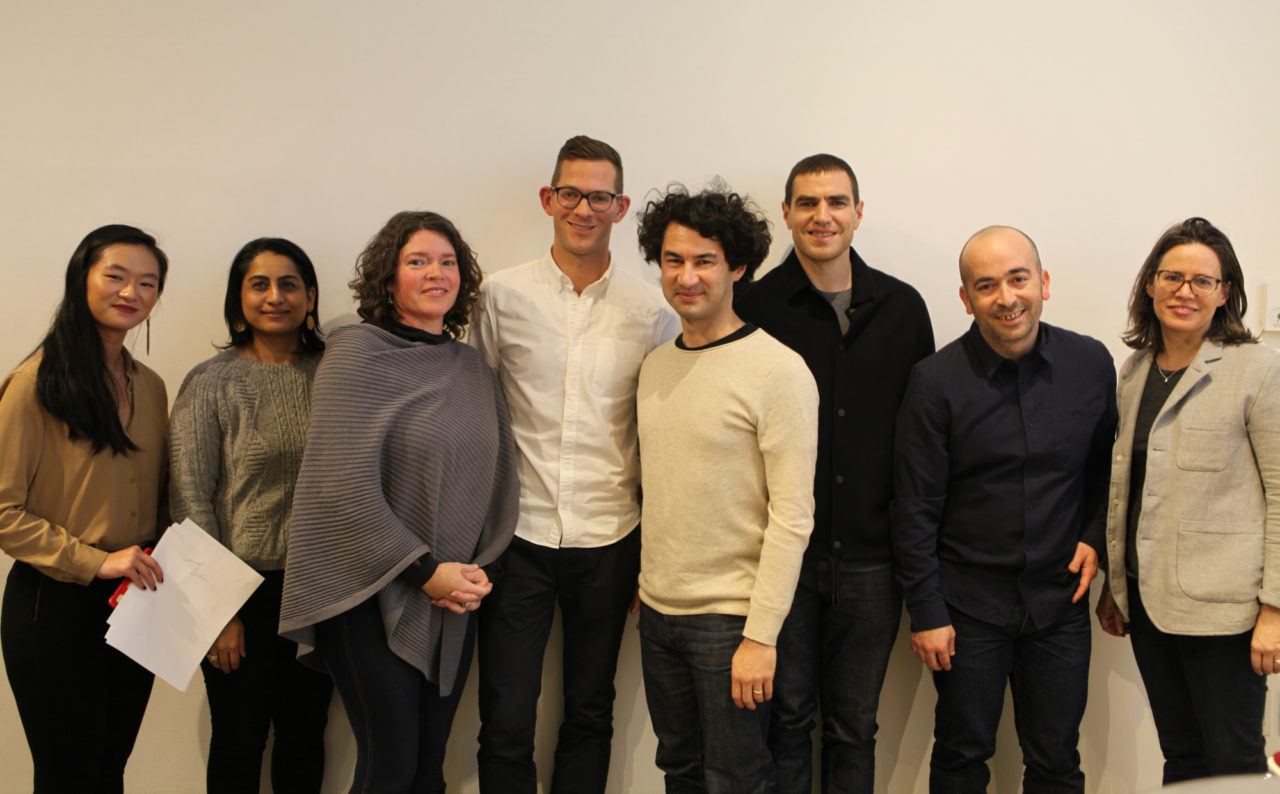 Experts presented on the use of AI in design and architecture.
Data is omnipresent. Our digital interactions throughout the day represent a wealth of information about our habits, preferences, interests, and activities. Our physical movements are captured by our phones and, increasingly, the buildings and cities where we work and live.
Considering the abundance of data, how do we curate and analyze it purposefully?
In December, the AIANY Social Science and Architecture Committee hosted AI and Sensemaking: Human-Centered Design in the Age of Abundant Data, where experts from the worlds of design, technology, data science, and organizational sociology examined this question. Organizations are turning to AI for the “sensemaking” that helps us understand the significance of the data. The speakers—Daniel Pittman, partner for strategy and innovation at TAD; Will Shapiro, cofounder and CEO of Topos Inc.; Andreas Hoffbauer, founder and director of Atelier Kultur; Melissa Marsh, founder and executive director of PLASTARC and senior managing director of occupant experience at Savills; and moderator Nitzan Hermon, founder and consultant at Future-of.Agency—reflected on AI and architecture through case studies, current projects, and potential scenarios.
Daniel Pittman showed how TAD, which specializes in the integration of architecture and technology, is exploring AI’s relevance for user experience, data analysis, and messaging. To illustrate how AI could provide new perspectives on complex information, he described a generative content project that relies on AI to create a real-time depiction of financial markets using boids; the room-height, multi-wall installation is both an aesthetic statement and a means of providing insight into market data.
The firm is exploring other arenas where AI could foster insight or greater simplicity in settings ranging from corporate offices to medical facilities. Referencing the firm’s work to integrate AI into different projects, Pittman considered the implications of natural language interfaces and authentication; of process automation, in which intelligent systems help clients operate more efficiently and gain insights from their technology networks; and of the firm’s efforts to create “frictionless environments” in which technology enables seamless experiences in workspaces.
Takeaways:
There is a disjunction between rhetoric and the reality of AI; his firm’s purpose is to distinguish between the two. Beyond that, the firm has three roles in this arena: it helps clients best prepare for what lies ahead; determines what are legitimate, pragmatic steps forward for AI; and provides insight about how clients should be thinking about AI and why it’s relevant to their people and customers.Throughout his consulting work, Will Shapiro has taken powerful data analysis tools to, as he described it, “understand place holistically.” Topos relies on AI to discover the dynamics of people and urban environments that can be meaningful for governments, planners, and businesses. As a demonstration of the potential for discovery, he discussed his firm’s “Five Boroughs for the 21st Century,” an effort that used AI to cluster New York City regions not by geography, but by data. Using an AI technique called “k-means clustering,” he analyzed publicly available urban data to identify 17 key dimensions that define the city. The correlations that emerge—between nightlife and dollar-pizza eateries, or between a neighborhood’s pizza topping options and residents’ median household incomes—reveal surprising parallels and a basis for creating the new mappings.
Takeaways:
AI creates the possibility for us to understand cities in a more granular, temporal way in the face of rapid shifts in urban life and dynamics. This analysis could be powerful in determining how cities are designed and zoned—in conceiving the way we organize elements and neighborhoods of the urban environment. AI, Shapiro said, would “allow people to use data to make those decisions, instead of intuition or arbitrary standards.”Melissa Marsh highlighted the use of data in defining and improving design, placing a strong emphasis on curating information that is truly relevant to the design endeavor. Her firm PLASTARC focuses on strategic design for workplace performance and innovation, and she noted that buildings now gather a plethora of data, yes—but this data often says nothing about behavior, which is the key factor in human-centered design. “What makes data in buildings relevant is people’s actions and interactions,” she observed. With that in mind, practical applications of data in architecture must focus on human dynamics.
Case Study:
To highlight PLASTARC’s data-sifting approach, Marsh spoke about a consulting project to examine why a newly completed office was often 50% empty. By amassing data points about physical space characteristics, resources, and social drivers, the firm revealed the intersection between and the characteristics of places and the choice to occupy them. The firm relied on the assessment to improve the design of the spaces, using a combination of social, technological, and physical interventions—a mode of assessment that is ripe for AI.Takeaways:
Just because buildings are becoming “smarter” doesn’t necessarily mean that we are bringing greater intelligence to architectural design. In order to create more meaningful analyses, we need more time to gather data from pre- and post-occupancy periods.AI is pushing us to conceive how analytic insights might apply to future projects, but “our first responsibility is to look at what we’ve already built before we focus on what the next buildings will be.”
When Andreas Hoffbauer visits an organization’s offices, people will frequently remark to him, “Look how collaborative we are.” Yet for Hoffbauer, an organizational sociologist who helps businesses foster innovation, there is often a disconnect between the way people aspire for a space to perform and how it actually performs. His role is to consider why these workplaces aren’t fulfilling their purpose and to help the organization address the problem.
Hoffbauer’s analysis has revealed the limitation of relying on data—because the under-performing workplaces were often designed using analytic insights. Yet the data and the AI analyses, Hoffbauer has found, have some invalid assumptions. Among them:
- Workplace interactions are dematerialized to a limited set of variables that do not capture the full range of employee behavior and work culture.
- The analyses assume, often incorrectly, that past practices are a valid basis for predicting future practices and thus designing new workspaces.
- Most importantly, the analytical models and data ignore the behaviors, practices, norms, and social contexts that allow certain kinds of work to happen.
Takeaways:
Buildings designed around current practices and current user data will not necessarily perform in the long-term as our behaviors and workplace culture change. Instead, organizations and designers have to consider how behaviors, practices, and norms fit with where an organization expects or aspires to be in the future. In this effort, sociologists can help in determining what behaviors would predominate. As an example of such a collaboration, Hoffbauer pointed to the library Snøhetta designed for Ryerson University in Toronto, “a library without books” that cultivates collaboration, conversation, and interaction, the activities anticipated to characterize the campus athenaeum of the future.Guardrails: The Ethics of AI
A recurring theme throughout the discussion focused on the ethical dimension of AI as it related to architecture. The panelists noted several potential issues:
- AI can provide insight, but it can also perpetuate biases and self-indulgent creative loops; the result—spaces that are stagnant and employees who are disconnected or alienated.
- Over time, analyses derived from building data can become stale because, when the information set does not change, it perpetuates a certain view of the world.
- Organizations and governments have begun to use AI to uniquely identify individuals, creating the possibility for nefarious ends, as seen in China’s use of AI to identify Uighurs, among other initiatives.
- Research into AI’s application for detecting emotions through physiological measures, facial expressions, and body movement could lead to enforced conformity and retribution for straying from the norm, in both organizations and societies at large.
Takeaways:
Designers and technologists need to consider how they can introduce a contrarian view into the data-gathering mechanism and analysis—a view that questions the assumptions built into the data and analytics.In using AI technology—whether natural language systems or facial recognition algorithms—it is the responsibility of design and technology firms to consider the potential impact on social norms, privacy, and other ethical considerations, and present these issues to the client.
Data Curation
In considering how to curate information that would be most meaningful for a particular project, Hermon noted that he prefers to “work with deep context as opposed to wide data.” He investigates the content that would have the greatest relevance, based on the organization’s questions or goals, rather than accumulating a wide range of data that doesn’t apply to those aims.
On a similar note, Marsh noted, “We need to be faster at figuring out what is impactful and not impactful and have better hypotheses going in so we’re being more thoughtful before we go into the data, or we could be just boiling the ocean.”
The Future of AI
Among the beneficial impact of AI, Hoffbauer noted that it could play a role in “trying to make spaces that people like to work in, spaces that make a positive impact in people’s lives.” Marsh suggested that AI could contribute to the paradigm of thinking of buildings as “living organisms that we’re always learning from and adjusting to over time.”
The panelists agreed that the integration of AI and architecture is still in its infancy, and, as such, we haven’t yet identified appropriate measures of success and progress; we haven’t identified the rules and objectives in this field. “We have work to do as a profession or industry about what is progress and what does good look like,” Marsh said. “Once we are able to identify what identifies success or performance within that context or environment, then we could get to better architecture and have a possibility of using computation to make a better architecture.”
-
November 22, 2019
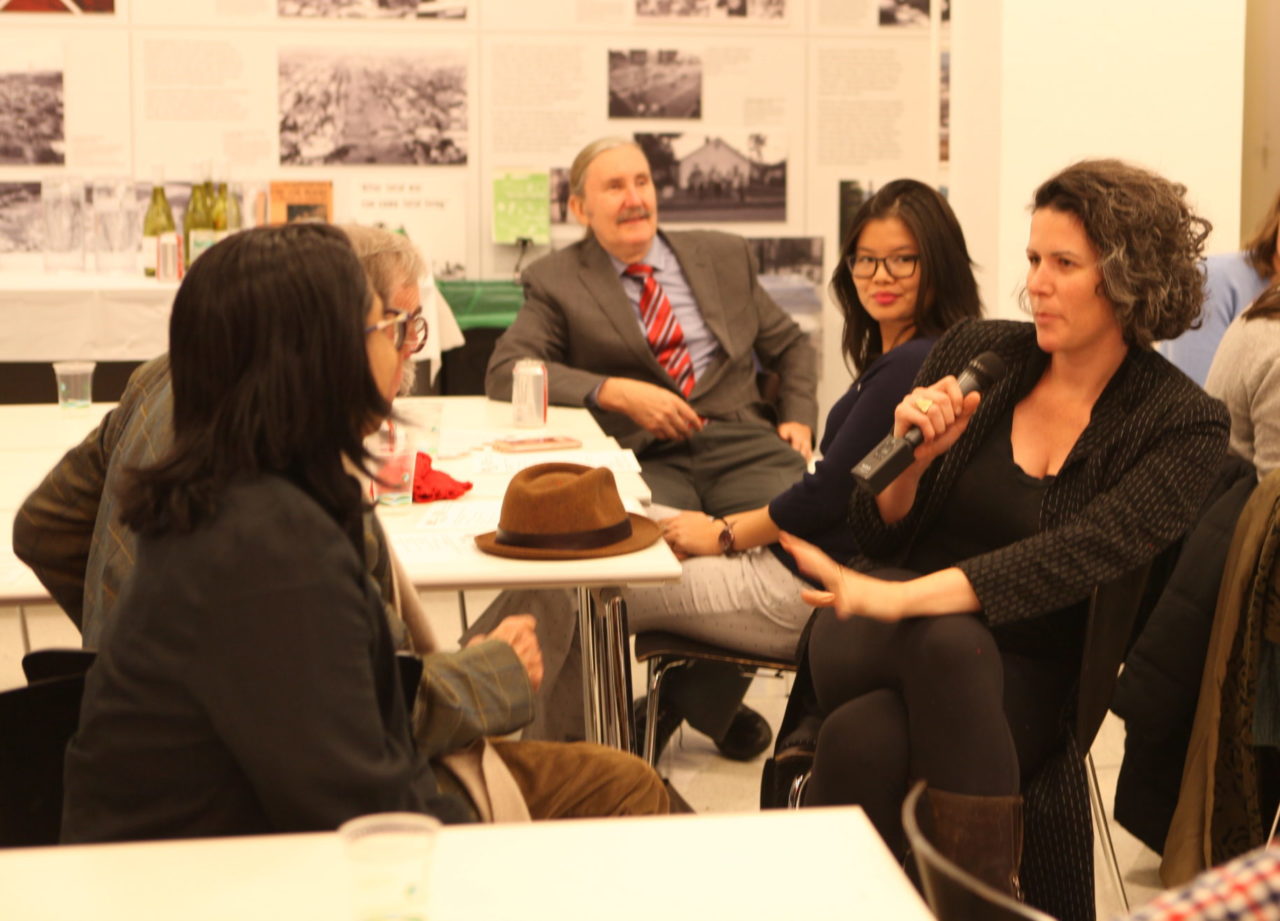 Attendees and panelists exchanged ideas for improving the design of polling places.
Panelists:
Ben Kallos, NYC Council Member, 5th District
Doug Kellner, Co-Chair, New York State Board of Elections
Maggie Ollove, Service Designer and Civic Researcher, Center for Civic Design
Eric Spencer, Development Director, Ennead Architects; Democratic District Leader, 73rd District Part CModerator:
Fauzia Khanani, AIA Associate; Principal, Studio Fо̄rSummary by Carin Barbanel
How welcoming are the spaces in which we vote? Can we find our way through them efficiently? Welcoming physical sites encourage citizens to participate in our democracy, yet designers and architects aren’t usually asked to consider that usage when envisioning a common area. Fauzia Khanani, AIA Associate and Principal of Studio For, moderated a panel of prestigious experts who summarized the history of voting in New York and innovations that are improving voter participation. Attendees were then invited attendees to imagine improvements to voting methodologies that New York’s Board of Elections (BOE) may be able to implement.
Doug Kellner has been working in the election space for decades and currently sits as Co-Chair of the New York State Board of Elections. He discussed how voting has evolved in New York. Ben Kallos, New York City Council Member, connected this legacy to current unfair incumbent advantages. Maggie Ollove, civic researcher and designer at the Center for Civic Design, illustrated how improved ballot designs impact electoral outcomes. Eric Spencer, Director at Ennead Architects and a Democratic District Leader in Manhattan, connected these themes and posited ideas for our future.
Kellner began with an overview of the history of voting in New York, which began in colonial times. Absentee ballots were created to enable soldiers serving in the Civil War to vote, ensuring Lincoln’s reelection. By the turn of the century, the US government was printing ballots, implicitly limiting the field of candidates. Voting machines and confidential ballots improved access and the rolls were expanded. Nonwhite voters and, finally, women gained the franchise a century ago. The voting machines with the handles that many of us remember from childhood were introduced in the 1950s. Only recently did New York move to scanned paper ballots and electronic poll books, and early voting was just introduced for the first time this year.
Kellner went on to give some background on how elections are administered now. Election Districts (EDs) are geographic divisions designed to include a similar number of voters. These are further split into Assembly Districts (ADs). One question that was posed: Do voters really need to vote in their ED/AD now that we have electronic poll books? So far, the answer is yes. Even if voter rolls are portable, crowd control is still a real concern; imagine the mayhem of NYC residents wanting to vote in midtown on election day! The ED/AD system is also necessary to maintain the secrecy of votes and provide a proper audit trail. Further, online voting is not a viable option as there is no way to ensure an election will not be compromised.
NYC Council Member Ben Kallos discussed downsides of the Election District system. An incumbent legislator can select a polling place amid bevies of supporters or put several ADs in one site to create long waits that can dissuade others. More often, difficulties in distributing poll sites are usually logistical, not nefarious. There are not sufficient public spaces for every New Yorker to vote without friction. During presidential elections that friction is substantial. Electronic poll books and early voting help but we can do more. Kallos asked participants to encourage co-op and condo boards to invite the BOE into large ground floor lobbies of their buildings.
Maggie Ollove spoke about the design of ballots themselves. She reminded us of the problematic ballot that resulted in 2000’s Bush vs. Gore nightmare scenario. She then showed us examples of better ballots, but explained that BOE officials who create ballots are not designers. They are, however, eager for instruction. Suggestions such as using 12 point sans serif fonts and page designs are generally welcomed. Ollove closed by sharing successful ideas from other districts such as drop-off ballot acceptance.
Eric Spencer spoke to the current political climate, reassuring the audience that our era is not the most contentious in our country’s history. Even as social media’s fractious nature exacerbates our awareness of divisions, community spaces can combat disharmony. Voting by mail is convenient, but creating a festive atmosphere a lá the City Streets program could return an element of community spirit to the voting process. Additive, adaptive solutions might include putting tents in parks and including other civic outreach in these spaces.
Fauzia Khanani segued to the closing activity, in which attendees broke into small groups for conversations about voting as a spatial act. The panelists each joined a group of attendees to suggest solutions. Some ideas included thoughtful signage coupled and better placement of voting equipment to increase throughput, allowing voters to hand off completed vote by mail ballots in subway stations and other public spaces, placing mobile polling trucks in public plazas.
One idea of note for those who design buildings: include polling usage in the original design specs for buildings that are likely to be used as such. Susan Lerner, Executive Director of Common Cause, suggested architects and designers read the report produced by The Presidential Commission on Election Administration. It contains industry-tested solutions that can be incorporated into polling site plans.
This was an energizing and inspiring evening. Voting gives the people who inspire us the power to act on our behalf, so it was fitting to focus on how design can support and inspire people to participate in the process of self-government.
Please join us for future events.
-
September 19, 2019
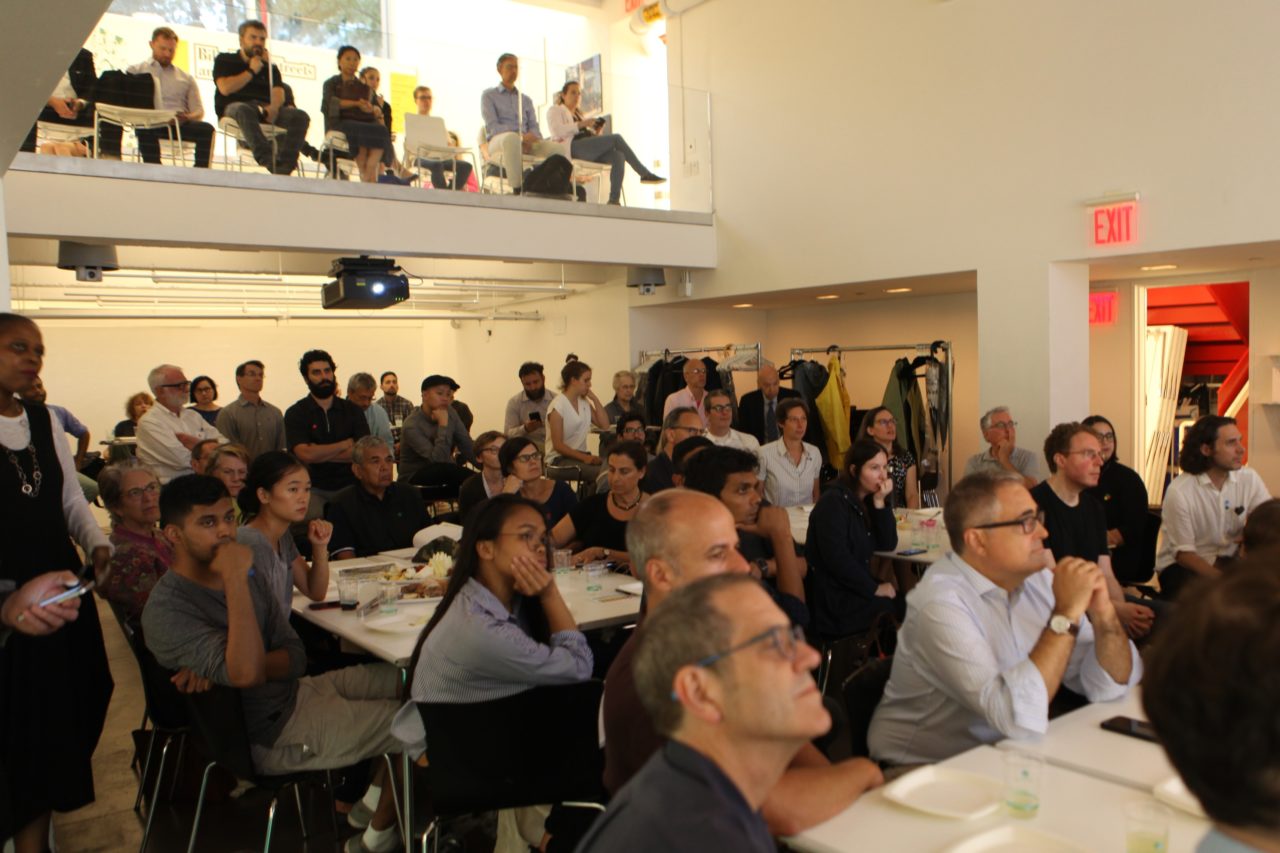 A packed house listens to presenters discussing the design of learning environments
by Kate Ganim
The education landscape is changing quickly. New technologies and pedagogies, converging disciplines, high costs, preparation for not-yet-existent careers: it’s undeniable that education at all levels is evolving. Students now have a broader range of non-traditional paths available to them, and their needs and experiences vary more than ever. A range of professionals across disciplines are taking steps to make education more inclusive and accessible to historically under-represented populations, working to improve anything from racial or cultural diversity to neuro-diversity. Architecture has a responsibility to evolve its practice in order to support and anticipate these changes in education.
Historically, only a small segment of architects have collaborated with research-based disciplines or made substantial use of post-occupancy evaluations (POEs) to improve learning spaces. There are many precedents showcasing successful use of data and a multi-disciplinary approach to educational design, along with the positive impact that it can have on student experience and learning outcomes. Unfortunately, this approach is far from the norm despite the evidence that it makes the student experience more equitable and engaging.
There are several obstacles facing architects who are interested in a research-based approach. There is rarely a budget available for this type of data collection and analysis, and it can be easily deprioritized or skipped despite its demonstrated success. Thus, the architect can expect to need to educate their client on its indispensability. Also, there is little perceived incentive to invest in the “student experience” since public funding for schools is driven primarily by student test scores (especially for public schools). No broadly accepted evaluation standards exist for POEs or educational space research; as a result, 90% of the architects who use this type of research develop their own surveys and methods in-house. There is no commonly accepted platform on which to share these methods or findings publicly, so many undertaking this work are duplicating or re-creating similar tools and approaches.
On August 7, 2019, AIANY Social Science and Architecture, AIANY Architecture for Education, and AIA National CAE Research Task Force held an event titled: “Learning About Schools: Where Do Design and Research Fit In?” Design and consulting professionals shared their perspectives and approaches around integrating user and client-driven research into the design of educational spaces. It was facilitated by Evie Klein, Co-founder, User Design Information Group, Graduate Center, CUNY, and Michael A. Nieminen, FAIA, Partner, Kliment Halsband Architects. The featured guest speakers were Elliot Felix, Founder of brightspot; Dina Sorensen, Assoc. AIA, Senior Associate, former K-12 Education Leader at DLR Group; and Daniel Baumann, Lead Designer at Henning Larsen. While each of the speakers had their own unique approach, there were common themes throughout:
- Talk to stakeholders. There are many stakeholders in an educational space. Work with a diverse group of stakeholders that is representative of the community. Take time to understand who they are, what they care about, and what they need. Don’t rely on administrators to tell you what students need: talk to students directly. Treat them like the cultural and community experts that they are. Students can also help to interpret and offer insights on other data that is collected.
- Take a multi-modal approach. There are a number of ways to collect useful data to gain insights. Qualitative research can include stakeholder interviews or workshops. Quantitative research can include different sensors and heat-mapping techniques, or coding stakeholder interviews. Use multiple types of data to paint a clearer and more robust picture.
- Integrate feedback throughout the process. Pre- and post-occupancy evaluations are great, but don’t go deep enough. Bring your stakeholders through the process with you. Get their input early and often to ensure that your design direction is aligned with and supportive of their needs and culture.
The mindset should be exploratory, open-minded, and “bottom-up,” leading with curiosity in order to uncover insights or innovative approaches. Alternatively, a “top-down” approach is at risk of seeking evidence to confirm existing assumptions and beliefs.
While architects are not solely responsible for the student experience and engagement, they are in a powerful position to impact students and the future of education. An incredible opportunity lies in cross-disciplinary collaboration with experts in fields like neuroscience, environmental and developmental psychology, and data science, to integrate their insights into physical space.
The uniqueness of each school community plays a significant role. Each has its own “cultural needs.” The goal is not to create the “best learning space,” but rather to create the learning space that is the best fit for that community. Alignment between the physical space and the people who use it is paramount.
Please consider joining these additional conversations about the intersections of social science and design:
-
- “DIALOGUES” on October 22nd, 2019, hosted by the AIA Committee on Architecture for Education
- The AIANY Social Science + Architecture Committee monthly committee meetings are open to the public and typically take place at 8:30am on the last Thursday of each month.
- The AIANY Committee on Architecture For Education monthly committee meetings are open to the public and typically take place at 6:00 pm on the first Wednesday of each month.
Kate Ganim is a designer and entrepreneur with a background in architecture. She built KIDmob and LMNOP Design in San Francisco before moving to Brooklyn in early 2019.
-
March 28, 2019
 AIANY's Social Science and Architecture hosted a panel on tools and technology (March 5, 2019)
by Diana Mosher
On March 5, the AIANY Social Science and Architecture Committee hosted Proof: The Power of Social Research in Design. This multidisciplinary panel facilitated by PLASTARC Founder and Executive Director Melissa Marsh explored new quantitative and qualitative tools available to designers, as well as ways that social science research can be embedded into the design process.
Arlene Ducao is a Principal at the DuKode Studio, a scientific and environmental design firm in Brooklyn, and the CEO and cofounder of Dukode’s affiliate company Multimer. Multimer provides tools that enable organizations to conduct research and fill in gaps in data. Using a simple kit and common wearables like smartwatches and heart rate straps, designers can collect, visualize, and analyze geolocated biosensor data. As that data is collected, designers can monitor it in real time on Multimer’s platform. This can be useful for delving into outdoor experiences, examining workplace strategies, or studying design in virtual space.
Stephanie Park, Senior Lead Strategist at WeWork, draws from her multidisciplinary background and expertise in design, psychology, and data science as she leads immersive research to create an ideal user experience. Her work sits at the intersection of architecture and cognitive psychology, to studying how building performance affects people and vice versa. She warned that technology doesn’t always reveal the whole story. Attendees learned how to avoid costly mistakes that can occur when making assumptions about client culture based solely on data.
Danil Nagy is Product Innovation Manager at Silverstein Properties, where he leads the development of technology to enhance and transform Silverstein’s business. Nagy described an automated tool created for a developer in Japan that helps the sales team find vacant lots and pitch development projects to the owners. Automation allows the developer to grow their business by increasing both the quantity and quality of the proposals that they can offer. Nagy also shared some thoughts about how to avoid over-engineered systems and how to maximize human comfort by minimizing resource usage.
The panel concluded with a look at some exciting advances in tools and automation. Emerging technologies such as computer vision, data mining, learning cloud computing, and generative design have enabled us to get closer to Negroponte’s vision of a future where human designers and intelligent machines assist each other in creating a better built environment.
-
December 18, 2018
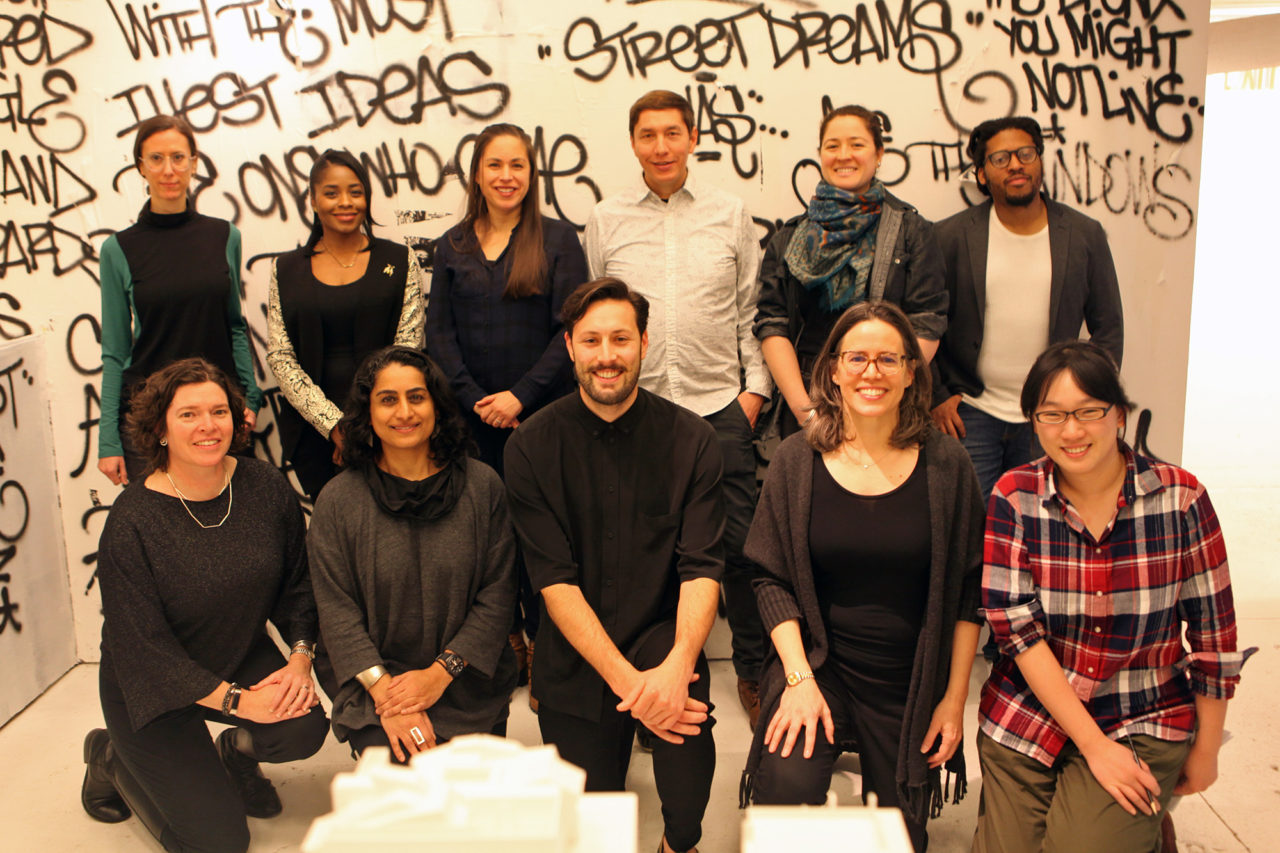 Poets, architects, and other makers discussed how identity influences their work.
by Kuan-Ju Chen and Jessica Morris
The effects of identity on projects and places are powerful. Should identity be recognized as a material in the discipline of architecture as it is in disciplines like poetry? “Remix Resample Remaster” prompted consideration of whether deeper reflection on the role of identity in the process of making could result in places that are more reflective, adaptive, and flexible.
This participatory program was hosted on 12.11.18 by the AIANY Diversity and Inclusion, Emerging New York Architects, and Social Science and Architecture Committees at the Center for Architecture. Through small-group workshops, participants considered how the work of poets, educators, artists, and fellow architects is affected by their identities both consciously and unconsciously.
Speakers shared short stories that inspired breakout discussions about identity, place, and creative works. Daniel Aronberg, Assoc. AIA and Co-Chair of AIANY Emerging New York Architects Committee, introduced the theme of equality with a reading of the poem “No Difference” by Shel Silverstein. Fauzia Khanani, Assoc. AIA, Principal and Founder of Studio Fōr, then shared excerpts from the New York Times Race/Related Newsletter that illustrated how a porch could represent very different things in people’s lives.
Also among the invited guests was Danei Cesario, AIA, NCARB, NOMA, Associate of Array Architects, and Co-Chair of AIANY Diversity and Inclusion Committee. She highlighted her roles as a mom, a wife, and the 333rd black female licensed architect in American history. With these multiple roles, she has many opportunities to encourage empowerment through practice. Cesario was followed by Paco Márquez, a poet and former editor of OccuPoetry, a poetry journal focused on economic justice. Márquez read two original poems that use language, intentionally-incorrect grammar, and cadence to directly address his identity as a bilingual and Latino immigrant. He also shared a submission tracking spreadsheet showing acceptance or rejection by various journals, allowing the relationship between identity and acceptance to be evaluated. Initially, Márquez’s works were more often accepted by journals aimed at a Latino audience, which caused him to question his professional identity—he did not want to be seen only as a Latino poet. He asked the audience to consider if and when a cultural producer might aspire to break out of identity pigeonholes.
Katie Yamasaki, a Japanese-American artist and muralist who grew up in Detroit, shared a story from grade school that was tied to race, memory, and the writing of history. That story became the inspiration for her children’s books and public artwork, highlighting how formative identity politics can be. Yamasaki’s use of large-scale murals as identity markers serves to reinforce existing relationships, give presence to loved ones who are elsewhere, and create community-building mechanisms. Kamau Ware, artist, historian and founder of Kamau Studios, self-identifies as an information-loving nerd. Ware’s work—walking, talking, sketching, and creating with others he meets—is about the underlying and hidden histories of place. The interest in deep heritage and thirst for information exchange through culture building is the creative force of his identity-driven work, though it is not always obvious at the outset. Finally, Abby Conklin, Program Manager at Creative Connections NYC, shared a poem she authored and asked “How can we see each other wholly?” Conklin echoed Márquez in her lament of stereotyping, which she said is typically based on limited knowledge. Conklin advocated that we suspend judgement and engage in consideration of all sides, especially because every individual is multifaceted.
The subsequent breakout sessions further explored identity as it relates to vocational roles. Each group was led by one of the invited guests, who facilitated discussion after a short self-introduction. Some groups explored the identity of “architect” in general. A few participants were hesitant to call themselves “architects” simply because they were not yet licensed, prompting a discussion of whether young professionals should not feel permitted to identify as such. A few stereotypes of the profession were discussed, such as long working hours and income levels. Though there was agreement that these were a mix of some truth and some speculation, questions arose about how these stereotypes came to be and what might shift them.
Identities can be nested, and their expression may serve as a means to represent and uphold shared visions and values. Identity and expression exist at every moment of practice, from interpreting codes, writing specifications, and outlining material selections, to visioning RFP responses or annotating and placing arrowheads on drawings. Architecture and engineering, technical and creative writing, organizing, and even walking all communicate values.
The group discussions concluded with a series of questions. Everyone was asked to think of a public park that they regularly engaged with and to consider how identity influences one’s experience of that place. Different ideas of how those places might be improved illustrated that identity is an essential starting point in defining architectural problems and working through design solutions. The responses were recorded and later shared back with the full group.
Identity, when harnessed, can be a cultural currency. It is a currency with immeasurable value when shared—not for the purpose of feeding egos, but in service to an economy of common good.
###
This post was sponsored by PLASTARC.
-
October 30, 2018
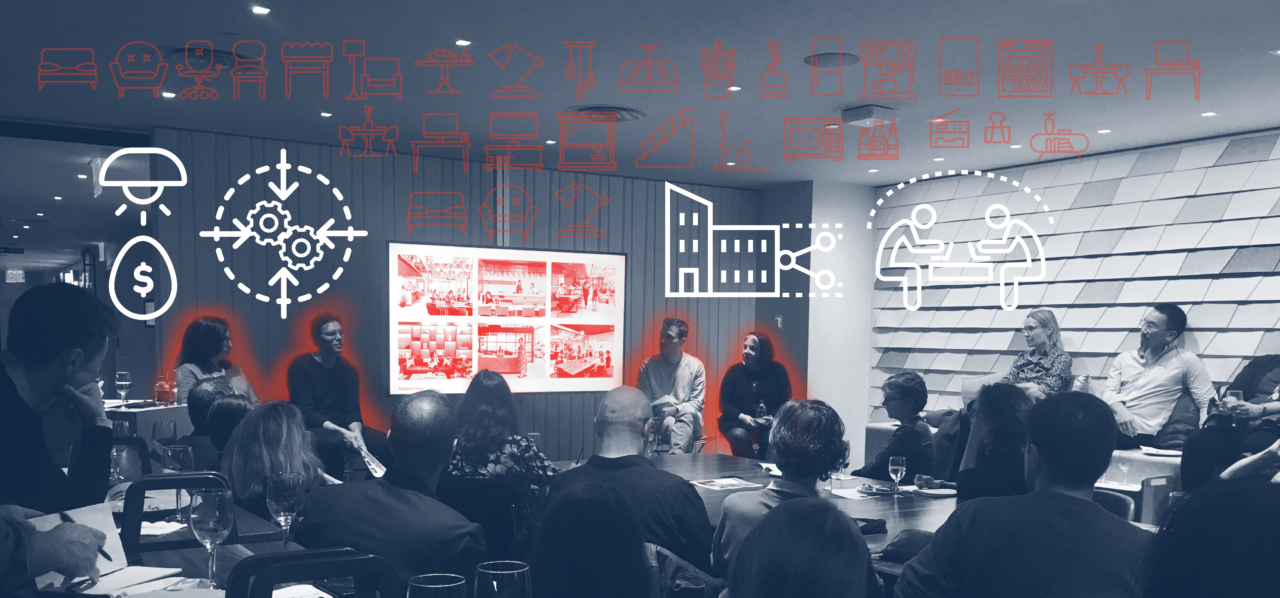 Panelists discuss the evolution of coworking practice.
While coworking may be associated with large open desk areas and scrappy, early-stage startups, shared space has grown up, requiring more sophisticated design, measurement, and marketing, a panel of experts told AIA members and guests at a panel in on October 23.
A confluence of trends, including people seeking choice in how, when and where they work; corporate need for short and long-term flexibility; the miniaturization and portability of technology; and Millennials desiring to work in environments reminiscent of their recent college experience, has changed the landscape, according to Joyce Bromberg, chief strategy officer at Convene, a New York City-based network of meeting, event and flexible workspaces.
Coworking has evolved into a new way to provide workplace for enterprise-level clients, explained Bromberg, whose firm provides solutions for groups of 10 to 100 people.
Everything that we know about landlords and how workplaces are designed, built, managed, and staffed is being disrupted, necessitating a new name for what Bromberg predicts will become the way people work and how real estate will be consumed.
As a fundamental part of the shared economy, coworking embodies the notions of access and pay-for-what-you-use, while incorporating shorter lease terms and an added layer of service and hospitality that ultimately empowers the provider, according to Eivind Karlsen, head of design at Industrious.
“We’re challenged to make sure that every day employees come into work we create a service that satisfies them, or they can move to another operator,” Karlsen said. “That’s a fairly new dynamic. You’re giving the occupier that key that they didn’t previously have.”
For the corporate occupant, it has led to more purposeful decision-making about where to locate particular groups and departments, according to Lucia Diana, global real estate for Verizon.
Moderator Melissa Marsh, founder of PLASTARC, summarized: “The definition of coworking is about how people work and how the real estate, design and construction industry deliver that product in a more systematic or productized way.” It’s also:
- A way of working with people in more diverse environments
- Co-locating people in different companies
- A way of delivering hospitality-driven office environment as a service
- Flexibility
- Speed of change from real estate and demand side
- Redefining corporate intellectual property boundaries from defense to offensive
Panelists also discussed the vicissitudes of generic and unique approaches to flexible space products and considered ways coworking is evolving toward a hospitality-style model with varied market segments, brands and levels of service.
Challenges with measurement were something all panelists experienced in the flexible office model where “people vote with their feet.”
While many providers are investing in various sensor-style products, challenges lie in mandating adoption.
“Any tool is only as good as the number of people that use it,” said Bromberg.
At Verizon, where the focus is on measuring utilization and measurement with retail-style people-counters, real data helps analyze and resolve situations such as a 25-person room occupied by three people, Diana described.
While data drives much of the decision-making and programmatic allocation of space that follows, great value can be derived from non-quantitative measurements, according to Karlsen, whose firm has found the community manager relationship to be a particularly valuable gauge.
“Getting those qualitative touch points on a daily basis inform how that member is experiencing that space, what challenges they have, where we can help provide a better day at work,” he added.
And in some cases, it’s the space itself that signals a successful project, as the Rockwell Group’s Matthew Winter explained.
Describing a corporate office project that consolidated six groups under one roof, he noted that only a small percentage of individuals were allowed to keep private offices. Some departments opted for a purely democratic experience, with executives moving into open spaces with their teams, while others fought hard to keep a disproportionate number of offices.
For open offices, shared spaces and ancillary lounges, Rockwell’s design features a hospitality-focused center-hearth approach.
“The true measurement of the success of this project will be if at the end of it, some of the EVPs and SVPs are not spending time in the office they fought so hard for, and instead holding court in one of those lounges,” noted Winter.
Coworking was the second in a two-part workplace series presented by the Interiors, Marketing & Communications and Social Science and Architecture committees of the New York City chapter of the AIA. On May 2, the committee presented Workplace Design Part 1 exploring how marketing the physical work environment can attract and retain talent.
###
This post was sponsored by PLASTARC.
-
October 12, 2018
This conference will explore how environments at all scales can be designed in support of a more sustainable world. While cities are contributors to the causes of climate change and other environmental problems, the urban setting will be the proving ground for many of the solutions that address environmental, economic, social and behavioral issues across the globe. Environmental design research is integral to shaping urban design and changing environmental behavior at the global scale. This interdisciplinary call invites proposals from researchers and practitioners to share their knowledge of best practices that address the critical mission of urban sustainability, encompassing built and natural environments for which long- and short-term. EDRA encourages submissions on the following topic areas:
- Urban Sustainability, Equity and Globalization
- Global Climate Change: Attitudes and Behavior
- Green and Blue Infrastructure, Natural Resources and Urban Ecology
- Participatory and Evidence-Based Strategies for Sustainable Design
- Environmental Design Research: Advocacy Through Policy and Design
- Place-making: Personal, Social and Cultural Meanings of Space
- Resilient Community Planning, Housing and Design
- Heritage and Cultural Infrastructure
- Sustainable Lifestyles and Behavior
–
Submit your proposals here. Please email [email protected] with any questions.
–
Key due dates:
November 12, 2018
Due date for all Individual and Group Presentations.
(Papers, Symposia, Workshops, Practitioner/Researcher Collaborations and Intensives.)December 1, 2018
Due date for Visual Presentations abstracts for Display Posters and Digital Media Shorts.December 7, 2018
Early Bird Registration OpensJanuary 26, 2019
Acceptance notification to all authors and presenters.March 16, 2019
Due date for conference participants and presenters to register for the conference (required to be part of the EDRA50 program). Regular registration also begins.May 22-26, 2019
EDRA50 Sustainable Urban Environments Conference in Brooklyn, New York -
December 27, 2017
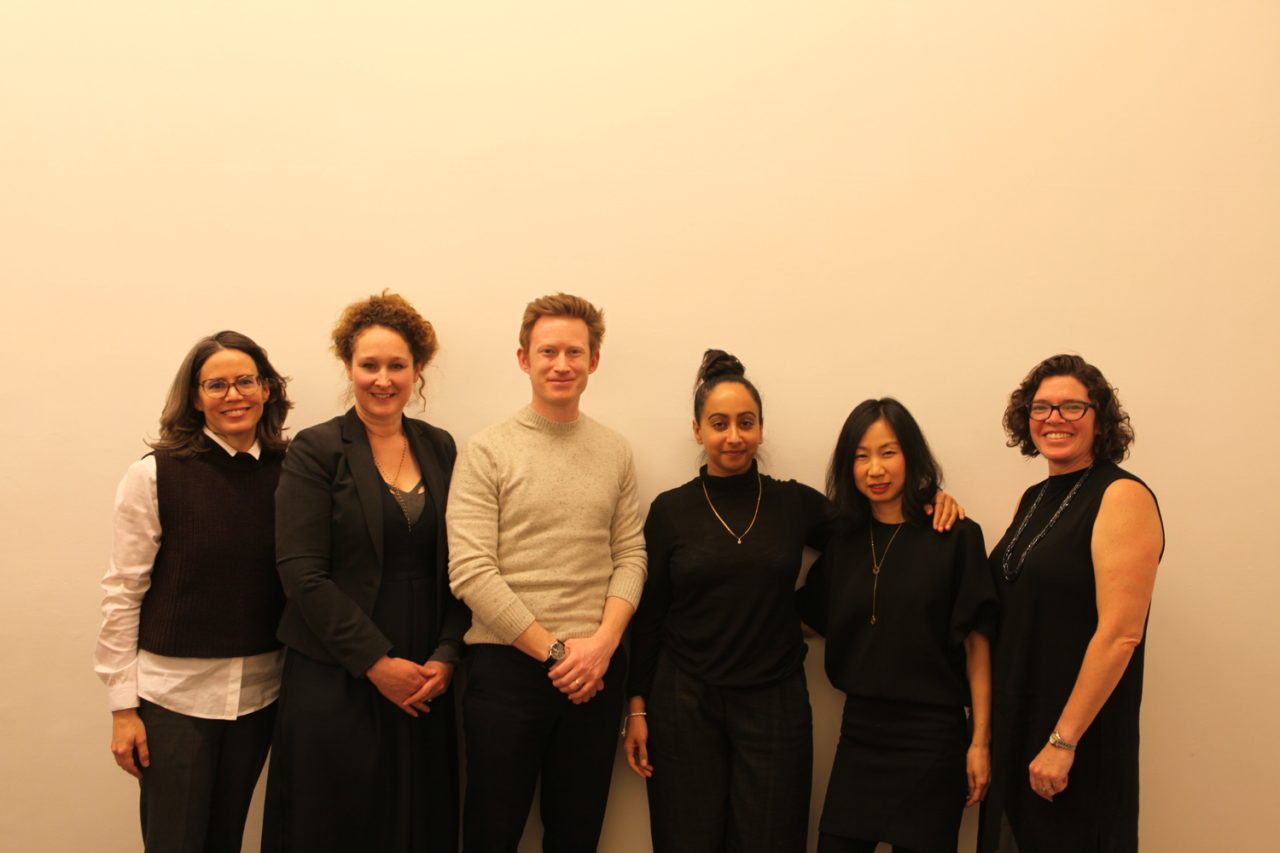
So much data, so much space, so many variables! What does it all mean for architecture, design and real estate?
Thankfully, the 12.11.17 AIANY Social Science and Architecture Committee event, “In Pursuit of Performance: Financial and Social Metrics of Architectural Success,” helped break down data possibilities into more manageable, meaningful parts. This two-hour program provided perspectives and metrics from a diverse group of speakers.