



The library has become an easy target for those who wish to rewrite history. In recent years, challenges to library funding and collections have coincided with something far more systemic: the erasure of public knowledge infrastructure itself. Datasets vanish from government websites. Climate research disappears from federal servers. When knowledge lives in the cloud, it can be deleted with a keystroke. When it lives in algorithms, it can be subtly censored, deprioritized, or buried beneath biased results shaped by those controlling the code.
A book cannot be deleted from a server or rewritten across a network in the same way. It exists as an object, a primary source, a piece of original truth that persists regardless of who holds power. In an era when institutional knowledge and public information can vanish or be selectively hidden, the physical library and the books within it stand as a material defense of our shared history and democracy itself.
Yet as designers of libraries, we have largely turned away from the book. Over the past decades, the prevailing discourse around library evolution has centered on removing collection space to make room for social and community programming. There is real value in this; libraries as dynamic third spaces are vital to civic life. But in our zeal to modernize, we risk overcorrecting and diminishing something equally essential: the visceral experience of being surrounded by books. The smell of paper. The weight of history on a shelf. The quiet assurance that certain truths endure in physical form.
This tension between the library as gathering place and the library as archive need not be a conflict. Rather, it is an opportunity for designers to practice care in the deepest sense, honoring what a library has always been while reimagining what it can become.
Repair Through Inclusive Design
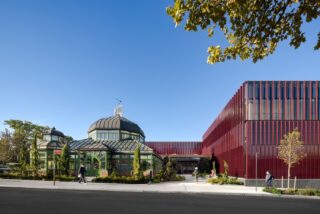
My firm recently worked on three New York Public Library Carnegie branch revitalizations: the 125th Street branch and Fort Washington branch in Manhattan and the Port Richmond branch in Staten Island. These projects taught us that the most powerful design intervention is restoration that also allows for evolution.
The challenge was architectural and political: How do you bring a century-old building up to modern code (updated HVAC, electrical, digital infrastructure) while honoring the iconic Beaux-Arts sequences of large, open, flexible spaces that made Carnegies legendary? We hid the envelope and energy improvements within the walls themselves, so the soaring spaces remained unchanged. We blended stacks and study space. At Port Richmond, we lowered the grand vaulted ceiling that defined the room just enough to tuck necessary building systems above, but we maintained the vault’s iconic proportions and detailing. The community would never see the work; they would only feel its effects. That was the point. We recognized that a community’s relationship to a space is built on continuity. When we centered the historic fabric of these buildings, we sent a signal saying, “Your history matters. This place is for you.”
The design process itself becomes an act of repair. We structure community engagement not around isolated user groups but around thematic coalitions. Librarians, custodians, students, parents, and longtime patrons gathered around shared concerns: sustainability, inclusive design, historic preservation. The relationships forged in the design process become the true infrastructure of civic repair.
Care as Citizen Practice
To design for libraries is to practice a different kind of citizenship. It means working in your own backyard, where you are attuned to context and remain accountable to those who inhabit the spaces you create.
Librarians understand this instinctively. Their job scope expands constantly: They are archivists, technologists, social workers, community organizers, and, increasingly, information experts in an age of algorithmic manipulation. They are among the most attuned observers of community needs, equipped to lead in an AI age where the ability to evaluate sources, understand bias, and defend truth becomes essential.
Designers can learn from this. When we work with librarians as true partners, we build better buildings and stronger practices. We learn how space shapes behavior, how design can either reinforce inequity or actively repair it, and how the most durable infrastructure is built on trust.
Libraries are future-facing institutions, rooted in the belief that knowledge, access, and democratic participation are worth defending. When we design them with care, listening to librarians and communities, building on what people love, we create places people will fight for. And places people love become places they protect.
The physical book, alongside the librarian and community members gathered in that space, remains a radical symbol in our current moment. To design for libraries is to design for democracy. To restore them is to repair the civic fabric they hold together.