

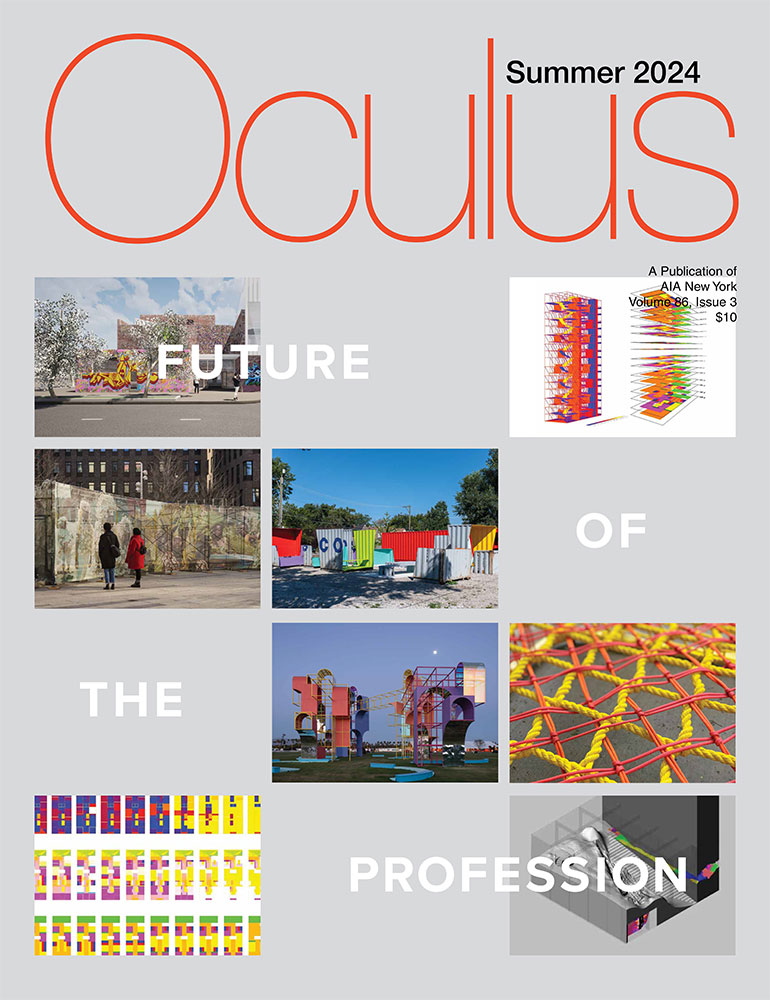
Oculus Summer 2024 magazine cover
“Schools of Thought” appears on pages 16–21 of the Summer 2024 issue of Oculus.

Stephen Zacks’s article, “Schools of Thought,” in the Summer 2024 issue, does a good job of reporting on the intense debate surrounding the NCARB “Pathways to Practice” initiative. However, the article omits a significant and promising solution to increasing access to the profession: online education.

I teach a studio in the newly established online graduate architecture program at Arizona State University. The online program is asynchronous, which gives students flexibility to work within their individual time constraints. Most of my students have jobs, and some have families, but they still find time for school. I’ve discovered we can achieve the same rigor and level of instruction as the in-person modality. We are even able to create a sense of social space, holding a weekly Zoom meeting for all sections, which is optional, but well attended and lively. We also have a website that functions as a community forum to post work and hold discussions. Instructors provide weekly feedback and are available for office hours (i.e., “desk crits”) on Zoom. This is not the online education that was hastily improvised during the pandemic.

Tuition for the online degree is affordable. Students participate from across the U.S. as well as from overseas. Upon completion of the program, online students receive a Master of Architecture degree that is indistinguishable from the degree received by their in-person colleagues. I agree with Michael J. Monti, executive director of the Association of Collegiate Schools of Architecture (ACSA), and Mo Zell, ACSA president and interim dean of art and architecture at the University of Wisconsin, Milwaukee, who were quoted in Zacks’s article, that increased emphasis on the experience path as a solution to inequitable access to education will result in a two-tiered profession. With online education, that need not happen.
Dear Editor,

The visual op-ed by Garo Gumusyan in the Fall 2020 issue of Oculus, “Bring Fútbol to the Skyline and Green Spaces to Uptown, misrepresents accessibility considerations on Randall’s Island.

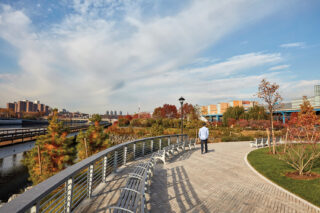
For 20 years, my firm has been involved with the redevelopment of the public park on the island. In that time, working with many other dedicated design professionals in collaboration with the NYC Parks Department, the NYC Economic Development Corporation, the Randall’s Island Park Alliance, and community stakeholders, we have helped redevelop the island into the premier destination for sports and recreation in the city, while restoring its natural environment, including shoreline and wetlands. The result of this prolonged effort is that the island is now rightfully considered an important public-private model for the revitalization of large public spaces. The article, however, completely disregards the long-term, whole-scale transformation that has been ongoing for two decades. The author has constructed an alternate reality where needs such as waterfront development, park accessibility, and social equity have “gone puzzlingly unaddressed.” As an architect intimately involved in master planning for Randall’s Island from the beginning of this project, and as a Latino and an immigrant, I am offended by this writer’s mischaracterization.

The claim that the fields and facilities “are used disproportionately by private-school students” is misleading. Of the 11,000 hours of annual playing time, about half go to public schools and community groups, with the remainder going to private and parochial schools. Free public programming and environmental field trips serve over 8,000 student a year, 85% from public schools in East Harlem and the South Bronx. Sportime, the operator of the tennis center, has also heavily focused outreach efforts on East Harlem and the South Bronx, providing over 15,000 hours of free school-based and local community-based organizations with tennis instruction to more than 5,000 youths from the two communities. The result of these efforts is that the island is hardly the enclave for the privileged that the writer describes.

The Icahn Stadium site is described as “currently dominated by vehicle parking,” which is false. More egregiously, the writer contends that Icahn Stadium is expendable because it “differs little from running tracks found at numerous sites throughout the city.” In fact, designed for premier outdoor track and field events, Icahn Stadium is one of only seven International Association of Athletics Federation’s World Athletics-certified facilities in the U.S. It is the only facility in the Northeast with this designation. More importantly, it may be the only one also designed as a community hub used on a daily basis by local school groups from the surrounding neighborhoods, giving aspiring young track and field athletes a world-class training venue.

Though the writer’s love of soccer is clear, the vision for a professional soccer stadium and its associated cable-stay bridge on the island would be catastrophic to the ecosystem that was so carefully restored as part of the park now enjoyed by so many. That this speculative proposal appears in an issue titled “Climate Change + Social Justice” is both ironic and tragic.

Sincerely,
Ricardo Zurita, AIA, LEED AP
Principal, Ricardo Zurita Architecture & Planning, PC


Read Garo Gumusyan’s response to this letter here >


Editor’s Note: This letter is an online exclusive that did not appear in the Winter 2021 print edition of
Oculus

BROWSER UPGRADE RECOMMENDED

Our website has detected that you are using a browser that will prevent you from accessing certain features. An upgrade is recommended to experience. Use the links below to upgrade your exisiting browser.