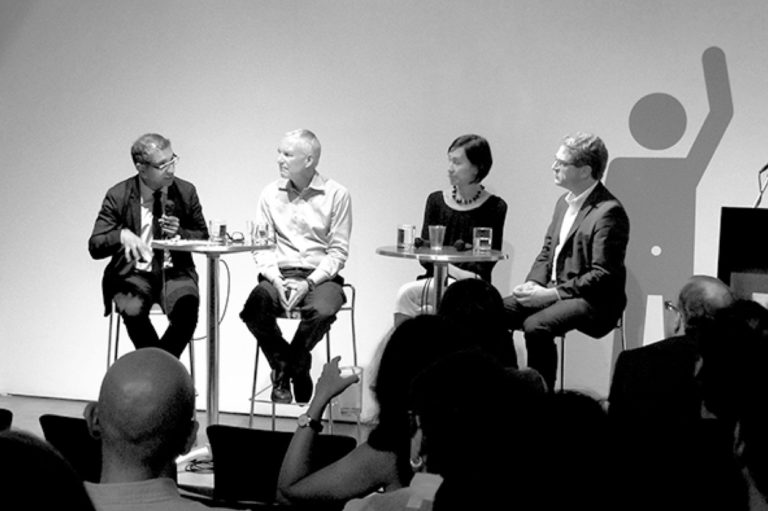



Mary-Margaret Zindren, Hon. AIAMN, speaks with Oculus editors about community care, civic leadership, and Minnesota’s response to the ICE and Border Patrol Occupation.
Overall, we’d like to hear about your personal experience and those of your members. What do you see as your role as the head of AIA Minnesota during this time of ICE deployment and civil unrest?
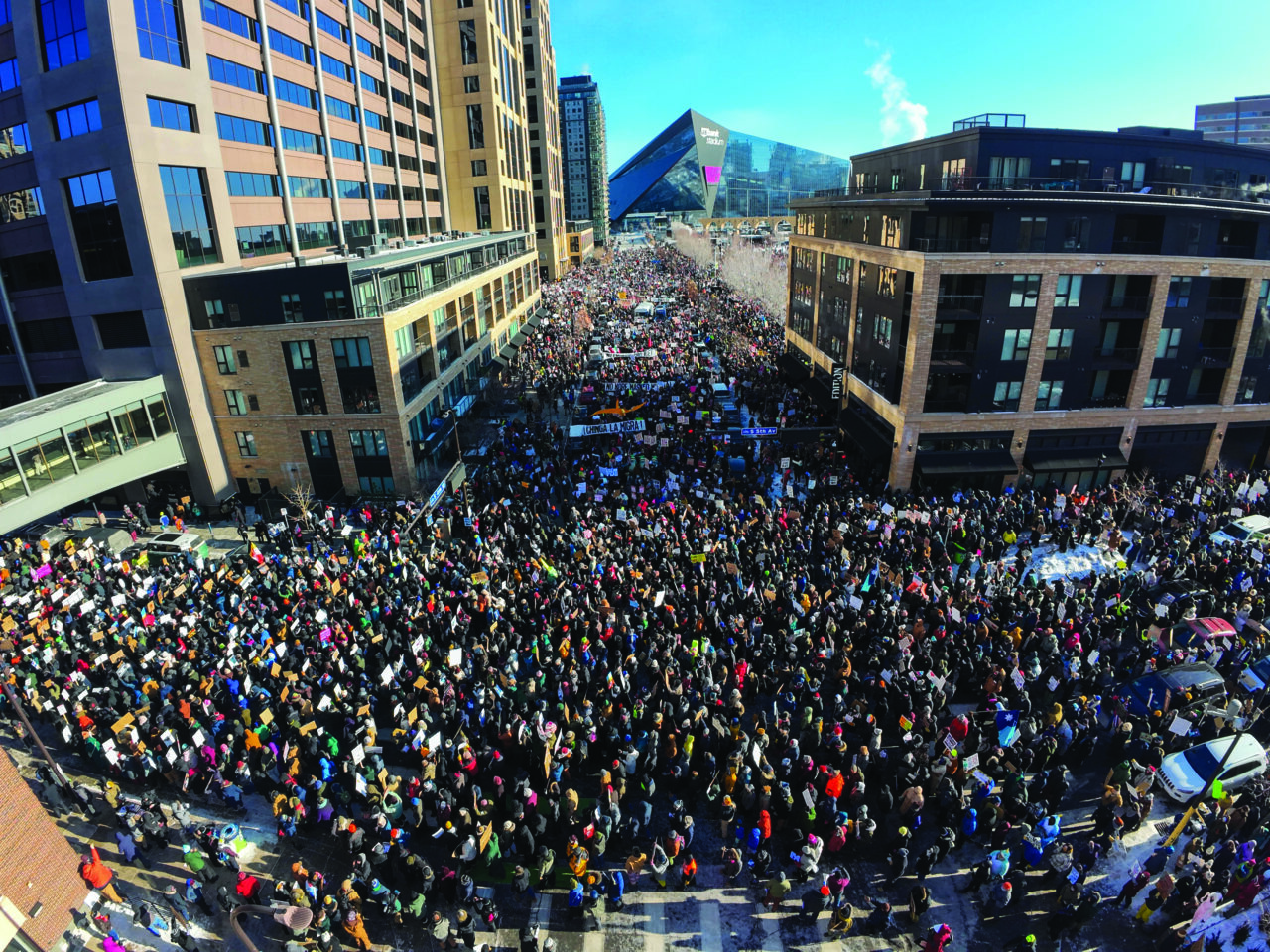
We describe it as an occupation. The military presence was felt in so many areas of the Twin Cities and in suburbs and other Minnesota cities with significant populations of Black and brown people. They estimate that around 4 thousand federal agents were here at the height of “Operation Metro Surge”—nearly four times the number of police officers of Minneapolis and St. Paul and acting in both targeted and random ways.
The helicopters overhead reinforced this. Even if you lived in a less targeted area, you would hear the helicopters at all times of day and night. For me and for many others, the sound of helicopters is always associated with the tragedy and trauma the Twin Cities has experienced. I’ve lived here for nearly 30 years. I think I first remember intense helicopter traffic when the 35W bridge collapsed into the Mississippi River during rush hour back in 2007. There was so much uncertainty and fear. More than 100 cars dropped into the river. Many of us knew people who nearly died.
Then the police killings of Jamar Clark and Philando Castile. I helped to hold ground at the 4th precinct. I had friends who knew Philando—some from high school, others had kids who knew him from his work at a school cafeteria near my home. Helicopters were a constant presence during those times. And of course the murder of George Floyd and the civil unrest of the days that followed. From my house you could not only hear the helicopters, you could also hear the rubber bullets. Two blocks away, a gas station was burned to the ground. This is all to say, even just this one sound of the ICE occupation brought to the fore multiple periods of grief and disbelief and fear and anger we have experienced in the Twin Cities. And instead of a few days this went on for nearly two months.
When our members face challenges that are not integral to the everyday work of architecture or to broader industry challenges, like recessions or the rise of AI, we simply focus on our role as a third space of support. I often say to my members that I don’t want us to be their number one or their number two—those places are reserved for loved ones and for work; but we do want to be their number three or number four. And for many of our members we do hold that place in their lives.
During the ICE occupation, and in the weeks and months following the most intense period of the surge, our staff team would start off each conversation with members simply checking in to see how they were doing. Many members would break down in those moments. They would tell us about how they had been keeping it together for their family or powering through their work, and in talking with us they just let it all out—their fears and anger and disbelief. Their weariness.
This is the unique position that our organization, our staff team, holds with members. We exist to support each member throughout the whole of their career in architecture—from first introduction to the profession through architecture school, first jobs, mid-career, retirement, and to the end of their lives. Our volunteer leaders and staff have shown five-year-olds how to design a house suited for their favorite stuffed animal, and we’ve attended funerals for people who had been AIA members for 70 years. Because we are with our members for the ups and downs of a life in architecture, they recognize that we are with them for the ups and downs of life broadly, too. Last week a member told us about their continuing fears of seeing SUVs with blacked out windows and thinking about whether they should still be keeping their passport on them. That same week a member sent a photo of their newborn baby to share with the staff team.
Our work as an individually based membership association is very personal, which is why we take it personally when our members of color, when our immigrant members, are treated badly by anyone; when they feel fearful for themselves and their loved ones. The whole time of Operation Metro Surge, I felt like I was holding my breath. I genuinely feared that a member of our architecture community—a student, a faculty member, a designer, or an architect—would be harmed or taken. Or that this would be true of one of their loved ones. Two of our members had been visiting family in the Caribbean and were warned by neighbors not to come home yet, that their block had become a checkpoint within the broader Latino area they live in. Once they felt safe to come home, I felt I could breathe again, that the worst was over.
In the aftermath of the intense ICE presence, are there efforts by local architects to protect themselves and the broader design/construction community? Are there ways in which designers are shaping a more positive or constructive goal in the aftermath of the occupation?
What’s true is that our members did not show up as architects; they showed up as community members—as neighbors in the broadest sense of the word.
They showed up to protect kids leaving school to make sure they got home without being accosted or taken. They showed up to gather and deliver supplies like diapers and food to people who were too afraid to leave their homes because of the color of their skin or the accent they speak with or what they wear.
You have to remember, people were being physically assaulted, taken and detained for hours or days or sent to other states or other countries. And they were and are US citizens. They were and are legal immigrants. Or they are those whose only crime was being undocumented.
People were also being killed, assaulted, and detained for protesting—for holding a protest sign that was deemed disrespectful, or blowing a whistle too loudly, or for using their bodies to protect a neighbor.
To be real about it, none of this has much if anything to do with architecture. In times like this, you aren’t an architect first; I wasn’t an executive director first. We were humans and neighbors first.
As an organization, we did not stand up specific efforts for the AEC industry related to the ICE occupation, nor did the firms I know. Instead, firms, AIA Minnesota and our local chapters gave people space and support to show up as they needed to and wanted to. I do think our experience dealing with the trauma and impacts of the murder of George Floyd led us to be more practiced in showing up in ways that were actually supportive and that recognized the whole of who people are.
For people of color and immigrants in the AEC industry, we provided emotional support and responded to the specific needs they identified—from time away from work and their usual volunteerism to care for vulnerable relatives and neighbors, to protest and to protect people in their neighborhoods, to pack food and materials with faith communities and food shelves, to donate to provide rent relief to those economically affected by the occupation and to legal defense funds.
Our firm leaders and volunteers recognized that events like these can require expanded definitions of “family” when it comes to people taking time to care for their loved ones. And that people may power through in the moment and then days, weeks, months, even years later experience the emotional force of it all.
As AIA Minnesota, AIA Minneapolis, and AIA St. Paul, we supported and encouraged architects and designers to show up as community members. Doing so is foundational to the civic leadership we encourage in our AIA members. And this is where there actually is a strong connection. The more that architects and designers are in real and right relationship with community, the more that they understand community needs, the better their design solutions, and the more equipped they are to take on civic leadership roles
The more that architects and designers are in real and right relationship with community, the more that they understand community needs, the better their design solutions, and the more equipped they are to take on civic leadership roles.During the civil unrest after the murder of George Floyd, my then president, Karen Lu, FAIA, and I wrote a column that was reprinted and quoted in publications across the US and internationally. It led, “People matter more than buildings. This must always be so.” The ICE occupation was another time when our members demonstrated this belief.
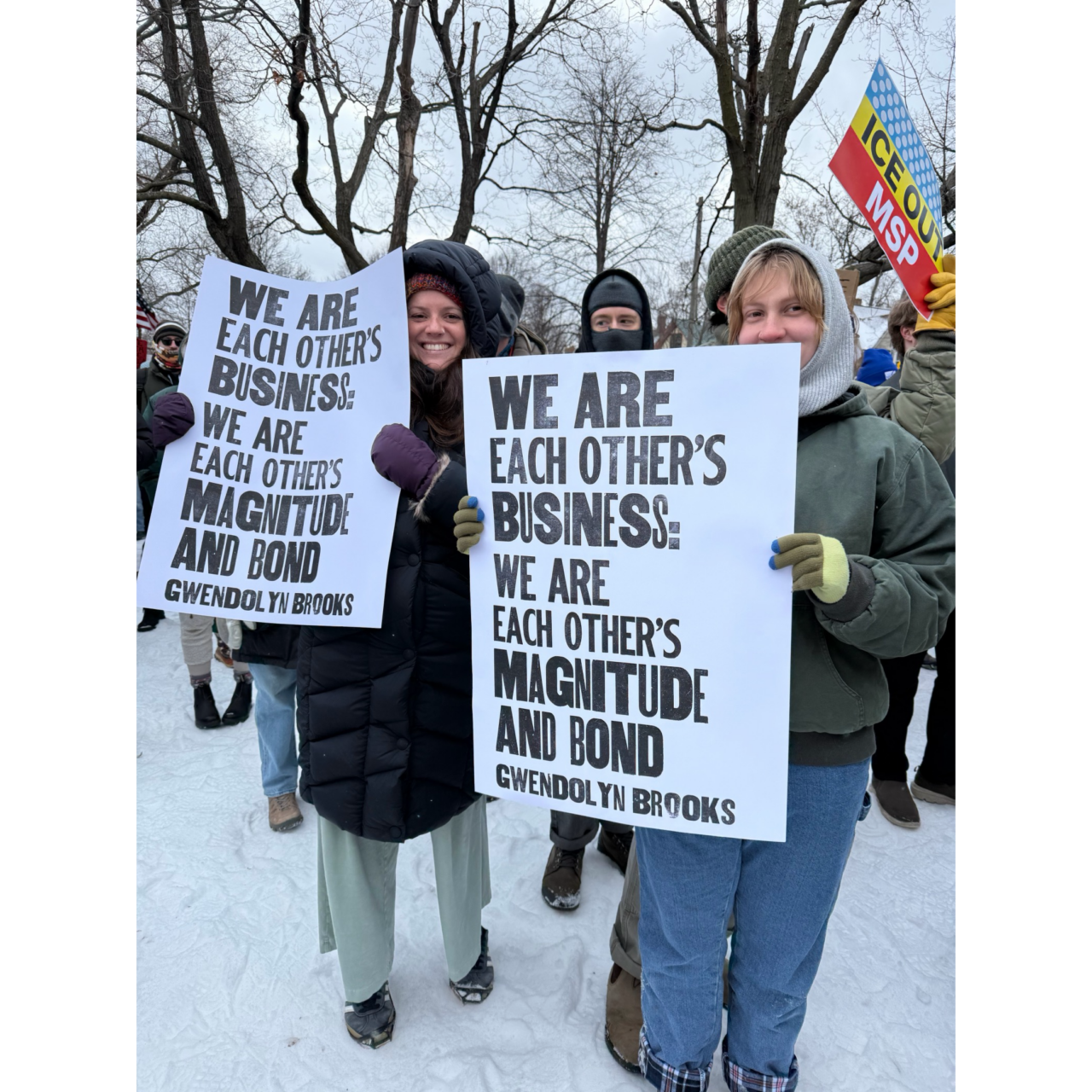
There’s another phrase I think our Twin Cities response was rooted in. It’s from the late and beloved senator Paul Wellstone, who died in a plane crash 25 years ago. Ironically, it is carved into the stone of the Federal building in Minneapolis where you go to get your passport renewed. He said, “We all do better when we all do better.” This is a sort of mantra for us. You see it on lawn signs, on protest signs. It speaks to the mutuality and interconnectedness that feels foundational for us here.
Are there ways that the layout, development, accessibility, and zoning of Minneapolis and St. Paul made things harder or easier for ICE to carry out its actions?
That’s an interesting question. Many Twin Cities neighborhoods are zoned for single-family housing and have alleys that are easily accessible behind each home. The neighborhood where Renee Good was killed is primarily detached single-family homes interspersed with low-rise multi-family buildings (four-plexes, six-plexes). My older daughter’s neighborhood is close by and laid out the same way. ICE used and blocked both the streets and the alleys. They did this when they were targeting particular people and when they accosted people who were just walking or driving down the street, people who they profiled based on race, ethnicity, or religion.
The Twin Cities, like most US metropolitan areas, has a history of discriminatory development and housing policy—things like redlining, racial covenants, and the siting of highways through predominantly Black neighborhoods. We also have a large Native population, mainly of the Dakota and Ojibwe nations, who have been in Minneapolis for generations, many forced here in the 1950s through the Indian Relocation Act. They have established a strong and vibrant American Indian Cultural Corridor with community and arts centers, healthcare, and housing.
The Twin Cities region also has a strong history of actively encouraging and supporting immigrants to settle in Minnesota. We have a faith- and nonprofit-based infrastructure that goes back to the 1800s where Swedish, Norwegian, Polish, and Catholic churches and settlement houses provided support to new immigrants. After World War II and the Vietnam War, the Twin Cities was a welcoming hub for refugees. This continued in the ’80s and ’90s through today. We have large Latino, Hmong, and East African communities, who have established neighborhood hubs of activity, including restaurants, shops, schools, and places of worship that are specific to various racial and ethnic groups.
When you combine all these factors, you get specific pockets of the city that can be easily targeted if you are seeking to profile people based on skin color, language, and religion. There are particular major corridors—East Lake Street, Nicollet Avenue (including “Eat Street,” where Alex Pretti was killed), Cedar Avenue, East 7th Street, Cesar Chavez Street, University Avenue, among others—that were swarmed with Federal agents during the occupation. This happened in the neighborhoods surrounding those corridors, too. ICE agents would fan into the residential areas and even set up militarized checkpoints, stopping each car to look at who was in it, their skin color, how they were dressed, and to hear what accent they spoke with. They would then take people regardless of their immigration status, ignoring passports and papers. This all makes it sound so orderly. The checkpoints were, but most of the time it was chaos. ICE agents would speed down both major corridors and quiet residential streets and alleys, ignoring stop signs and red lights, often in big SUVs with tinted windows. They would drive the wrong way on one-way streets. And they would surround people and cars at random, blocking people in.
What are your priorities as an organization as you move forward?
I attended my younger daughter’s college graduation this weekend. She graduated from the College of Liberal Arts at the University of Minnesota. It was held in the hockey arena, where nearly 10,000 of us gathered to celebrate. The commencement speaker was an alum of UMN who is a screenwriter; he wrote Contagion and also worked on the documentary An Inconvenient Truth. What he had to say about global pandemics and climate change was interesting and got big rounds of applause. But when he spoke of his pride of being a Minnesotan following the ways we stood up for our neighbors during the ICE occupation, the response from the crowd was deafening. In a room already bursting with pride for our graduates, we overflowed with emotion.
We are Minneapolis strong. Twin Cities strong. Minnesota strong. And our strength shows up, as The Atlantic put it, in “neighborism—a commitment to protecting the people around you, no matter who they are or where they came from.” Where that strength comes from exactly, I don’t know. It truly may be as simple as the weather. I think Thomas Friedman got it really right when he said, “Minnesotans are winter people. Don’t come for winter people in winter. They’re not afraid of the cold. Just the opposite. The weather has forged a unique neighborliness…a basic human impulse to look out for your neighbors.”
So again, Minnesota’s architects and designers showed up as humans and as neighbors. That’s exactly what they should have done in this situation. Showing up putting people first, rather than putting architecture first, was the right thing. At a recent AIA Minneapolis Annual Meeting, we did a poll and asked our members to identify their superpower as architects and designers. The number one response was empathy. I agree. I’ve seen it in their design solutions, and I’ve seen it in how they show up for each other and for the people around them, no matter who they are or where they came from.