





New Yorkers don’t always see eye to eye. They are famously opinionated and rarely shy about voicing disagreement. But there is one thing on which consensus is pretty much universal: a deep-seated hatred for sidewalk sheds. They are everywhere, thousands of steel pipe and hunter-green plywood structures covering miles of sidewalks, interrupting our daily commutes and leisurely strolls. They narrow already crowded sidewalks, block storefronts, and create long, dimly-lit, claustrophobic corridors that feel less like public space than infrastructure purgatory.
The sheds exist for a good reason, of course: protecting pedestrians from falling debris during construction, façade repairs, and building maintenance. In a vertical city where building never ceases, they are a necessary evil. But the standard shed—the so-called “BSA shed,” approved by the Board of Standards and Appeals in 1974—was never meant to be a permanent fixture of the streetscape, even though it often lingers for years at a time.
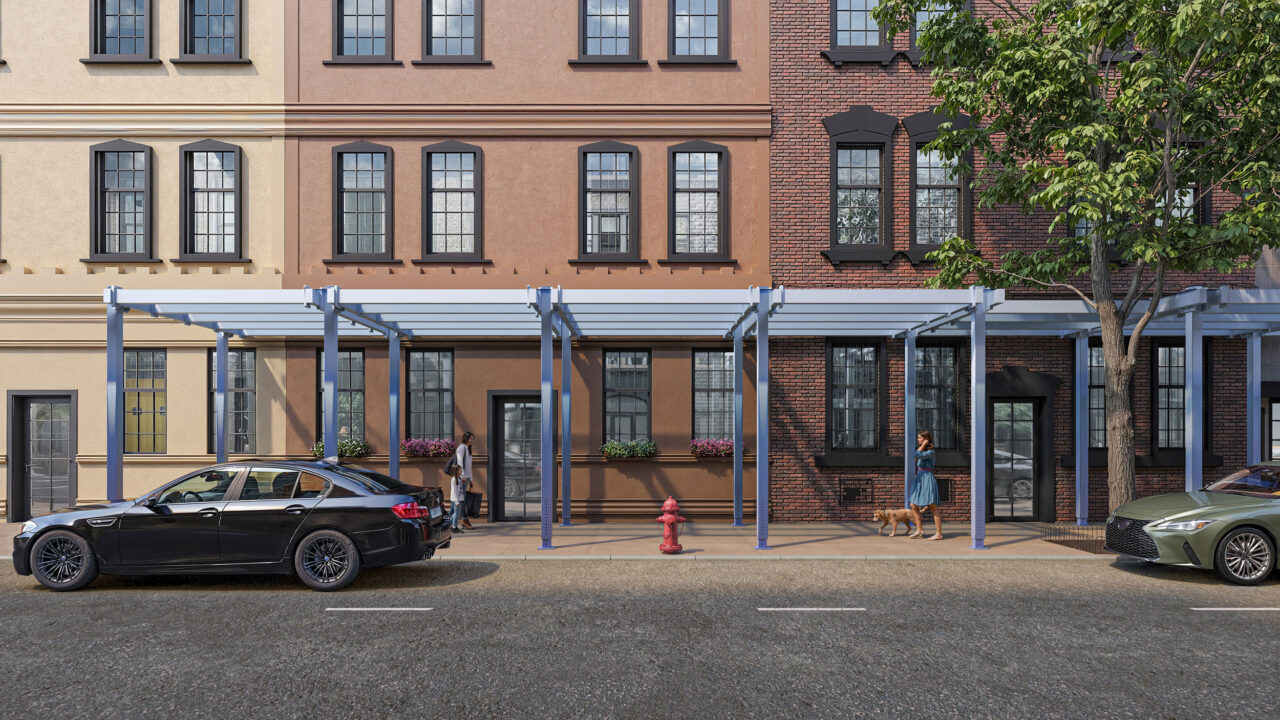
Last November, following an RFP, Mayor Eric Adams and the New York City Department of Buildings (DOB) unveiled six new sidewalk shed designs as part of the city’s Get Sheds Down initiative, a broader effort announced in 2023 to reduce the duration of sidewalk sheds and rethink their role in the public realm. Three designs were developed by Practice for Architecture and Urbanism (PAU) and three by Arup that respond to long-standing complaints while maintaining public safety requirements—and in doing so, they have given the sidewalk shed a distinctly new face.
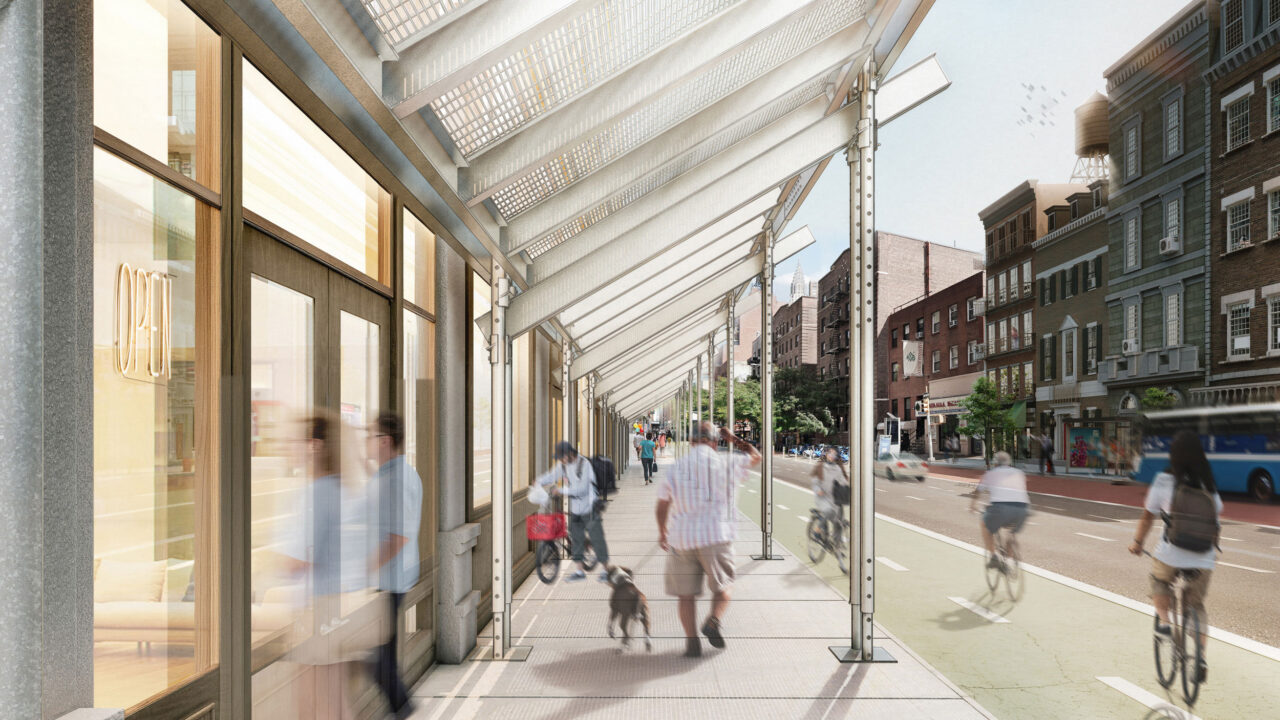
For PAU (whose team includes LERA Consulting Structural Engineers, Tang Studio Architect, Fisher Marantz Stone, RWDI, Dharam Consulting, and Langan), the project was a chance to address a problem hiding in plain sight. “We’re urbanists, and improving our cities and the everyday experience of the sidewalk is central to the work we strive to do,” says Associate Principal Mark Faulkner. Given that a single shed can extend hundreds of feet, he adds, “The scale is literally massive. Being able to manipulate that, for the better, was a huge opportunity.”
PAU approached the task analytically, distilling the city’s goals into a set of key, interrelated priorities: circulation and visibility, natural and artificial lighting, cost and sustainability, structural and safety considerations, and assembly and flexibility. Extensive research followed, including data analysis to understand the range of conditions and concerns the sheds would need to address.
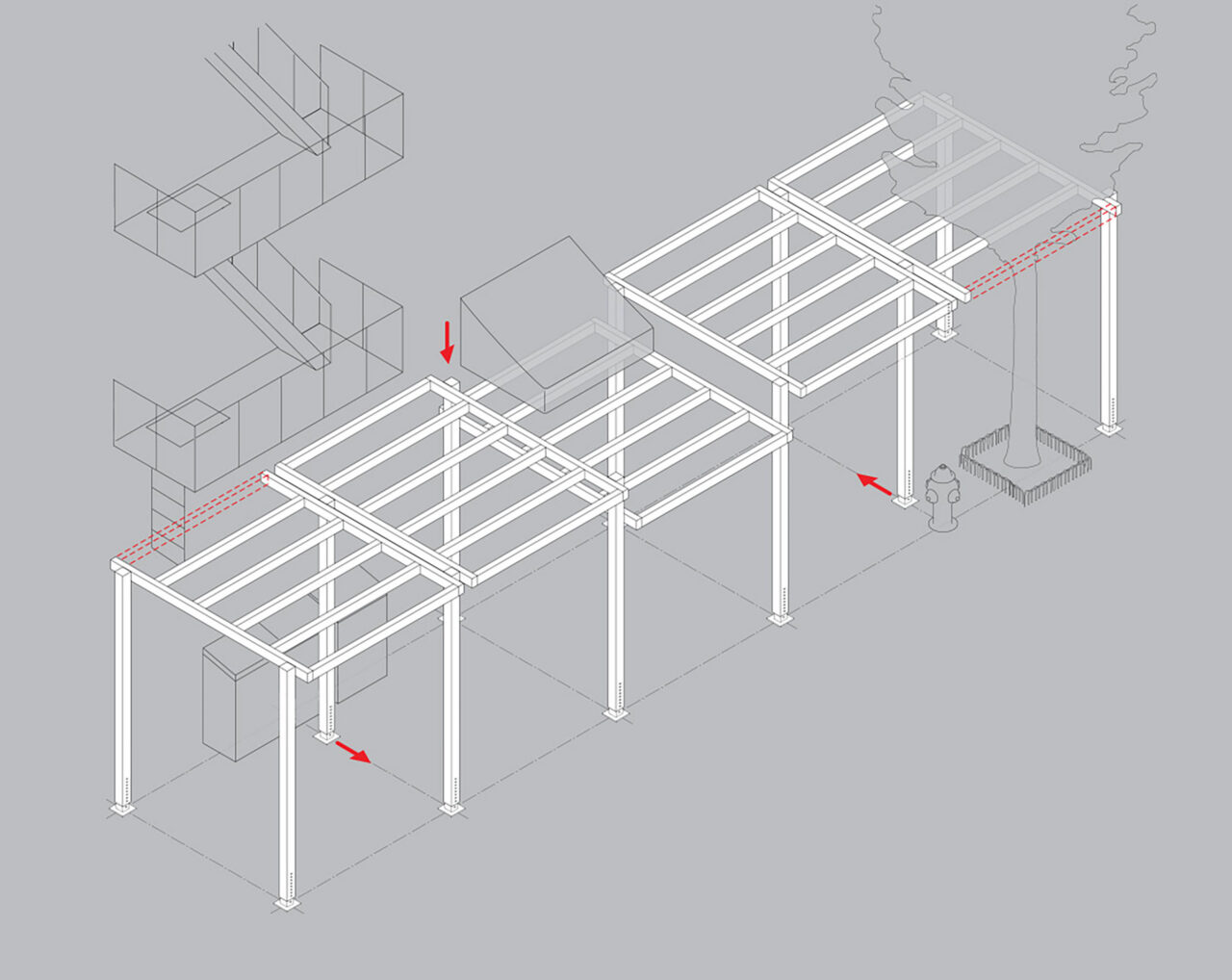
The Baseline Shed, intended for most sidewalks, introduces a subtly angled roof—adaptable to accommodate a flat deck, if required—that opens sightlines and allows daylight to reach the sidewalk. The Wide Baseline Shed adapts this approach for broader sidewalks, maintaining a flat working platform above while carving light in at the curb edge. Both systems employ a steel framework with grated decking topped by polycarbonate. The Speed Shed, by contrast, is a lightweight aluminum system with rockfall netting, designed for rapid, emergency deployment. To achieve its goals, PAU eliminated cross bracing at pedestrian level, developing two-way structural nodes at the deck that carry the loads through frame action.
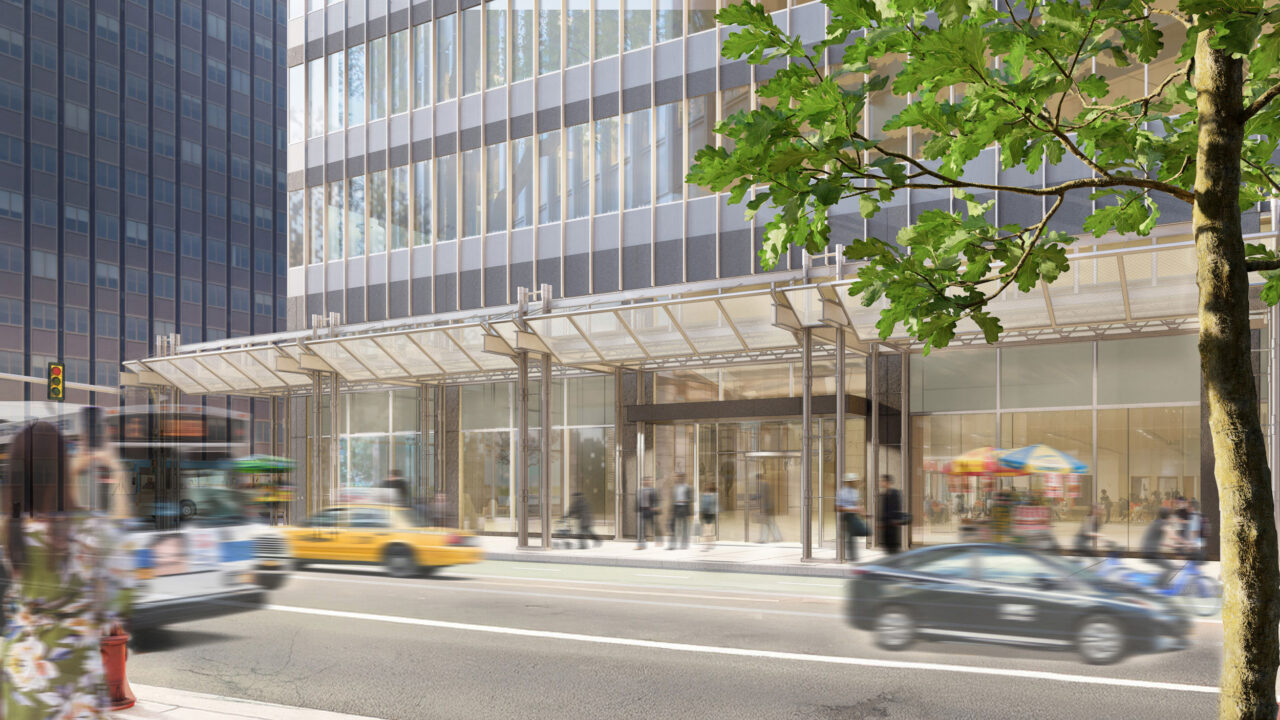
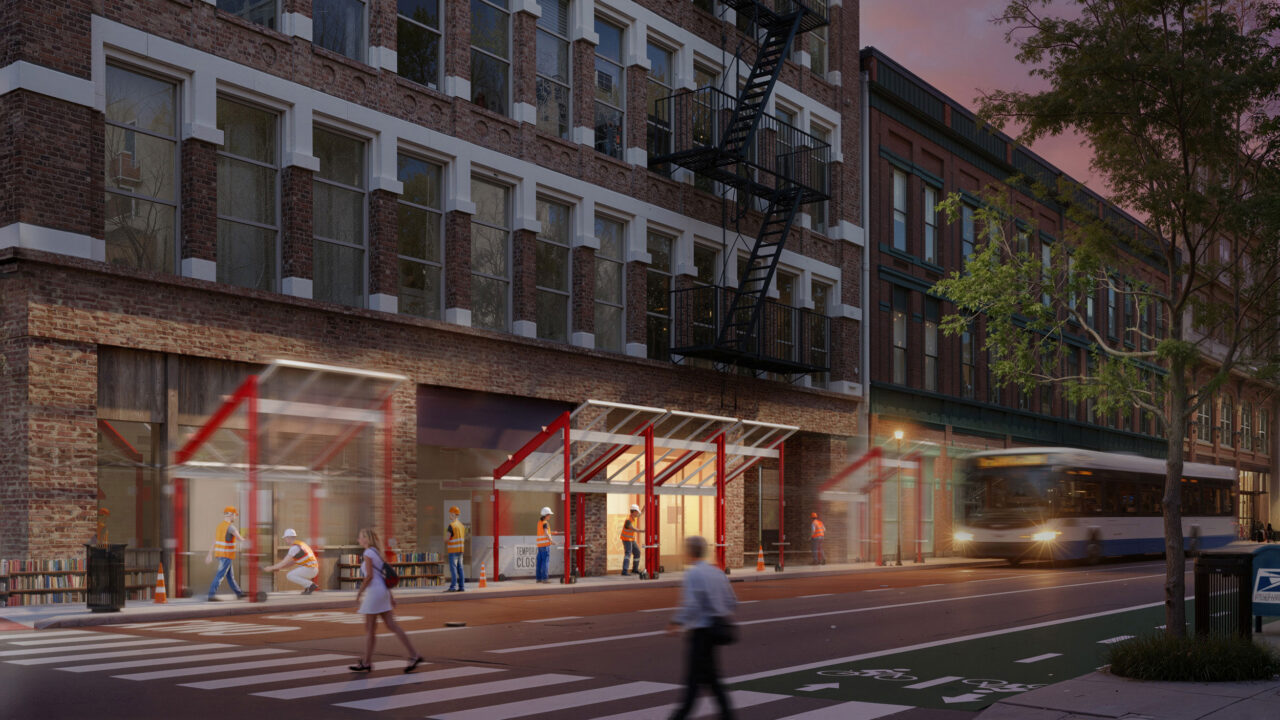
Arup’s engagement with sidewalk sheds dates to the 2009 urbanSHED competition, when the firm provided engineering support for finalist KNE Studio. “We’ve been thinking about sidewalk sheds for almost 15 years,” says Seth Wolfe, a principal in the New York office. More recently, the team was consulting with CORE Scaffolding on alternative shed concepts when the city issued its latest RFP, at which point Reddymade joined the team. “It felt like a real opportunity to finally improve the urban landscape and the pedestrian experience in a meaningful way,” says Wolfe.
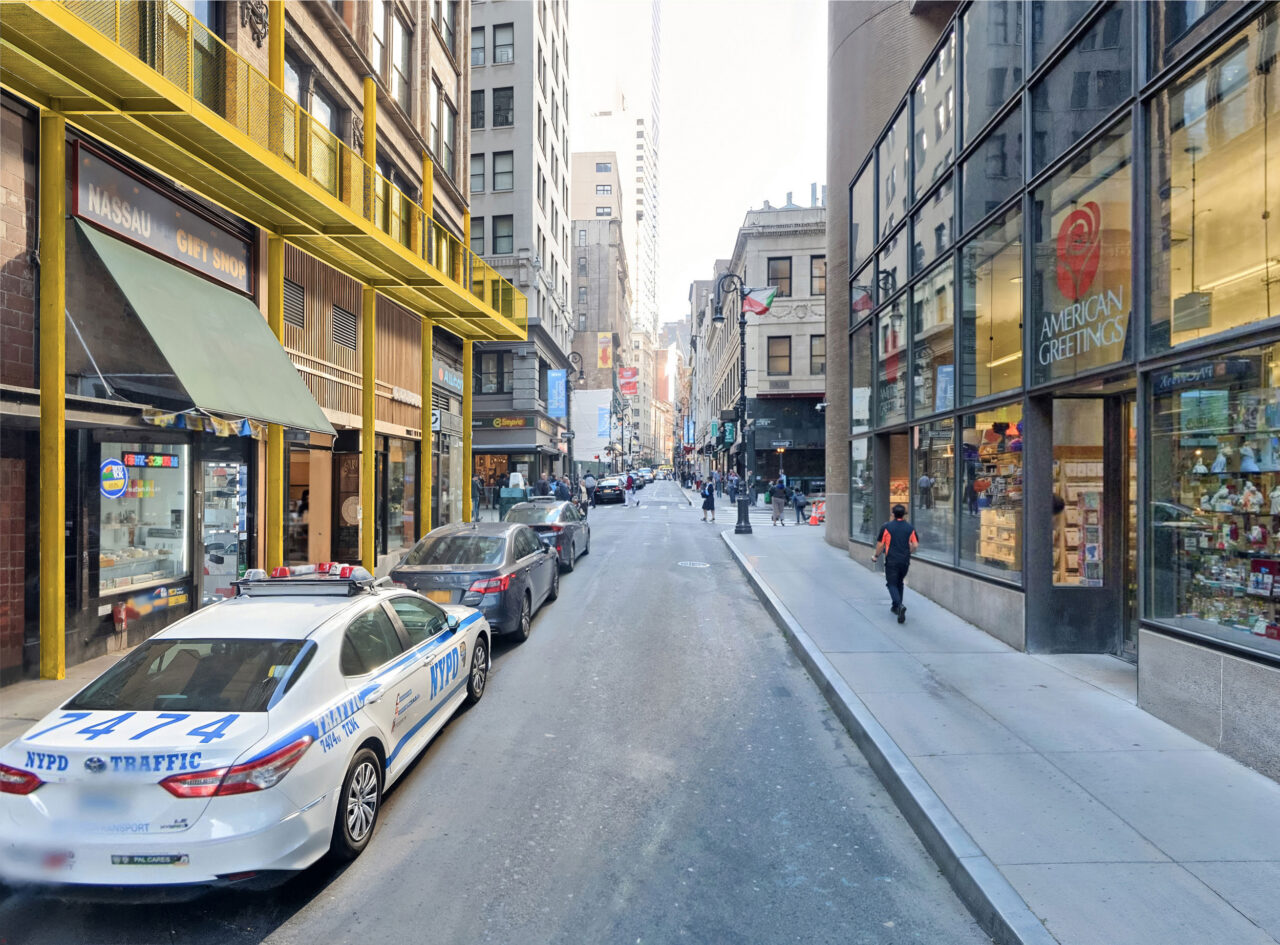
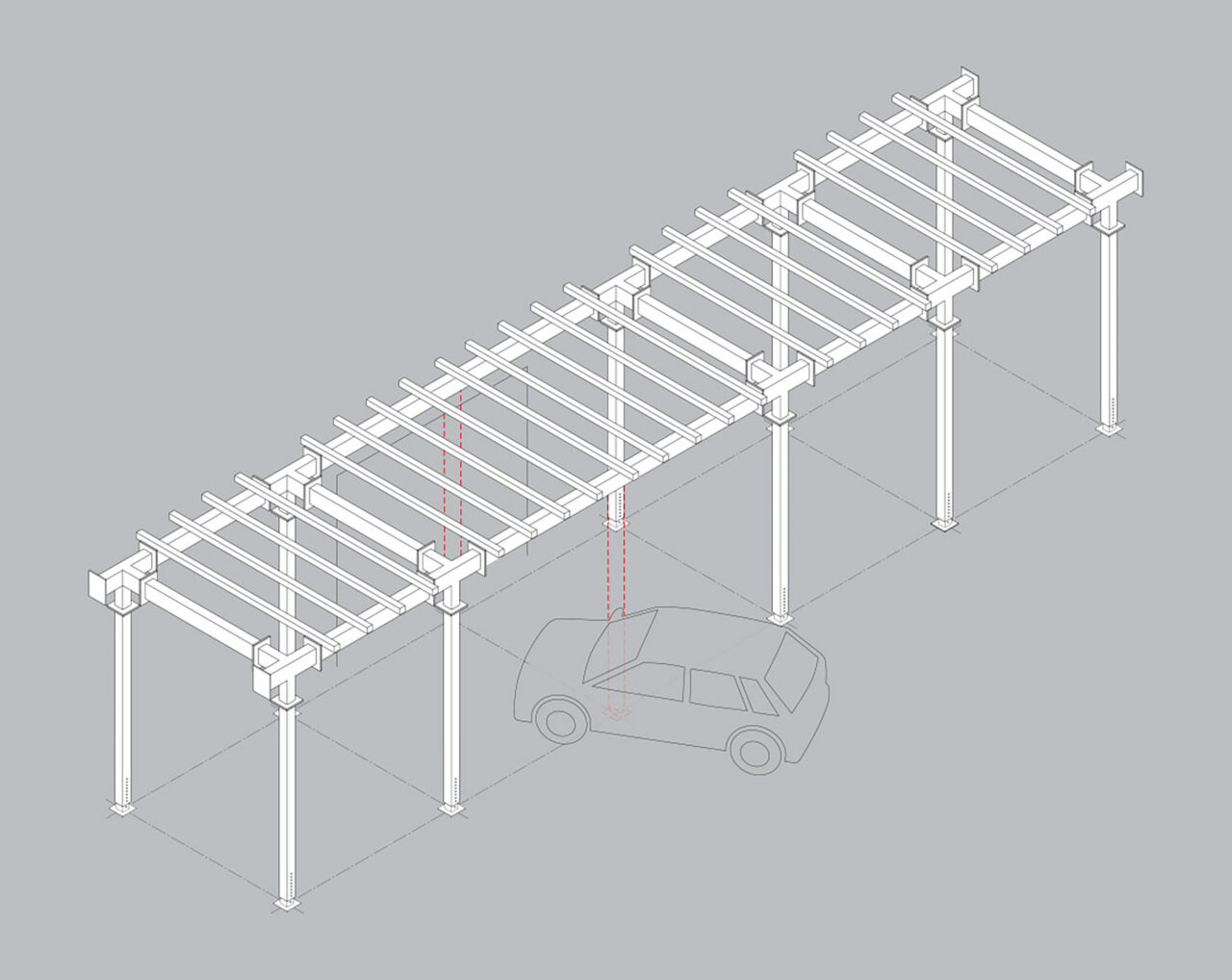
Building on years of research, Arup’s three designs—the Rigid Shed, Flex Shed, and Air Shed—emphasize modularity and adaptability across a range of sidewalk geometries and site conditions, including larger column spacing and longer spans, without altering the overall architecture. The Rigid Shed is a heavy-duty system capable of supporting construction and scaffolding, organized around prefabricated structural nodes that accept columns and beams of varying sizes. The Flex Shed is a lighter-duty, protection-only system that allows both horizontal and vertical adjustments, enabling the structure to shift around trees, signage, and other obstructions. The Air Shed eliminates sidewalk columns altogether by tying back into the building structure, an approach inspired by modular shelving systems and suited to especially narrow sidewalks. Across all three, Arup prioritized open circulation and improved lighting—including options for metal grating and polycarbonate decking—both to enhance safety and to support the economic health of street-level retail. The team is also exploring ways to customize the sheds with different finishes, colors, or graphics.
While PAU and Arup did not collaborate directly, they have coordinated on certain tests—such as decking systems and wind-tunnel studies—to avoid duplicating efforts. The two firms’ schemes inevitably invite comparison to the Urban Umbrella, the product of the city’s 2009 competition. Though the light-colored, curved-canopy model is in use around the city, its proprietary nature and higher cost have limited widespread adoption. As DOB Deputy Press Secretary David Maggiotto explains, ownership of intellectual property proved to be a crucial lesson. “Unlike the urbanSHED competition, these six new designs all belong to the city,” he says. “Any company will be able to use them free of charge.”
That distinction matters. The continued dominance of the BSA shed owes much to convenience: its plans can be copied directly from the original approval and self-certified for code compliance, enabling same-day permits. To extend that same ease of adoption to the new designs, the DOB is laying the groundwork to embed them into agency rules. Once finalized, design professionals will be able to cut and paste the schematics, self-certify compliance, and secure approvals without delay.
That distinction matters. The continued dominance of the BSA shed owes much to convenience: its plans can be copied directly from the original approval and self-certified for code compliance, enabling same-day permits. To extend that same ease of adoption to the new designs, the DOB is laying the groundwork to embed them into agency rules. Once finalized, design professionals will be able to cut and paste the schematics, self-certify compliance, and secure approvals without delay.
Cost remains a central question; contractors and property owners may hesitate to adopt systems that are new, unfamiliar, and likely more expensive than the time-tested BSA shed. The design teams were explicitly tasked with keeping costs reasonable, reusing existing durable materials where possible, and designing systems that are straightforward to assemble and dismantle.
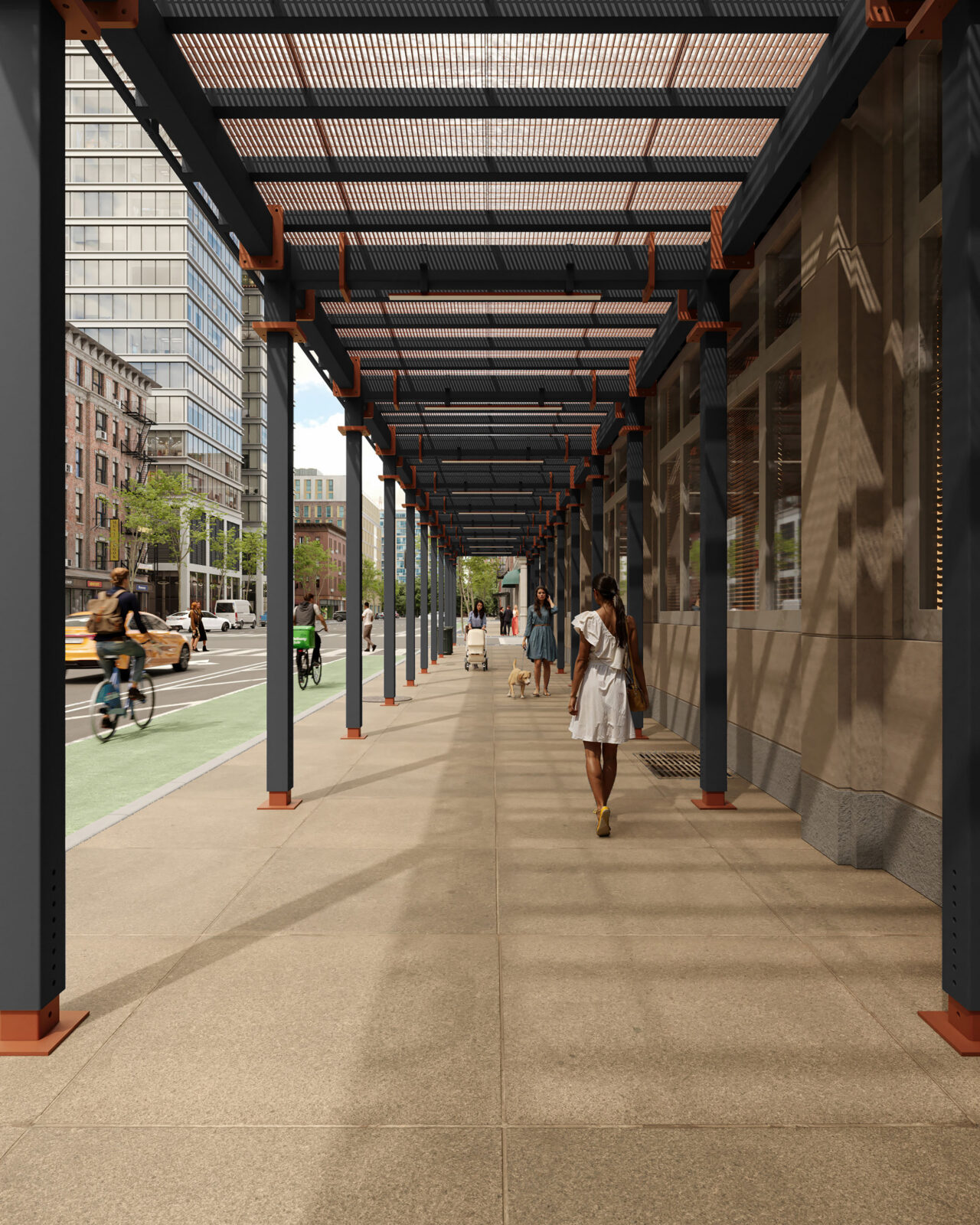
Even so, DOB acknowledges that the new sheds will require some upfront investment. The long-term hope is that better lighting, clearer circulation, and less visual obstruction will pay dividends for building owners and neighborhoods alike. The teams are confident of this gamble: “We know from our partner, CORE Scaffolding, that building owners are willing to spend more for something that doesn’t obstruct their storefronts, and makes building access easier,” says Wolfe. “It’s not going to become a reality unless we are costconscious,” says Faulkner.
What happens next is less dramatic than the unveiling, but no less consequential. As the teams develop construction documents and mock-ups, they are simultaneously working with the DOB on the agency rulemaking process, which includes public review and hearings. If all proceeds on schedule, the city expects the new sheds to begin appearing on sidewalks in 2026. One wild card remains: the new mayor, whose stance on the new sidewalk sheds, as of press time, has yet to be made clear. (Before his election, Mayor Mamdani did pledge to remove all city-owned sidewalk scaffolding that had been in place for more than three years.)
If widely adopted, the designs could quietly but fundamentally reshape New York’s streets. Sidewalk sheds are not going away; they are a permanent part of this dynamic city’s ecosystem. It may finally be time to treat them not as a provisional bandage, but as an integral part of the urban fabric.
BETH BROOME (“Street Level”) is the former managing editor of Architectural Record and a writer based in Brooklyn.