



Architects are both advocates and mediators by training and in practice. We are taught to boil complex questions down to their essential elements, weigh differing viewpoints, and build consensus around solutions that are concrete and yet hold a multiplicity of experiences. And if this sounds like the practice of architecture, it also sounds like the practice of democracy—which is exactly why it is crucial that more architects take an active role in civic life.
Especially as our broader civic discourse grows increasingly strained, architects can help bring a sense of reason and balance to public conversations and processes that in turn support better community outcomes. In my volunteer role as the chair of Manhattan Community Board 5 (CB5), I have seen this beneficial dynamic firsthand.
Most New York City practitioners will be familiar with community boards, the all-volunteer bodies with advisory influence on key land-use decisions across the five boroughs. For those of us who have gone through a uniform land-use review procedure (ULURP) process in our professional lives, it can sometimes feel as if community boards are little more than roadblocks. But it is vital to remember that these bodies are among the primary ways residents can engage directly with city government; boards are also key mediators among public and city agencies and elected officials who set and enact policy. A board’s recommendations may not be binding on their own, but they have real impact—and this is where architects can make a difference as advocates.
A good example from recent news headlines is the Midtown South Mixed-Use Plan, a significant rezoning effort spanning 42 blocks in Midtown Manhattan that was developed with the aim of expanding housing production and economic activity. The plan area falls squarely within CB5’s district, and our board engaged in a review process with city agencies, key stakeholders, and the general public for more than a year. There was consensus on certain broad goals—nearly everyone can agree that we have a housing shortage—but in reclassifying a huge swath of land from industrial to residential use, many groups had differing concerns about what and who might get left out.
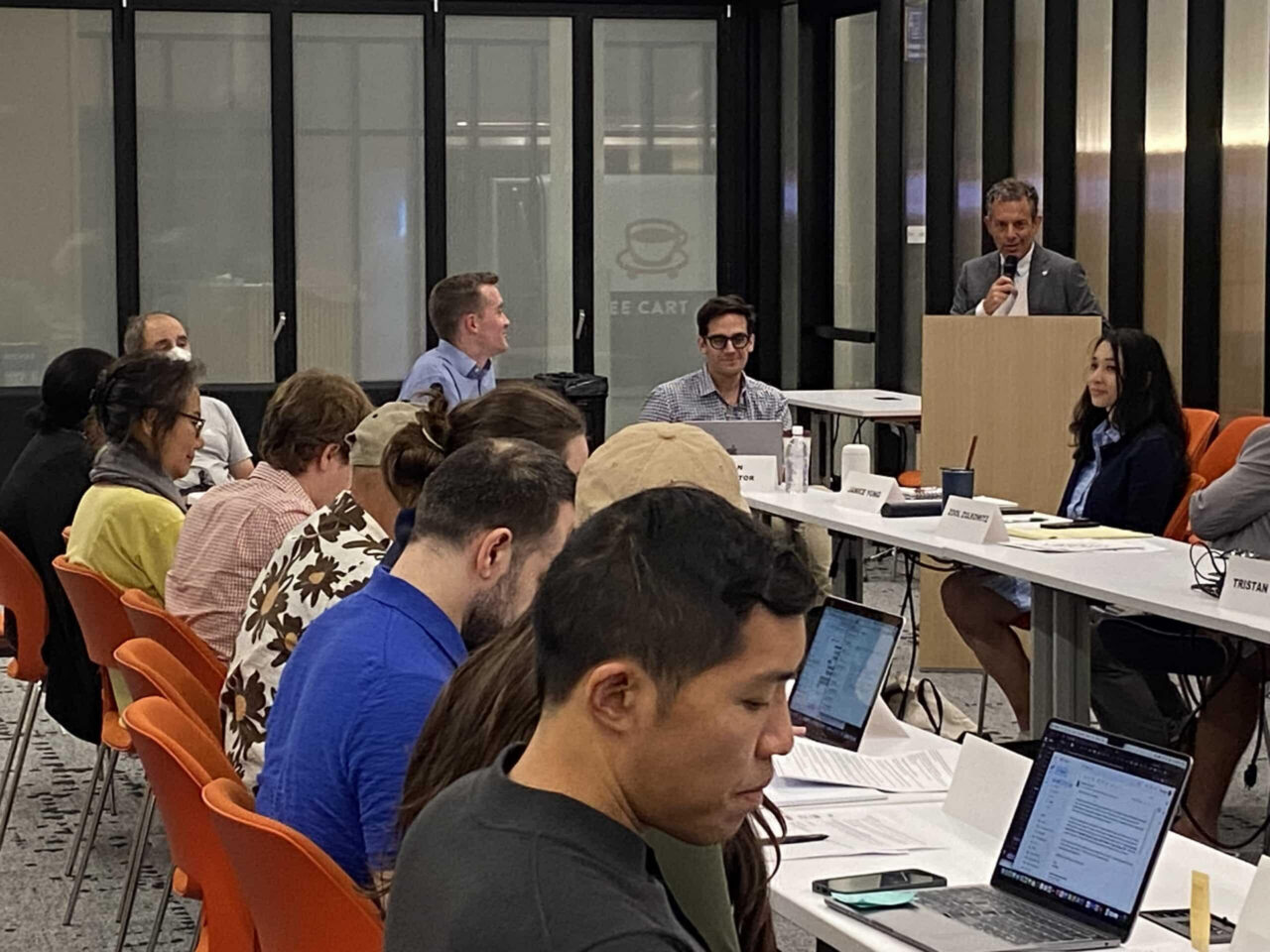
Fortunately, architects are well represented on CB5. In addition to myself, the chair and vice chair of the Land Use, Housing & Zoning Committee are architects, as are several of the board’s public members who can vote on committee-level resolutions and take part in important board discussions. Working in collaboration with our fellow board members, we were able to push for a contextual and community-focused approach to the rezoning, ultimately creating a points-of-agreement document that advocated for essentials such as sidewalk and transit improvements, pedestrianization efforts along Broadway, and securing one of the last remaining sites for a school in this district. At the same time, in part thanks to the professional experience of CB5’s architect members, we also encouraged New York City officials to remove restrictions on residential conversions in the rezoning area, enhancing sustainability while contributing to the overall housing production goals. When the rezoning was formally adopted by the New York City Council in August 2025, it was accompanied by many commitments our board had requested in the points-of-agreement document (thanks to coordination with our elected officials). CB5 viewed this outcome as a significant accomplishment and proof that advocating through a designer’s lens can have an impact.
Not every community board is so fortunate, and not every policy process follows this enviable path. The consequential City of Yes for Housing Opportunity zoning text amendment—which now sets the stage for as many as 80,000 new housing units in coming years—received at least a conditional “yes” vote from only 20 out of 59 community boards citywide, including CB5. While this landmark zoning plan ultimately was approved by the city council and the mayor, it still faces a not-insignificant level of opposition in many communities that may negatively impact other housing initiatives.
Plenty of architects gave nuanced testimony in favor of City of Yes, and the AIA New York Chapter itself provided a letter of support to the City Planning Commission. But much of this advocacy, while technically public, happened in a de facto professional silo outside the view of an average New York City resident, even one engaged enough to attend community meetings. What if more architects had been community board members throughout this process? Architects are very well represented on CB5, but this is more the exception than the rule. For public bodies with oversight on land-use decisions and the opportunity to explain essential yet complex considerations and likely outcomes to the public, it’s imperative that architects get involved at all levels.
It’s also important to recognize that this kind of civic engagement is a two-way street. Architects who serve on community boards or within similar groups will learn from these experiences in ways that benefit their professional work and make them better practitioners. This is certainly true from my perspective. Serving on CB5 and as the board’s chair during parts of the City of Yes review process, and for the entirety of the Midtown South Mixed-Use Plan process, gave me an accelerated course on best practices for negotiation, consensus building, and project management. This work has also pushed me to think creatively in new directions, and to learn from the process of collaborating with an extraordinarily diverse array of fellow citizens. It’s also a valuable reminder that the passion for problem-solving, and for inspiring social and spatial solutions, exists well outside our professional corridors. If we have the opportunity to lend our time and perspectives to this shared advocacy for a better city, why wouldn’t we?