






At some point in our education, we as architects and designers were once STEAM students. I have personally benefitted from a science, technology, engineering, arts and mathematics, or STEAM education as an alum of the New York City public high school system, during a time when STEAM education was not very prominent. That’s why, when Spacesmith was awarded the expansion of the Brooklyn STEAM Center High School at the Brooklyn Navy Yard, I knew our team had a special opportunity: to maximize student involvement as much as possible.
This recent experience, I think, sets out a roadmap for student advocacy and championing schools by being an integrated part of their curricular and enrichment planning. To set the stage, Spacesmith developed a very replicable approach to K–12 schools advocacy through its involvement.
The STEAM Center was intended to resemble a workplace, so students can be treated as young professionals and learn hands-on trades and skills that are applicable in the real world. The design intent was to highlight and celebrate all the inner workings that make up the built environment.
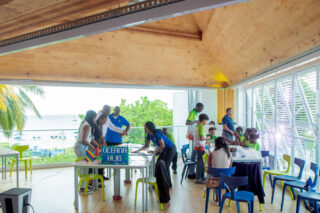
With that in mind, we inspired our project team to make the process a hands-on learning experience for their high-school-age students. The team conceived of various appealing and immersive ways to engage and uplift the students by making them part of every project delivery phase. Creating a mantra for the school’s design and the path to getting there, we began to say, “This school will be built with students, for students.”
Almost doubling its footprint on the full third floor of the Navy Yard’s Building 77, Spacesmith created a process to bring students’ minds into the design of 27,000 square feet of bright and comfortable classrooms, shops, lounge areas, and administrative zones customized for academic success in three STEAM path-ways: design and engineering, construction technology, and full-stack software application development. I worked with Spacesmith to engage about 24 students in the expansion project in several highly interactive ways:
Student surveys and observation days. Our diverse student teams provided actionable insights on daily operations and areas for improvement over their original facilities.
Design charrettes. Led by me as architect along with Spacesmith senior associate and interior designer, Alexandra Koretski, NCIDQ, the design team facilitated sessions with students from each STEAM pathway to envision how their learning environments should look and feel.
Construction walk-throughs. With our partners in the faculty and administration of the Brooklyn STEAM Center, a New York City public school, we crafted educational site tours for students during the build-out, transforming the expansion work itself into a teaching tool.
Direct advocacy of the school’s architectural needs is only one effect of the process. These kinds of client group engagement processes result in more than successful design outcomes, as they also promote the mission and vision of the school’s founders. They reinforce the benefits of STEAM learning environments for neurodiverse student bodies, and elevate the benefits through real-world outcomes—with budgets, schedules, and consequences for literally thousands of students and teachers.
Most of all, our experience reminds us as architects and designers that our professional capabilities can translate into effective advocacy simply by tweaking our processes and shifting our mindset. Three benefits come from this rededication of our approach: First, we support a highly effective grassroots advocacy to complement our other professional colleagues around the nation, who engage with public officials and school boards to drive better top-down decision-making. Second, we support innovation in K–12 education by allying with individual school leaders. Last and perhaps most fulfilling for this project team has been the opportunity to encourage the next generation of architects, interior designers, engineers, construction professionals, and others whose work will focus on leveraging design around the world.
This approach also offers a path toward designing for equality and justice. By equipping smart, young students with the tools of architecture so they can have a hand in the design of their schools, we’re helping them improve their quality of life—and their personal sense of efficacy and civic engagement in this exciting, fulfilling role. As one student told the na-tional non-profit Architecture + Advocacy last year, “Learning about architecture made me change my whole mentality. I realized we could not only make South L.A. better, but also the whole world.”
For firms like Spacesmith, this elevated approach to school engagement and design reflects our commitment to the tradition of great architectural craftsmanship, heightened service, and design excellence. Well-designed buildings and spaces are the result of creating meaningful experiences that engage the senses and enable physical, social, and psychological well-being. Enlisting student clients with latent interest in our mission is a natural and effective way to build upon our vision as we also advocate for their futures.