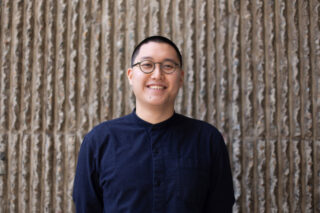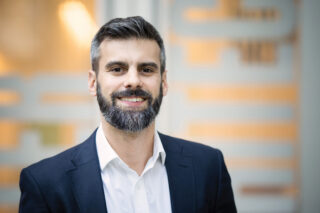




Megan Marini is a founding partner at 3x3, a community-centered design studio, where she leads work focused on civic infrastructure, public engagement and governance, and resilient systems. With more than 15 years of experience, she has worked with public institutions, nonprofits, and international organizations—including the City of New York, United Nations, and World Bank—to collaborate with communities on policy, program design, and initiatives that strengthen social resilience and community well-being.


Last fall, multiple flash floods turned everyday commutes into scenes of chaos: subway stations filled with water, streets transformed into rivers, and basement apartments—home to thousands of low-income New Yorkers—flooded in minutes. Within hours, social media—not government alerts—became the city’s emergency communication system. The storms were reminders of Superstorm Sandy, during which neighborhood groups mobilized more quickly than official responders to get food, pumps, and translation support to stranded residents. These increasingly common events continue to demonstrate not just a failure of infrastructure, but a failure of connection, where communication between residents and official channels often flows only one way.
Emergency events are just one example of how residents are left out of major decision-making and strategic planning. Architects, planners and allied professionals are all too familiar with our current civic engagement system, one built around project-specific public hearings that attract only a handful of residents, comment periods that open after policies are already finalized, and community engagement timed around election cycles. This system cannot meet the speed, volatility, or complexity of today’s challenges. A core barrier is the gap between lived experience and technical expertise: residents know problems firsthand, while officials and built-environment professionals manage systems, regulations, and constraints. Treating these forms of knowledge as complementary and jointly relevant rather than competing—through ongoing and transparent dialogue, engagement, and trust-building— is essential for effective governance and for fostering civic repair.
With the new mayor, Zohran Mamdani, New York City has an opportunity to rebuild the connective tissue between residents and the government that shapes their daily lives. We need a new compact between city government and communities—one in which civic infrastructure engages residents in capital planning and policy prioritization, design, and implementation, and builds shared capacity to adapt and respond to shifting challenges together. This is the potential of regenerative governance: an emerging model of participatory democracy in which civic engagement, collaborative decision-making, and collective action become self-sustaining processes that actively build trust and enhance local capacity to adapt to threats and opportunities. Investing in these forms of governance moves engagement beyond the stakeholders who already have time, access, and influence and expands to include participation of historically marginalized communities—especially communities of color—so they can help meaningfully shape public decisions and advance more equitable, just, and impactful outcomes.
Regenerative governance moves away from one-off consultations that seed mistrust and advances toward continuous civic collaboration. In practice, this could mean neighborhood civic assemblies that set priorities, monitor implementation, and co-design solutions while complying with the processes and constraints of municipal offices; civic labs within agencies that design, pilot, and test policies with residents rather than for them; neighborhood-based crisis response networks that build social resilience before the next storm, heatwave, blackout, or pandemic; and community-run data systems that gather real-time information on housing, food access, transit, and climate impacts, linked into municipal repositories and decision-making. This approach rebalances power, strengthens relationships, and creates the conditions necessary for democratic and civic institutions to continually renew themselves.
In recent years, cities across the country, including Boston, Los Angeles, Chicago and New York itself, have been partnering with community-based organizations and residents to design and test more adaptive and responsive civic engagement models. Policymakers, agencies, and offices historically engaged in public policy and planning have recognized that when community stakeholders participate early and continuously, programs, plans, policy, and projects are more durable and impactful, and citizens have more trust in the government. A recent study from the City University of New York has shown that when residents were involved in a community-engaged process to design and pilot a public space program, social cohesion was strengthened and social networks were seeded, predominantly benefiting underserved communities. The lesson is clear: cities that invest in participatory capacity build resilience.
The Mamdani Administration enters office with ambitious priorities—reforms to advance affordability, access to basic services, climate resilience, and transparency and accountability in government—and we are already seeing important action towards these goals. However, addressing the full spectrum of New Yorkers’ priorities with lasting impact and integrating them into the city’s systems requires not only better policies, but a different way of governing. We are already seeing signs that the administration recognizes this. Its visible engagement at Somos, a key annual gathering where New York’s Latino leaders, policymakers, and advocates align community priorities with legislative action for health, housing, education, and infrastructure, shows a commitment to be present where community leaders are organizing and setting priorities. The selection of a transition committee centered on community organizing and capacity development suggests a potential shift toward valuing lived experience and local community leadership as key sources of public expertise. And finally, its public invitation to residents to “Shape the Future of Our City” and the formation of a new Office of Mass Engagement, which seeks to build on the incoming administration’s mass-organizing success, reflect an interest in participatory governance rather than top-down policymaking.
These early moves do not yet constitute a new model of governance, but they offer promising signals oriented in that direction. The challenge will be translating symbolic gestures and early stage action into durable civic and social infrastructure that endures beyond the transition period. Large-scale engagement does not always translate to meaningful resident participation capable of shaping community-level outcomes. Without robust decision-making structures, credible feedback loops, and clear participant expectation setting, engagement risks becoming performative or extractive—fueling participation fatigue and further disenfranchisement. Furthermore, organizing and civic engagement aren’t always equivalent. They often serve different purposes, drive different outcomes, and require different forms of power-sharing. New York City already has some useful foundations for regenerative governance: the Civic Engagement Commission, community boards, participatory budgeting, neighborhood coalitions, and NYC Open Data. But without expanded mandates, resources, and integration into city-wide operations and decision-making structures, these assets remain siloed, underutilized, and structurally unable to drive adaptive policy and planning.
The Mamdani Administration has an opportunity to build the new democratic infrastructure necessary to meet our current moment. Regenerative governance offers a more effective and impactful approach to governing in an era of constant disruption—enabling cities to build the adaptive civic capacity necessary to navigate volatility, accelerate innovation and implementation, and deliver outcomes that are both equitable and durable. A system of public participation that evolves with—and is co-created by—those most affected will strengthen resilience at both community and city levels, support civic repair, and lay the foundation for a more inclusive, adaptive democracy that better serves New Yorkers. We support the administration’s direction and urge it to act now—the first 100 days offer a critical window to build decisively on early progress and institutionalize new norms before old patterns reassert themselves.