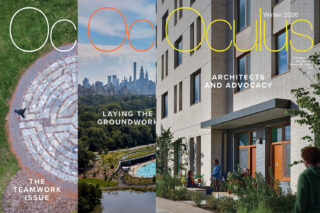



Published last winter, Eiren Caffall’s All the Water in the World paints a fictional image of New York after storms and flooding have overwhelmed the city’s infrastructure and inhabitants (along with, it seems, much of the world). The book opens on a small group of isolated survivors who have made their shelter on the roof of the American Museum of Natural History; when a superstorm breaches the city’s aging flood walls, one family is forced to set out for an imagined sanctuary to the north. The group floats through familiar streetscapes, now submerged. Once on the Hudson, their canoe passes just 10 feet below the bottom of the George Washington Bridge.
As of this writing, I am only about a third of the way through the book, yet the urgency and poignancy with which Caffall depicts the post-apocalyptic city, and the memories her protagonists carry of the time leading up to its collapse, feel uncannily connected to the reporting and first-person accounts that shape this issue. We can see how earnestly architects are engaging with ideas of how to build, improve, and protect New York. It is not difficult to imagine, in Caffall’s world, the professional and personal warnings and attempts at intervention that preceded her submerged city.
Though it could be easy enough to “go there” in our minds these days, this issue of Oculus is not about surrendering to visions of worst-case-scenario futures. It is about the work happening now, under real and growing pressure, by architects who refuse to treat decline as inevitable in spite of the social and economic challenges facing our city. Across these pages, advocacy is not abstract; it is embedded in zoning reforms and capital planning, in housing policy and waterfront infrastructure, in immigration law and public space. It lives in meetings, hearings, job sites, and neighborhoods.
And it does not cast the communities being advocated for as passive or subordinate. Instead, it shows how architects can take turns being students of their communities as well as their advisors. An especially optimistic moment in creating this issue arrived on the deadline for our quarterly “call for op-eds,” when we received an unprecedented number of responses to the question of how architects are using their unique expertise to push for social, structural, or political change. For that reason, we have given much of the issue over to these submissions, in a dedicated opinion section covering many aspects of housing and livable communities in New York, and in our usual op-ed department, with discussions including data centers, infrastructure for day laborers, and work that supports STEM students.
In “When to Say Yes,” Cliff Pearson examines the ethical calculus architects now confront when deciding which projects to pursue. The architects interviewed here describe a practice defined as much by discernment as by design—one that requires weighing values alongside viability, and long-term impact alongside short-term opportunity. That tension is echoed in Stephen Zacks’s reporting on the current administration’s new H-1B visa restrictions, which threaten to sever one of the profession’s most vital pipelines. At a moment when architecture depends on collaboration across borders and disciplines, the narrowing of that path carries consequences far beyond any single firm. For anyone else reading apocalyptic fiction (or real-life news), I hope this issue can foster a more hopeful outlook: the belief that cities can still be strengthened, repaired, and reimagined. The work gathered here is not utopian. It is practical, political, and often hard-won, an indication that architecture remains one of the most powerful tools for answering the challenges of today.