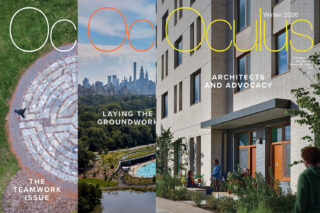
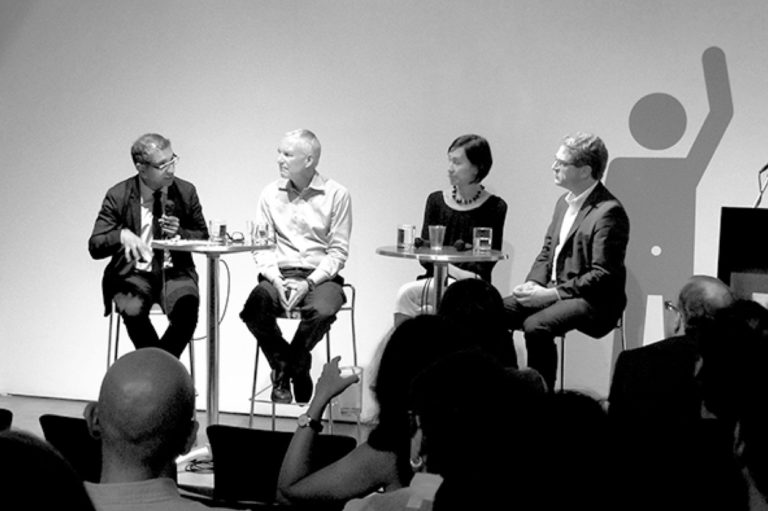

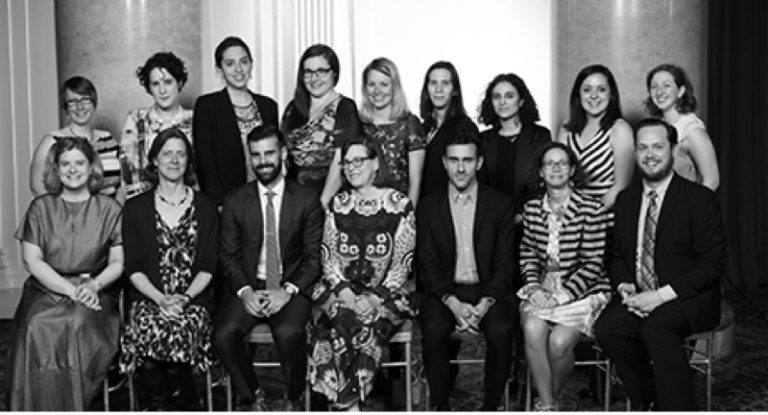


When Design Awards season comes around, I know it is going to offer a glimpse of where the discipline stands—not just in terms of projects that have recently come to completion, but also in terms of the discussions that happen in the jury room. I have an easy job, to come in at the end of the process and listen to the jurors discuss why they chose this year’s 24 award-winners across the categories of architecture, interiors, projects, and urban design. In the pages of this issue, you will see the striking photos and extensive team lists that represent the culmination of the year’s best efforts by AIA New York members, New York City-based architects in any location, and architects from around the world who have worked in the city. But these awards also reveal something less visible: shifts in what we value, what we expect, and what we are willing to recognize as meaningful work. This year’s jurors—Adam Ainslie; Maarten Gielen; Brie Hensold, HASLA; Susan Jones, FAIA; Jeff Kamuda, AIA; Christiana Moss, FAIA; and Kia Weatherspoon, NCIDQ, ASID—were clear-eyed and adept at noting these shifts in their analyses of each project that came before them.
As they told me about their two days of deliberation, one point continually resurfaced: Competent, well-resolved buildings—what Jones described as “good 20th-century projects”—were not what rose to the top. Instead, the jury’s honors reflect an evolving standard, asking more of architecture, and, in turn, of architects. The selected projects ask us to consider what lies beyond form, requiring each to prove its own story and its relevance.
The work featured in this issue confronts real conditions: housing scarcity, climate risk, aging infrastructure, cultural erasure, and the need to support public life. The projects do not prescribe a single solution or rely on the persuasive power of images alone. They operate within constraints—technical, social, political—and respond to them directly. As Jones added, “It takes a lot of work to change a paradigm from 20th- to 21st-century architecture. It sounds like a cliché, but it is not. It is hard work, hard research, developing new systems.” Again and again, the jury celebrated architecture in action.
I learned in our discussion that the jury also examined some of the professional shorthand surrounding architectural descriptions. The common language of “human-scale design” doesn’t always serve the end user, noted Weatherspoon. “We are in the business of people, and people make up communities,” she said. “Yes, it’s semantics, but I want to be more connected to those I’m serving, and when we use this language, that connects us.”
Many of the awarded projects demonstrate a similar profession-wide reorientation, from authorship to stewardship, from self-expression to responsibility. They demonstrate thoughtfulness through careful, nearly hidden decisions: how a public space can be maintained over time, how a building can adapt to changing community needs, or how residents are invited into a conversation early enough in the design process to have an impact. In this way, the architecture becomes a way of sustaining relationships with, and among, the people who use it.
We also see reinforcement of a broader trend, in line with Mark Gardner’s presidential theme of Repair: Democracy and Urban Space. The jury praised several projects that worked with existing conditions, restoring buildings, rethinking infrastructure, reactivating landscapes, and reinvesting in civic space. In this work, repair is not framed as a compromise due to budget or inertia, but as a means of practice that requires technical rigor, patience, and a willingness to engage with complexity. It also suggests a different kind of ambition—one measured not by novelty, but by the ability to extend the life and meaning of what is already in place.
At the same time, the jury was clear that this work is not easy. It demands research, coordination, and persistence. It often requires architects to operate beyond the traditional boundaries of the profession—to advocate, to organize, and to expand the scope of a project before it even begins. As Hensold noted, the most compelling competition submissions made the thinking behind the work visible: the systems developed, the partnerships formed, and the questions that shaped the outcome.
While none of this issue’s projects can fully resolve the social challenges they attempt to confront, they do remind us that architects’ work, in an ideal world, is inspired and improved by constraints. Amid the millions of moments in today’s world that are defined by uncertainty, I hope we can come together in recognition of the clarity behind these awards. They celebrate both what has been accomplished and what is now expected of the profession moving forward.