







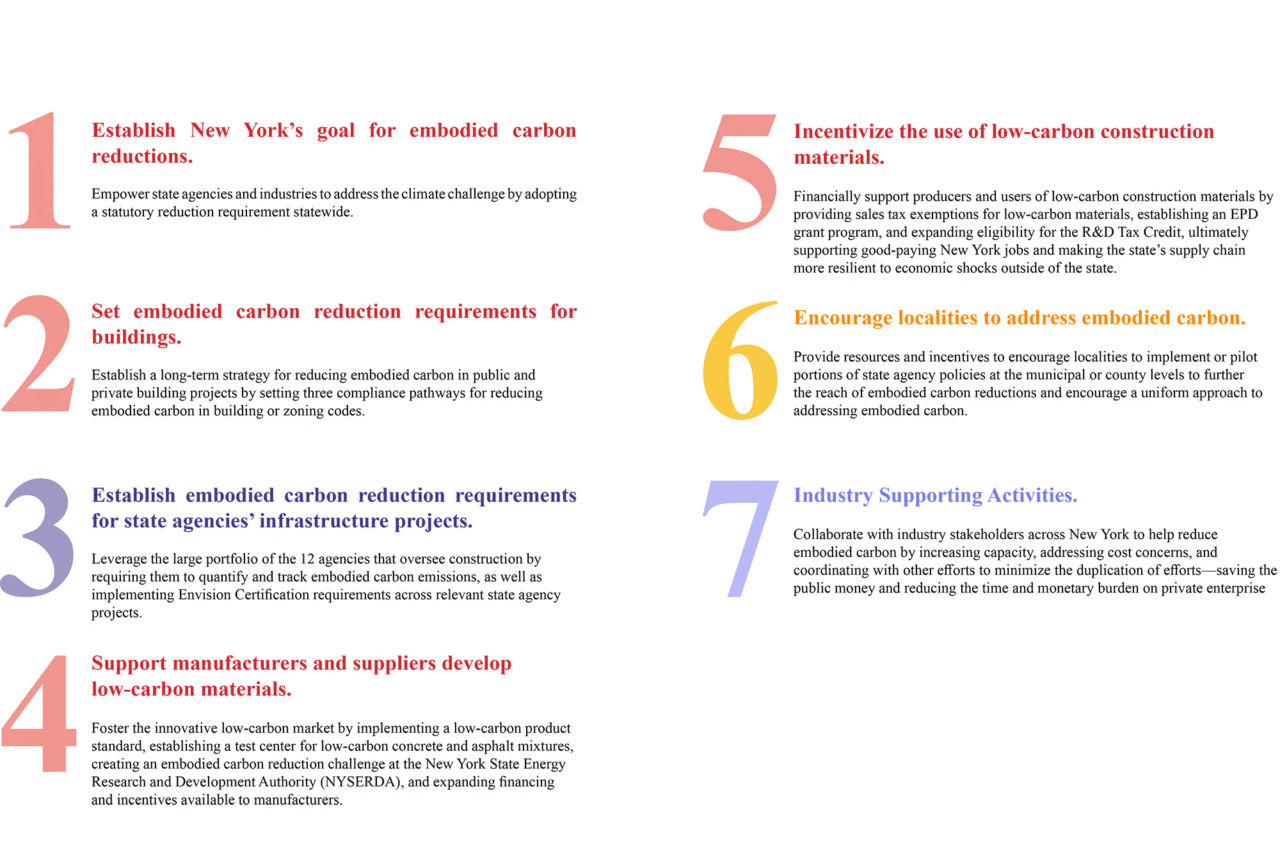
1. Establish New York’s Goal for Embodied Carbon Reductions
Set a statewide statutory commitment to reduce embodied carbon emissions from new buildings, renovations, and infrastructure by 25% by 2035 and 40% by 2040. Based on recent research, much of this reduction should be possible by scaling current technology and best practices, with emerging technology taking over after 20404. High-level targets are essential for communicating the magnitude of reduction needed by all players in the material supply chain and construction economy. These targets should be supported by a corresponding framework for achieving reductions, such as the points outlined below. Codifying reductions over the long term enables New York to build on strategies the state is currently using, including government commitments, procurement requirements and specifications, and private sector commitments.
a. Translate the statutory reductions into interim absolute targets to measure progress
b. Establish a NYS Expert Advisory Group and create a roadmap
c. Establish a technical assistance program and provide funding to implementing agencies
d. Codify Executive Order 22 to legislatively direct agencies to adopt a sustainability and decarbonization program

2. Set Embodied Carbon Reduction Requirements for Buildings
The embodied carbon of new and existing buildings in New York State from residential and commercial construction is projected to add 900 MMT CO2e to the economy over the 2025–2050 period. Buildings form the basis for local businesses, communities, and industry, and present an unparalleled opportunity to leverage innovation for community benefit. In alignment with the state’s carbon reduction goals, establishing embodied carbon reduction requirements for buildings is a key opportunity for policymakers.
a. Set three compliance pathways as the long-term strategy to reduce embodied carbon through state codes
b. Implement and refine project-scale requirements with agency input
c. Consider introducing a collective compliance path for owners or managers of multi-building portfolios
3. Establish Embodied Carbon Reduction Requirements for State Agencies’ Infrastructure Projects
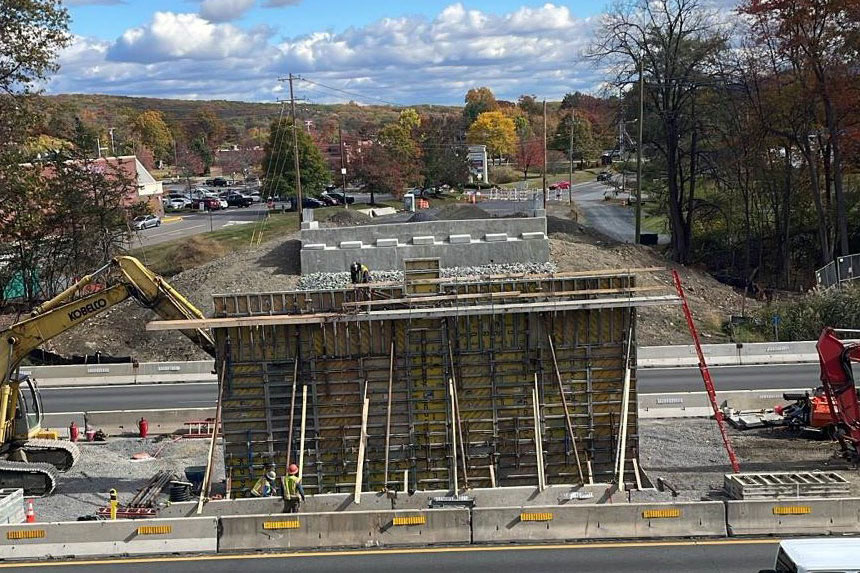
New York State public agencies are responsible for over $28 billion in total construction per year. This large-scale public investment powers the state’s economy by physically connecting New Yorkers to one another, their jobs, the country’s economy, and the rest of the world. As these agencies directly oversee project requirements and construction efforts, this investment provides a unique ability for the New York State Legislature and the governor to direct agencies to quantify and reduce embodied carbon emissions with immediate effect. To support the alignment of New York’s emissions reduction goals, embodied carbon reduction requirements can be established for capital delivery agencies. All agencies should track their average agency-wide emissions intensity annually to track embodied carbon reduction progress and identify when additional agency actions may be required to meet New York’s climate goals. Agencies should track their reduction progress at the agency and project scales.
a. Agency scale: require emissions reporting for construction materials and activities
b. Project scale: integrate envision certification into project design and delivery workflows
4. Support Manufacturers and Suppliers in Scaling the Low Carbon Material Market
Championing innovative New York manufacturers and suppliers will spur additional jobs and investments within New York. However, these new jobs will require clear market signals to investors that New York is truly doubling down in purchasing low-carbon construction materials for public projects, as well as supporting private developers who use these products. Through a series of public commitments, investments, testing centers, and expanded eligibility programs, New York can send a clear, unambiguous message that both public and private businesses will purchase low-carbon construction materials in the state.
a. Adopt a low-carbon product standard
b. Sign a green public procurement (GPP) pledge commitment for New York
c. Support the testing and development of low-carbon, innovative materials
d. Establish an embodied carbon reduction challenge operated by NYSERDA
e. Expand C-PACE eligibility criteria to cover low-carbon building strategies
f. Establish incentives for whole-building life cycle assessments for large projects operated by NYSERDA
g. Evaluate environmental attribute certificate models for low-carbon construction materials
5. Incentivize the Use of Low-Carbon Construction Materials
Incentivizing and rewarding in-state producers of low-carbon construction materials will help 21 spur the growth of good-paying jobs for New Yorkers. However, incentivizing the use of low- carbon construction materials requires the ability to establish a statewide baseline to compare against a reported emissions intensity. Providing support for more product- and facility-specific EPDs will yield a more representative data set and enable reward mechanisms for private and public projects.
a. Provide sales tax exemption for low-carbon construction materials
b. Establish grant program for material manufacturers to develop EPDs
c. Expand eligibility for R&D tax credit
6. Encourage Localities to Address Embodied Carbon
Local stretch codes, zoning policy, and ordinances are an important and fundamental pathway that allow jurisdictions and municipalities to meet statewide and regional goals in a manner conducive with their fiscal resources, general interest, support of embodied carbon, and level of preparedness to meet the goals. Local stretch codes and ordinances can help drive adoption of statewide building standards and drive market transformation.
a. Encourage localities to adopt low carbon zoning requirements for buildings
b. Provide density bonuses for exceptional achievement in low-carbon requirements
c. Expand the Erie County Industrial Development Agency’s adaptive reuse tax incentive program statewide
d. Establish green building incentives to support adaptive reuse projects
e. Establish incentive programs for using low-carbon design principles in building or retrofitting new housing
7. Industry Supporting Activities
While New York agencies can lead the way for implementing best practices and providing technical support or financial resources to stakeholders, industry14 has a critical role in helping reduce embodied carbon. Through a wide variety of activities that support efforts to pass and sustain embodied carbon policies in New York State, industry stakeholders can build capacity, help address cost concerns or highlight additional considerations, and help coordinate with other efforts locally, regionally, and nationally. Each of these activities is detailed below, with examples of actions different stakeholders can take.