
Info
-
Co Chairs
-
Yasemin Kologlu, Int'l Assoc. AIA
-
Mallory Taub, Assoc. AIA
-
-
Special Projects
-
Social Media

Topics
-
June 28, 2022
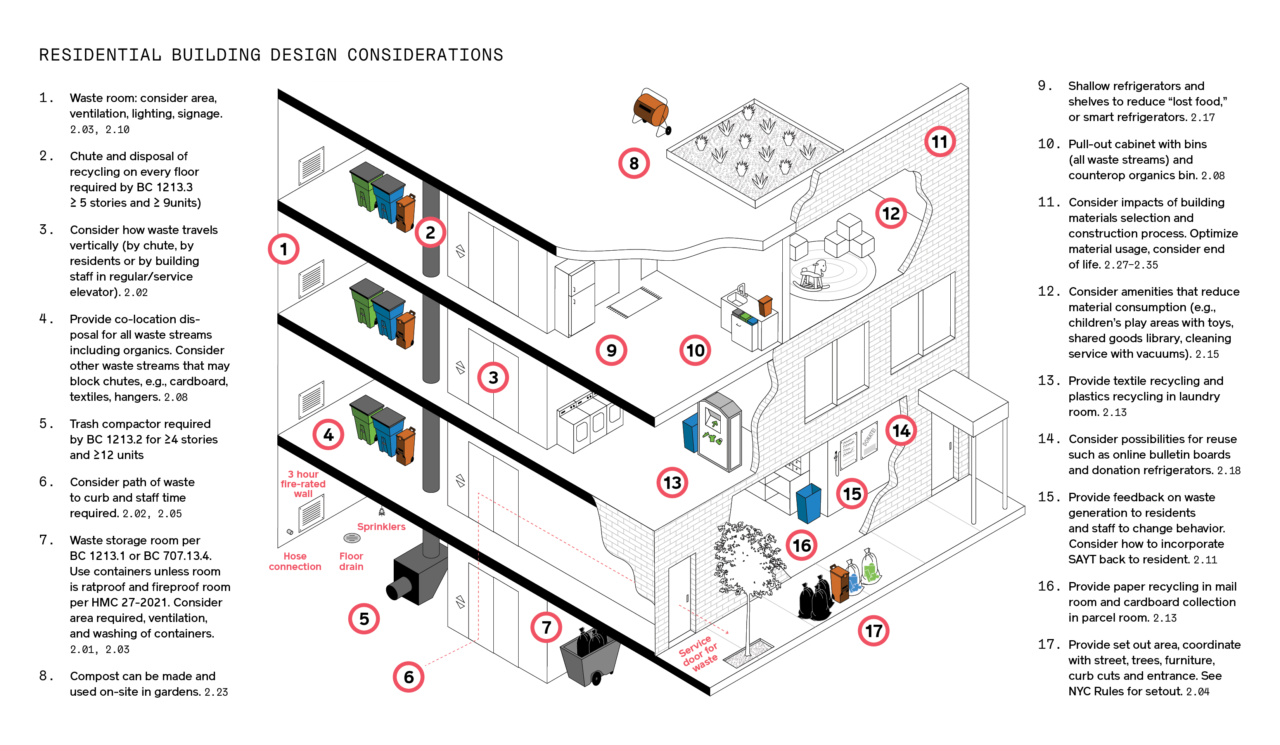
New residential buildings over 150 units in New York City now need to submit a Waste Management Plan for DSNY review at the same time as they submit plans to DOB. Hear from DSNY how the process works, and what they need to see in a plan. Walk through a sample plan and learn how to reduce the heap of trash bags typically set out on sidewalks. See case studies of how architects have applied best practice strategies to effectively separate recycling and food waste, reduce the volume of waste and ensure efficient waste management for building staff.
This course takes content from the AIANY webinar that took place on May 20 and adds more content. This includes how to use the Zero Waste Design Guidelines calculator for 150% storage volume, as well as further case studies and Q&A from event attendees.
This free online course offers 1 LU/HSW CEU with successful completion of the online quiz.

-
March 29, 2021
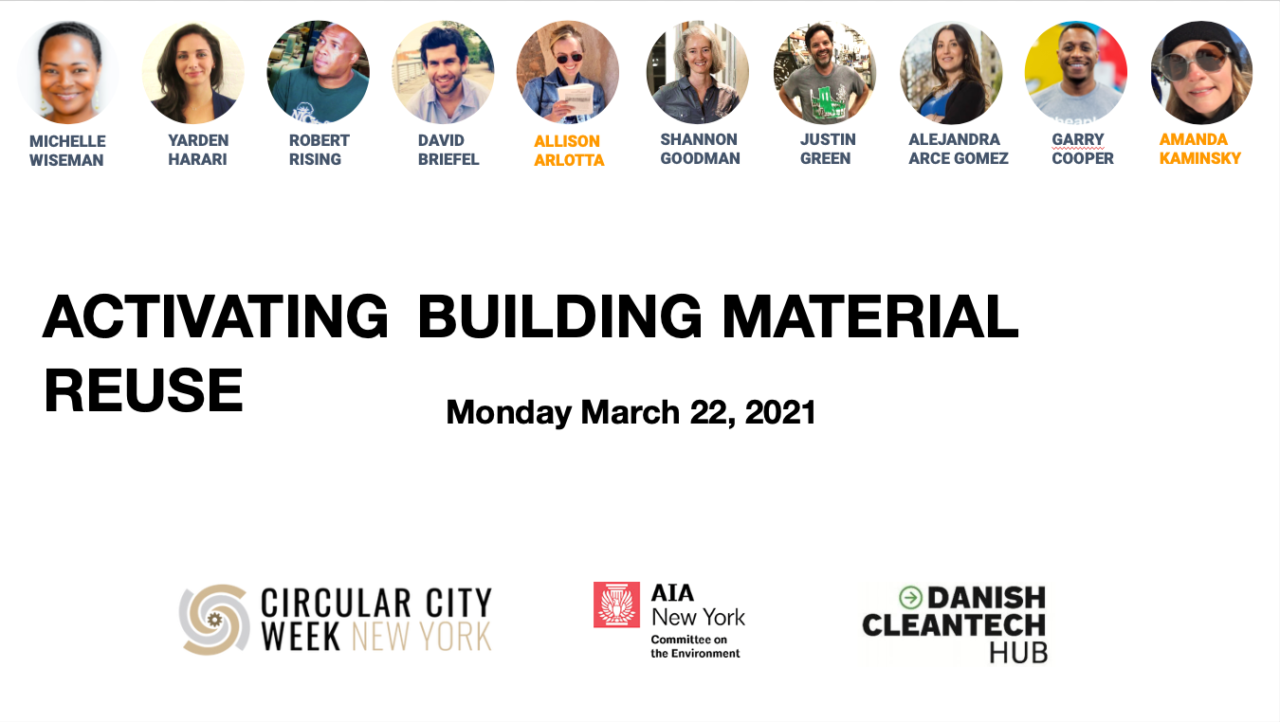
In collaboration with Circular City Week NYC, the AIA New York’s Committee on the Environment hosted an outstanding roundtable to discuss how material reuse can be collaboratively activated by designers, municipalities, and reuse organizations to help reduce waste and carbon impact, and to create an increasingly circular built environment.
Today, the dominant model for resource consumption in construction is linear: resources are extracted, processed into usable materials, which are then assembled into buildings. The buildings are used until they reach the end of their life—or their perceived end-of-life—and then demolished, with their waste largely dumped into landfills. Then with each new construction, too often we use materials that further extract virgin resources. This has environmental implications for our climate crisis: the transportation and processing of materials produce greenhouse gas emissions, whose accumulation in the atmosphere is causing irreversible climate change. Natural resources vary in their renewability and many are at risk for overconsumption.
This linear model also has an immense human impact. Landfills have detrimental health effects for their host communities, and mechanical demolition can produce dangerous levels of lead dust and particulate matter. Here in New York City, over 2,000 children test positive for lead poisoning every year. These environmental hazards cannot be separated from systemic issues of race and class, as we know that demolition, landfills, and lead poisoning disproportionately affect poor communities and communities of color.
In the US, our linear model is generating 600 million tons of construction and demolition (C&D) waste each year—twice the amount of municipal solid waste (MSW) generated. And while we tend to focus on reuse in residential projects, non-residential demolition actually contributes the most to construction and demolition waste. Which means we are missing an opportunity within commercial and institutional projects to reclaim and reuse material.
Only an estimated 22% of this mixed C&D debris gets diverted from going to landfills or turning into aggregate. Much of this diversion comes in the form of recycling rather than reuse. Many materials downgrade in quality or integrity with each recycling, limiting the number of times they can recycled. Recycling often delays but does not prevent a material from being disposed. In a circular system, this “waste” would provide the “feed” for new buildings and products, diverting this material from landfills, prolonging the life of natural resources, and minimizing greenhouse gas emissions.
One way to make construction more circular is through the deconstruction of buildings at the end of their lives instead of demolition, which some of our speakers will be talking about today. Deconstruction is the process of dismantling a structure methodically, mostly by hand, in order to maximize the recovery of reusable material. Because it requires more manual labor, deconstruction is also a job creator. Research from Portland, where deconstruction of certain building types is required, found that deconstruction projects employed twice as many people as typical demolition. Deconstruction also produces less toxic dust than mechanical demolition and it often uncovers previously unidentified abatable material like asbestos.
Material reuse is critical for reducing greenhouse gas emissions, conserving natural resources, and decreasing landfilling, and has the potential to protect public health and create jobs. As part of Circular City Week NYC, the AIA New York’s Committee on the Environment hosted an outstanding roundtable to discuss how reuse can be collaboratively activated by designers, municipalities, and reuse organizations to help reduce waste and carbon impact, and to create an increasingly circular built environment.
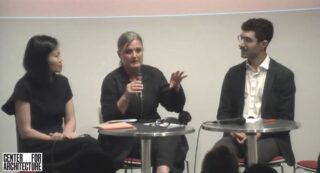
Justin Green (Executive Director, BIG Reuse) and Robert Rising (NYCitySlab) talked about working with salvaged materials in New York and what draws their customers to choose reuse. Shannon Goodman (Executive Director, LifeCycle Building Center) and Michelle Wiseman (Director of Waste Diversion, City of Atlanta) shared the work they are doing to build reuse infrastructure in Atlanta with a focus on community benefit. David Briefel (Regional Sustainability Design Director, Gensler) talked about the importance of prioritizing embodied energy, not just operational energy, in architecture projects, while Yarden Harari (Associate, CallistonRTKL) discussed her firm’s material reuse stakeholder workshops. The roundtable also touched on new business approaches to reuse: Alejandra Arce Gomez (Sustainability Director, GCI Contractors/Madrone) explained her company’s innovative in-house salvage and material matching program; and Garry Cooper shared the work of his technology startup Rheaply, which helps organizations waste less by buying and selling surplus assets.
Circular City Week provided a rare opportunity to have this important conversation and to hear from such a wide range of perspectives within the world material reuse. Moderators Amanda Kaminksy (Founder, Building Product Ecosystems) and Allison Arlotta (Board Member, Build Reuse) hope to continue the discussion at future events.
-
February 12, 2021
Our Energy Modeling subcommittee collaborated with AIA Philadelphia’s 2030 Working Group on this great series which will help your firm meet AIA 2030 commitments.
Register with AIA Philadelphia >
-
February 3, 2020
In-office presentations on the Zero Waste Design Guidelines are available to architects, developers and associated professionals in NYC. This year there is an additional course offering on Design Strategies and Case studies at the District Scale.
For a free consultation on how best to apply zero waste design strategies to a particular project in NYC, see Project Consultation:How to Apply Best Practice Design Strategies to Reduce Waste. Reach out to [email protected] to schedule.
-
COTE is keenly aware of the importance of reducing embodied carbon in buildings. At the Embodied Carbon Part 1: The Blindspot in the Building Industry event and workshop last fall, COTE member Kristina Miele launched the AIA New York local chapter of the Embodied Carbon Network, in collaboration with COTE.
Please join us for Embodied Carbon Part 2: Practical Design Decisions for Reducing Embodied Carbon on February 18 (see details here).
-
September 12, 2019
Please join members of AIANY COTE at the Global Climate Strike with Greta Thunberg next Friday, September 20, at noon at Foley Square, marching to Battery Park. RSVP for the NYC strike here.
Read more about Greta’s visit here, or in the New Yorker. Email Gaby Brainard at [email protected] if you’d like to join and we’ll email you information and time to meet.
Encourage your whole office to join, and sign up at architect’s advocate. To see public facing statements from other architectural firms, see this one from VMDO. Join us!
-
March 12, 2019
Governor Cuomo Announces Launch of $30 Million “Buildings of Excellence” Competition to Advance Innovative Low- and Zero-Carbon Emitting Building Projects. The competition will include three rounds. Each round will provide up to $10 million, with up to $1 million available per project. The first round is focused on multi-family buildings. Applications are being accepted through June 4, 2019 with awards expected in the summer of 2019.
For more information see press release and solicitation portal.
-
March 2, 2019
DSNY, in partnership with the Department of Transportation (DOT), has released an RFEI seeking creative solutions for containerized refuse and recycling that will:
– increase waste diversion, including by reduction, reuse, and recycling
– reduce the volume of consolidated material set out on City sidewalks
– reduce vehicle miles traveled (VMT) and greenhouse gas (GHG) emissions associated with waste collection; and/or
– improve the cleanliness of City streets and sidewalksThe RFEI refers to the Zero Waste Design Guidelines, developed through the AIANY COTE and Center for Architecture:
“Through this RFEI, the City seeks Responses inspired by the best practices as outlined in the Guidelines. Respondents should review Zero Waste Design Guidelines Chapter 3: Collection & Urban Design, which includes examples of best practices, including: sub-surface waste containers; “roll-on, roll-off” containers for private or public use; waste collection containers for public and/or private use; and freight distribution and waste collection micro-centers.”
-
Save A Sample! has launched Save A Sample! for Art with the goal of helping design firms donate unneeded materials to artisan programs—365 days a year!
“We’ve always dreamed of saving great samples all year long. 2019 is the year we make it happen!,” says Suzanne Swift, Save A Sample!’s founder and president of SpecSimple.com. Save A Sample! for Art partners with top design firms throughout the country to help local artisans achieve their dreams to support themselves through their art.”
It’s easy to participate. Design firms request a pre-paid mailing label, fill a box with great materials, and are matched with a local artisans program in their area. “Save A Sample makes it easy to avoid filling up our landfills and instead re-purposes materials to give them a new life,” says Helle Hodjat, Resource Director/Designer at Gensler. Artisans use the samples to create unique artwork.
Sign up today at to be notified for the Save A Sample! for Art launch!
-
May 26, 2018
“You are not a profession that has distinguished itself by your social and civic contributions…” Whitney M. Young Jr. famously and provocatively stated when he gave the keynote speech at the AIA convention of 1968.
How much has changed since then? Have we begun to make significant contributions to solutions for our communities? To issues of diversity, gentrification or general inequality that face the people affected by our building projects or in our neighborhoods?
At this lecture, the renowned Majora Carter—MacArthur Fellow, urban revitalizer and TED talker—talked about her community work. She discussed her personal decision to work with her South Bronx community to help it thrive by working locally, together with neighbors and community. She showed by example how she has helped design professionals understand the array of overlooked opportunities in socioeconomically disadvantaged communities—BEFORE picking up a pencil or creating policy.
Can we do this in our own daily work? Susan Kaplan started off with a discussion of how much can actually can be done in a building project—how we can have huge positive impact in other people’s daily lives, become the advisors and professionals that help clients see the risks in NOT addressing social issues that are part and parcel of any project, and help clients shine to investors, government officials and potential employees alike, by optimizing their commitment to issues beyond the bottom line.
-
May 10, 2018
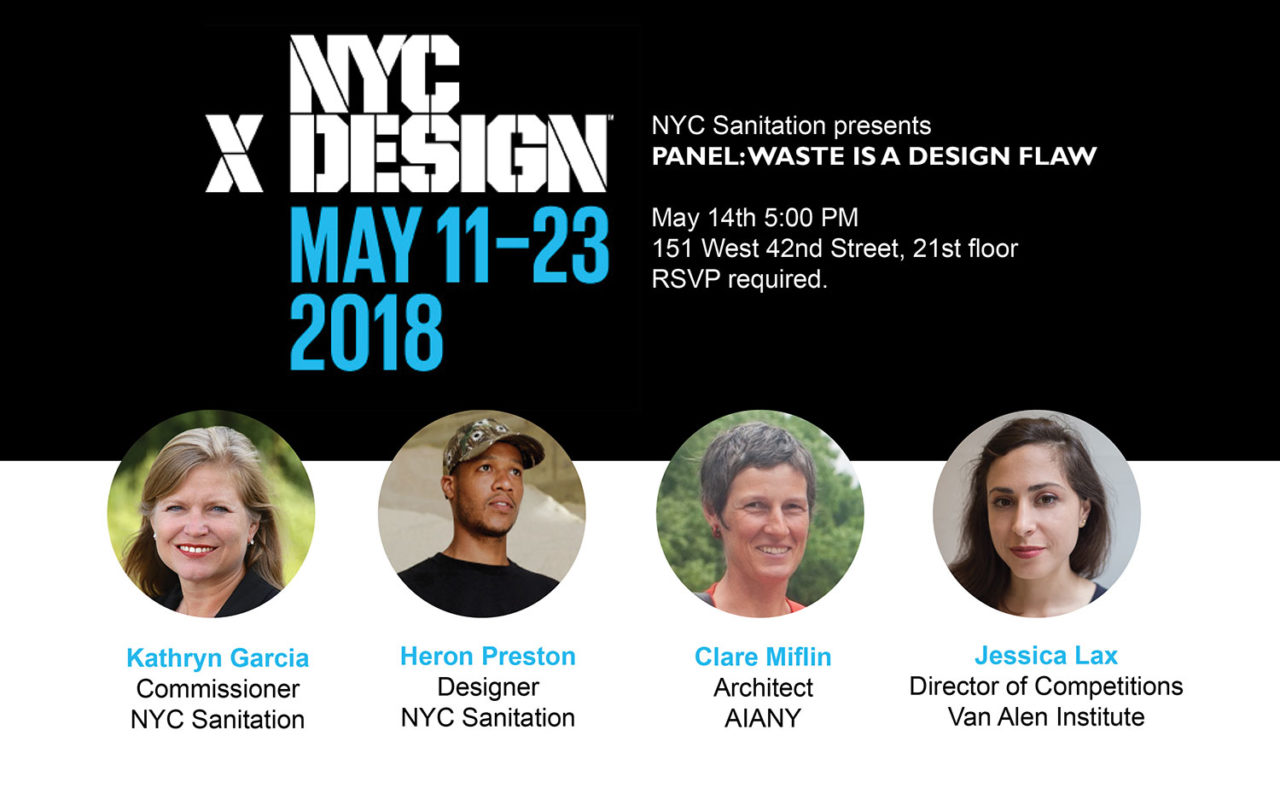
MONDAY, MAY 14 5:00PM
151 West 42nd Street (21st Floor)Every week, the average New Yorker throws out nearly 15 pounds of waste at home and another nine pounds of waste at work and in commercial establishments. Altogether, that adds up to more than six million tons of waste generated per year.
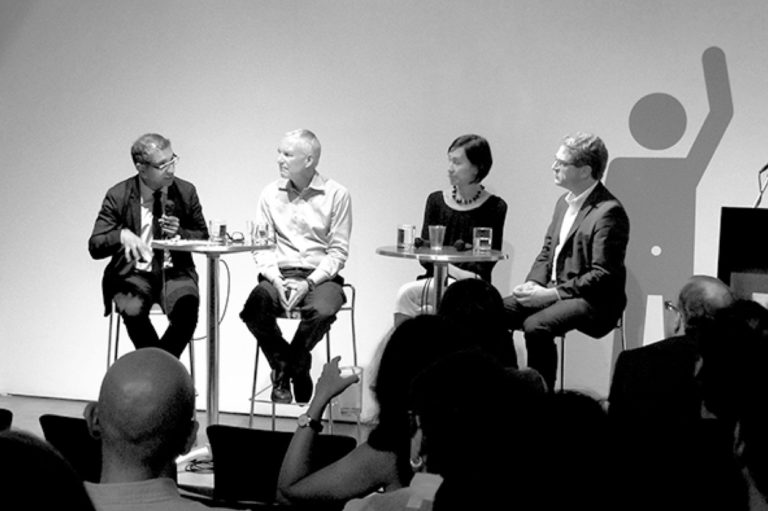
What role do designers play in New York City’s waste ecosystem? And how can designers help the City achieve its ambitious goal of sending Zero Waste to Landfills by 2030? Join us to explore the latest creative solutions—from high-fashion textile up-cycling to new guidelines for building design.
Speakers:
Kathryn Garcia, Sanitation Commissioner
Heron Preston, Designer
Clare Miflin, AIA, Co-chair, AIANY Committee on the Environment, part of the Zero Waste Design Guidelines development team
Moderator: Jessica Lax, Van Alen InstitutePlease RSVP here.
See more Design Talks NYC here. -
March 1, 2018
![Infographic]()
Presentations on the Zero Waste Design Guidelines are available in office for Architects, Sustainability Consultants, Planners and Developers. AIA CEU 1 hour LU/HSW. GBCI 1 hr.
3 courses are available: General Overview, Residential Building Focus or Commercial Building Focus.
The Zero Waste Design Guidelines address the crucial role that design plays in achieving NYC’s ambitious goal, outlined in OneNYC, to send zero waste to landfills by 2030. As a resource to help designers, building operators, and planners, the Guidelines show how to dramatically reduce waste and work toward greater adoption of circular material flows. Treating waste as a resource rather than trash depends on our ability to easily separate and manage our waste. Applying design strategies to our current system of linear material use will improve sidewalks and buildings as it lessens environmental and social impacts in the city and beyond.
The presentation will give an overview of the design strategies within the guidelines and show how the waste calculator can be used to estimate the quantities of different waste streams a building will generate.
Contact Co-Chair Clare Miflin to schedule: [email protected].