


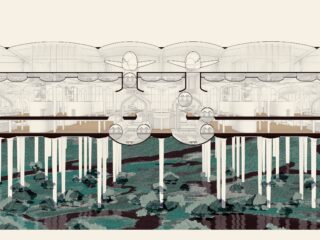
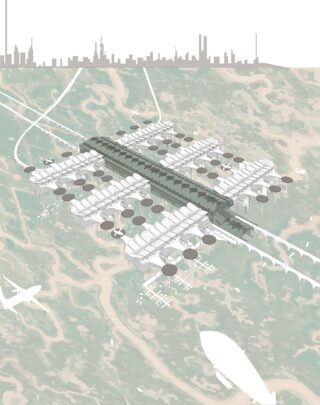
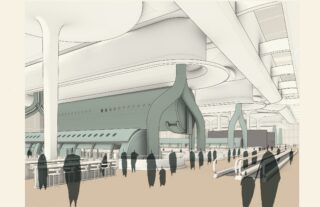
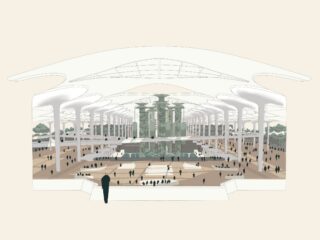
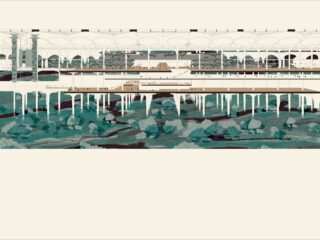
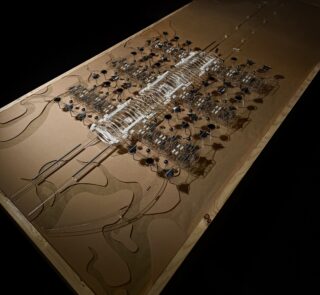
John F. Kennedy International Airport has long served as a global gateway to New York City, but its construction replaced much of the original marshland and marina culture of Jamaica Bay—over 70 percent of which has been lost. As sea levels rise, the site and surrounding neighborhoods face increasing flood risk, while hardened infrastructure prevents the natural migration of wetlands. This proposal reimagines JFK in 2100 as an airport that restores marsh ecosystems while redefining aviation infrastructure. With the adoption of vertical takeoff and landing aircraft, traditional runways are no longer required, allowing the ground plane to return to a regenerated landscape while airport operations shift above. The airport becomes a tool for ecological restoration. Sediment from harbor dredging is repurposed to rebuild marsh elevations through thin-layer placement, combined with biosolids and compost to support plant growth. On-site nursery pods cultivate marsh vegetation, which is transplanted across the site and adapted over time to rising sea levels. Energy systems are integrated into the landscape. Using direct seawater electrolysis, the airport produces hydrogen from Jamaica Bay to power aircraft and on-site systems, including fuel cells and geothermal heating and cooling. Architecturally, the roof serves as the airfield, with vertical landing pads shaping the design. Below, a central spine connects concourses and public amenities, including gardens, retail, and gathering spaces. By merging infrastructure with ecology, this vision transforms JFK into a resilient, regenerative system—restoring environmental function while redefining the future of air travel.