








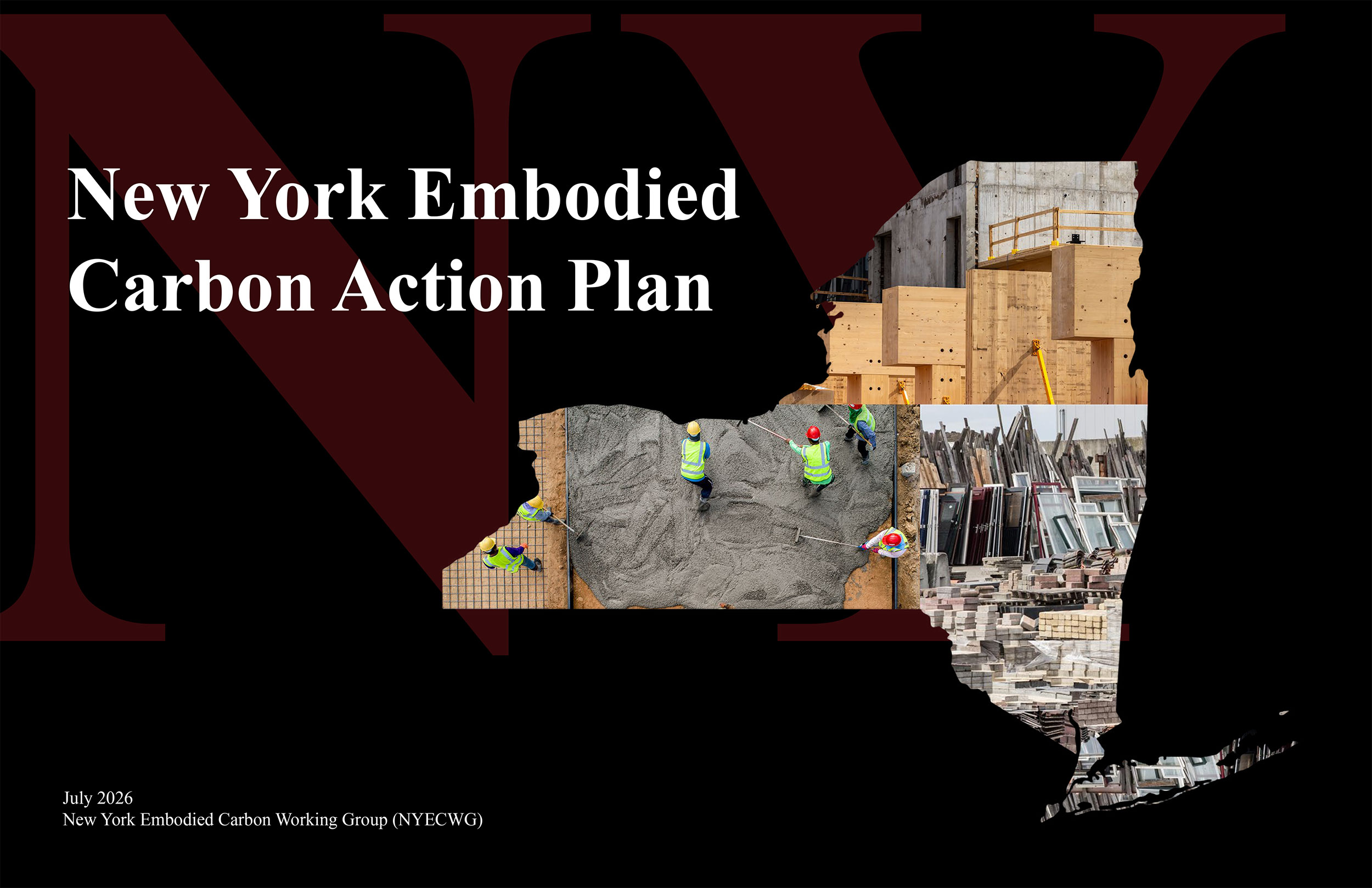
The New York Embodied Carbon Action Plan is a collaboratively developed set of policy recommendations created by a coalition of architects, engineers, contractors, manufacturers, owners, academics, and sustainability experts who make up the New York Embodied Carbon Working Group. This Action Plan provides a practical roadmap for reducing embodied carbon emissions while strengthening New York’s economy, supporting regional manufacturing, and advancing community resilience.
Building on the Working Group’s inaugural 2025 report on near-term actions, this comprehensive Action Plan details immediate and long-term policy interventions that will position New York as a national leader in low-carbon construction and circular economy practices.
Embodied carbon refers to the greenhouse gas emissions generated by the manufacturing, transportation, installation, maintenance, and disposal of construction materials used in buildings, roads, and other infrastructure. While there is no one-size-fits-all strategy for reducing embodied carbon, the strategies generally fall into four categories:
1. Build less, reuse more: Extend the life of existing buildings via adaptive reuse and material reuse
2. Build lighter: Use less of a given material (or floor area) to do the same work
3. Material and assembly substitution: Replace carbon-intensive materials and assemblies with alternatives
4. Procure low-carbon products: Compare different products and select the lower carbon options
While New York has made substantial progress in reducing operational emissions through building electrification, energy efficiency, and clean energy deployment, the emissions generated today will lock in fiscal and environmental impacts for decades to come. As state, county, and municipal programs make massive strides in reducing operational emissions, which are associated with the day-to-day energy required to heat, cool, and power our buildings, the massive carbon footprint associated with the physical construction and installation of materials themselves has remained largely unaddressed.
Ignoring this part of the carbon narrative undermines New York’s broader economic and climate progress. Managing embodied carbon is fundamentally an asset management exercise; by prioritizing the preservation, adaptive reuse, and strategic retrofitting of our built environment, the State can optimize existing capital assets while simultaneously addressing multiple pressing civic challenges. Most notably, scaling adaptive reuse can lower upfront material costs and project timelines, serving as a critical tool to accelerate the delivery of affordable housing across the state. By using a “Best Value” framework that evaluates cost, performance, carbon, and community-wide benefits together, New York can link climate goals to engineering excellence – ensuring these assets support local economic development, reduce long-term maintenance, and protect taxpayer dollars.
Without a clear, actionable path forward, New York faces a far more costly and disruptive future than if we take strategic action today. Through this independent action plan, the individual industry volunteers of the New York Embodied Carbon Working Group have developed a suite of strategies and recommendations for the State of New York to consider. These recommended policies are designed to significantly reduce embodied carbon while actively strengthening local manufacturing, reclaiming underutilized facilities, and insulating New York businesses from volatile global supply chains.
These recommendations are not abstract concepts; they represent an actionable framework built for the industry, by the industry. The strategies are rooted in the practical, real-world experiences of the engineering, design, manufacturing, and construction professionals who contributed to this plan. By integrating lessons learned from early moving jurisdictions across New York State and the United States, this framework is designed to support regional viability. To assist state policymakers, these real-world case studies, anticipated agency roles, and resource needs are detailed in the accompanying documentation.
The path to a low-carbon built environment accelerates New York’s economic progress, serving as a powerful roadmap for industrial and community resilience. Across the state, legacy industrial corridors and underutilized facilities represent capital assets ripe for revitalization. By modernizing local procurement frameworks and treating our existing building stock as material banks, New York can catalyze job growth across local communities and support the robust network of circular, innovative businesses that already call the Empire State home.
New York has the technical expertise, market demand, and academic talent to pioneer this thriving, circular market. By building the future with the materials we already have, New York can maximize the value of its public assets, keep capital investments local, and protect the domestic supply chains that drive our communities.