




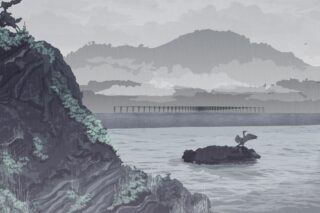
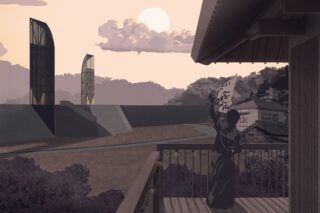
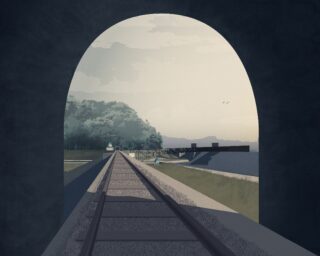
The 2011 Tōhoku earthquake and tsunami caused nearly 20,000 deaths and devastated communities along Japan’s eastern coastline. In response, the government constructed a continuous system of concrete and earth-bermed tsunami walls—some up to 16 meters high—along more than 1,000 kilometers of shoreline. While designed to protect against future disasters, these walls often dominate the landscape and disconnect communities from the sea, a place deeply tied to memory, loss, and cultural identity. Memory Landscapes is a conceptual project that explores how collective memory can inform the design of future coastal infrastructure. Focusing on the Tōhoku region, the project combines photographic research with speculative design to examine how remembrance can shape more meaningful and adaptive responses to disaster. The project proposes three site-specific interventions that transform existing tsunami walls into public space. At Unosumai, a structure embedded within and above the wall serves as a cenotaph honoring those lost. At Shibitachi, two towers attached to the wall function as sound instruments, connecting town and sea in both daily life and emergency conditions. At Shimanokoshi, a pedestrian bridge spans between parallel walls, restoring physical and visual access to the ocean. Each proposal reimagines the wall—through carving, grafting, or spanning—as more than a barrier. Instead, it becomes a space for reflection, connection, and community use. By integrating protection with public life, Memory Landscapes offers a framework for designing resilient infrastructure that acknowledges both risk and memory, with relevance for vulnerable coastal regions worldwide.